

Physiotherapy in Mayfair, London
Foot Pain & Ankle Pain Treatment in Mayfair, London
The foot and ankle are the most mechanically demanding structures in the body. Every step loads them with forces several times your body weight. When something goes wrong, the consequences reach further than most people expect: your gait changes, your knee and hip absorb compensatory stress, and what started as heel pain in the morning reshapes how you move through your entire day.
At Physio Remedies in Mayfair, we provide evidence-based musculoskeletal physiotherapy for the full range of foot and ankle conditions, from acute ankle sprains and stress fractures to chronic tendinopathies and the complex rehabilitation that follows surgery. Our foot biomechanics assessments look beyond the painful structure to understand what is driving the problem, whether that is load management, lower limb strength, or the way the whole body is moving over the foot.
One of our founders, Sarah Lawson, brings personal experience to this work: a foot injury in 2015 required three injections and ultimately surgery before she could return to the sport she values. That experience informs how we think about what patients need at each stage of recovery, and how long each stage genuinely takes.
How Is Your Foot or Ankle Pain Affecting You?
You have foot pain first thing in the morning that eases once you get moving, then returns after a day on your feet. You have tried rest, stretching, and new footwear. Nothing has shifted it.
You have been told you have a tendon problem. The exercises have helped slightly, but you are nowhere near back to the sport or activity you were doing before.
You are recovering from a fracture or surgery, and progress feels slow. You want a clear picture of where you stand and what comes next.
You rolled your ankle weeks ago. It was treated as a minor sprain, but it still feels unstable. You hesitate to run or change direction quickly, and you are worried it will happen again.

Why Your Foot or Ankle Pain Has Not Got Better
The most common reason people come to us after failing previous treatment is that the contributing factors were never fully assessed. A painful Achilles or a recurrent ankle sprain rarely exists in isolation. Poor calf strength, reduced ankle dorsiflexion, hip stability deficits, and training load errors all play a role, and if they are not addressed, the same problem returns.
The second reason is inadequate loading. Tendons and ligaments respond to progressive mechanical stress. Rest reduces pain in the short term but does nothing to restore tissue capacity. We regularly see patients who rested for months, improved to a point, then immediately flared again when they returned to activity. The structure was never actually rehabilitated.
The third is the absence of objective measures. Without testing, it is impossible to know when you are genuinely ready to return to sport. We use VALD dynamometry to measure strength symmetry between sides, setting a 90% threshold before return to activity. We do not clear patients based on how something feels.
Foot & Ankle Conditions We Treat:
-
Achilles Tendinopathy
The most commonly mismanaged tendon problem we see. We combine structured progressive loading with Piezowave2 focused shockwave therapy for cases that have not responded to loading alone.
-
Achilles Rupture: Conservative and Post-Surgical Rehabilitation
The quality of rehabilitation after an Achilles rupture determines your outcome, regardless of whether it was managed surgically or conservatively. We run several of these concurrently and use VALD dynamometry throughout to confirm strength recovery before return-to-sport clearance.
-
Plantar Fasciitis and Heel Pain
One of the most common causes of heel pain and one of the most frequently mistreated. Progressive strengthening and load management are the foundation. For persistent cases, our Piezowave2 focused shockwave system offers precision that radial devices cannot match.
-
Ankle Sprains, Ligament Injuries, and Chronic Ankle Instability
A lateral ankle sprain that is not properly rehabilitated leaves lasting instability and a high reinjury rate. Chronic ankle instability, where the ankle repeatedly gives way or feels unreliable long after the original injury, is a pattern we see frequently. We treat the full spectrum, from first-time sprains to chronic instability and post-surgical ligament reconstruction, using progressive balance, strength, and sport-specific loading with objective hop testing to confirm readiness.
-
Stress Fractures of the Foot and Ankle
Most commonly seen in runners who have increased training volume too quickly. We assess bone load, training history, nutrition, and foot biomechanics, and build a structured return-to-running programme that restores load tolerance before mileage resumes.
-
Post-Fracture Rehabilitation
Immobilisation causes muscle atrophy and altered movement patterns that do not resolve on their own. We guide patients from protected loading back to full function, using objective strength and impact testing before clearing return to running or sport.
-
Posterior Tibialis Tendinopathy and Flat Feet
When the posterior tibialis tendon becomes painful and dysfunctional, the arch gradually collapses, a presentation sometimes called dropped arch or adult-acquired flat foot. This condition responds well to progressive tendon loading and targeted strengthening when the diagnosis is accurate and the programme is properly structured.
-
Peroneal Tendon Injuries
The peroneal tendons are frequently injured alongside ankle sprains, or through overuse in runners. Injuries range from tendinopathy to tears and tendon subluxation. Accurate diagnosis matters: a subluxation treated as a simple sprain will not resolve and may require surgical stabilisation. We assess carefully and refer directly when needed.
-
Bunions: Conservative Management and Post-Surgical Rehabilitation
A bunion, or hallux valgus, is a structural deformity of the big toe joint that causes pain and alters forefoot loading. Not all bunions require surgery. Footwear modification, strengthening, and load management can significantly reduce pain and slow progression. When surgery is the right decision, pre-operative physiotherapy improves outcomes and structured post-operative rehabilitation is essential to restore strength, balance, and confident return to activity.
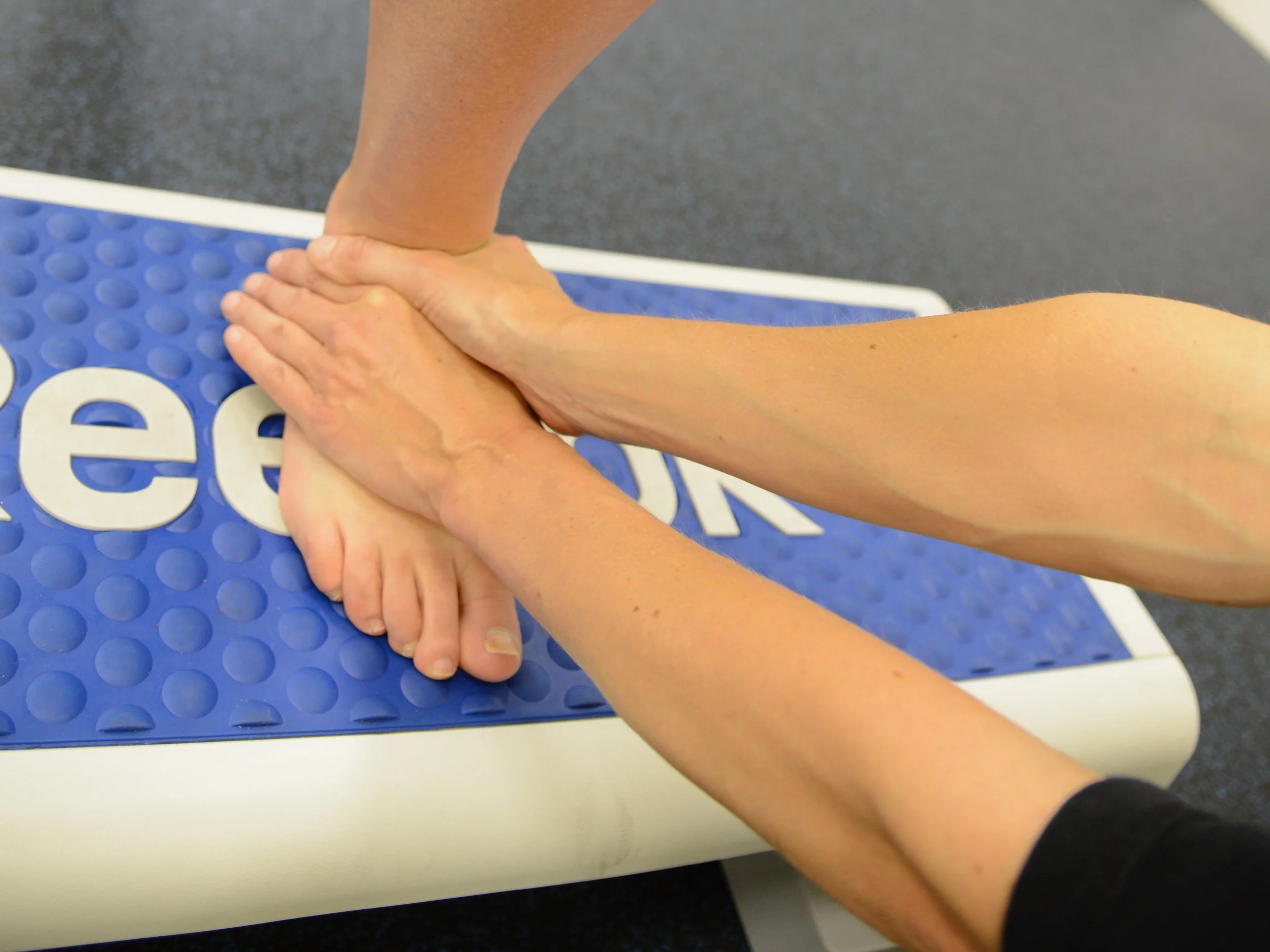
Our Approach to Foot and Ankle Physiotherapy
We use the Piezowave2 focused shockwave system, one of very few in central London, for appropriate tendon and soft tissue conditions. VALD dynamometry and ForceDecks provide objective strength and power data throughout rehabilitation. Where tissue is not yet ready for full loading, Blood Flow Restriction training allows us to build strength without placing excessive stress on the healing structure. When physiotherapy alone is not sufficient, we refer directly to orthopaedic consultants, musculoskeletal radiologists, and sports medicine physicians through established pathways. We accept BUPA, AXA and BUPA Global Insurance.
When to Come to Us
Come to us when foot pain or ankle pain is affecting your daily activities or sport. Come when rest has not resolved it, or when previous physiotherapy has plateaued short of where you need to be. Come when you are post-surgery and want rehabilitation guided by objective measures rather than a calendar. The sooner a foot or ankle problem is properly assessed and loaded appropriately, the better the outcome tends to be.

Expert Testimonial
"Both Sarah and her team at Physio remedies have been looking after my patients for over 15 years. The team shows compassion, care and are always driving forward innovation in the treatment they offer. When I broke my leg, Sarah, provided excellent advice and support, nicely confirming the excellent standard of care the team practice. Whether it be for diagnosis or treatment, I have no hesitation in recommending Physio Remedies."
Consultant Foot and Ankle Surgeon
MB BCh FRCS (Eng) FRCS (Tr & Orth)
Frequently Asked Questions
-
In most cases, no. The majority of foot and ankle conditions can be accurately diagnosed through clinical assessment. If imaging would change how we manage your condition, we can arrange MRI or ultrasound directly without a GP referral.
-
A foot physio with a specialist interest in lower limb conditions will assess foot biomechanics, gait, and the full kinetic chain in a level of detail that generalist practice does not always allow. At Physio Remedies, Sarah Lawson, Jane Baker, and Sian MacRae all focus specifically on this area, with Jane and Sian both members of the Association of Foot and Ankle Physiotherapists.
-
If you have plateaued, there are usually identifiable reasons: a loading programme that was not progressive enough, contributing factors in the rest of the lower limb that were not addressed, or a time-based rather than milestone-based progression that cleared you before the tissue was ready. We start by identifying where previous treatment fell short.
-
Often yes, particularly for tendinopathies, early-stage bunions, and many cases of chronic ankle instability. Even when surgery is ultimately the right decision, pre-operative conditioning significantly improves outcomes. We will tell you clearly if we think surgical opinion is needed and refer you promptly.
-
It depends on the diagnosis, how long the problem has been present, and what you are returning to. At your first appointment we will give you honest timelines based on what we find. An acute ankle sprain in a recreational runner and an Achilles rupture in a competitive athlete require very different conversations, and we have both regularly.
Book Your Foot & Ankle Assessment in Mayfair
Meet Sarah Lawson · Meet Lucy Metcalfe · Meet Jane Baker
Your first appointment lasts one hour. We diagnose precisely what is happening, begin treatment in that same session, and give you a clear plan for what comes next. The assessment costs £190 (this does not apply to AXA and BUPA patients).
If you are searching for a foot physio or ankle physio near Mayfair, Green Park, or Knightsbridge, we are based at the Lansdowne Club in Fitzmaurice Place, a few minutes' walk from Green Park station.
If you prefer to reach us directly: