

Foot & Ankle Physiotherapy
Peroneal Tendon Injury Treatment in Mayfair, London
The peroneal tendons (peroneus longus and peroneus brevis) run down the outside of the lower leg and curve around the back of the outer ankle bone (the lateral malleolus). They enable us to walk across uneven ground without the ankle rolling. When they are injured, the pain sits behind or just below that bony point on the outside of the ankle, and it very often presents as an ankle sprain that has not settled.
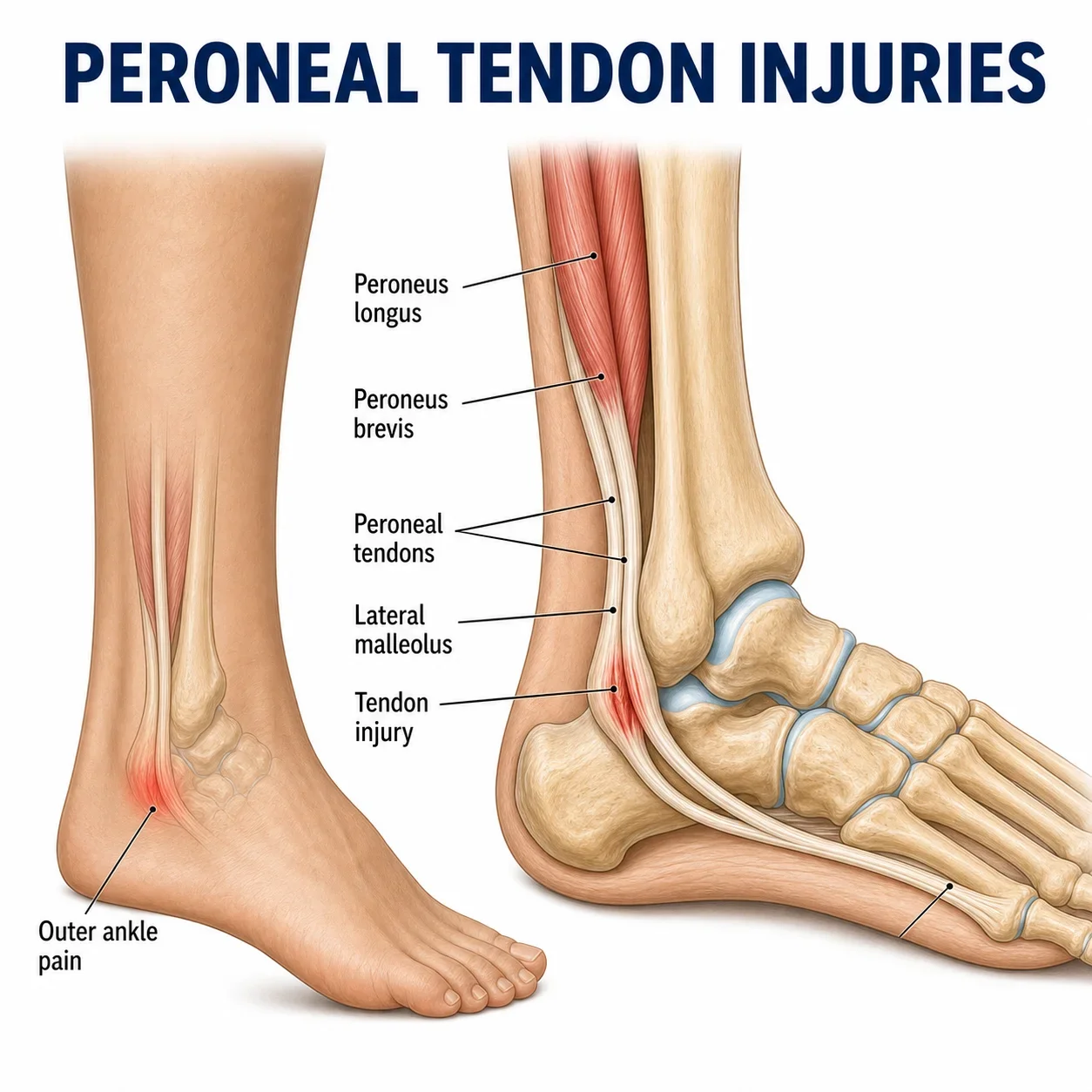
Peroneal tendon injuries take three forms, and the difference between them matters far more than most people are told.
Peroneal tendinopathy
Sometimes called peroneal tendonitis (but it’s a degenerative, not an inflammatory condition), it presents with pain that gradually builds with loading, such as running, racquet sport or simply going on a long walk in the countryside. It aches during and after activity and is stiff first thing in the morning.Peroneal tendon tear
A peroneal tendon tear, usually a lengthways split in the peroneus brevis, produces persistent outer ankle pain with definite weakness when you push the foot outwards. Rehabilitation helps a little but may then stall.Peroneal subluxation
This occurs when a tendon is slipping out of its groove, usually because one of the overlying ‘retinaculum’ bands that hold the tendons in place has failed. Peroneal subluxation gives a distinct snap or flick behind the ankle bone when you rotate the foot, reproducible every time. Loading this hard makes it worse, and it is the one of the three where surgery is most often the right answer.
How Is Your Peroneal Tendon Injury Affecting You?
You have outer ankle pain that has not resolved after what you were told was an ankle sprain. The ligaments have been treated and the pain has improved, but something is still wrong along the outside of the ankle and behind the ankle bone. You have been told to keep going with the exercises. The exercises are not changing it.
You have a snapping or flicking sensation at the back of your outer ankle when you rotate your foot. It may or may not be painful, but it happens consistently. Nobody has been able to explain it to you and you are increasingly concerned about what is actually happening.
You are a runner, or you play tennis, and the outside of your ankle builds up pain during activity and takes days to settle. You have been given strengthening exercises. They have not helped. The pattern keeps repeating.
You have had imaging that has confirmed a peroneal tendon tear or subluxation. You have been referred for physiotherapy but have not received a clear explanation of whether surgery might be needed, what the rehabilitation involves, or how long this realistically takes.

What Is a Peroneal Tendon Injury?
There are two peroneal tendons: the peroneus brevis and the peroneus longus. Both run from the peroneal muscles in the outer lower leg, curve around the back of the lateral malleolus, and attach to different bones in the foot. The peroneus brevis attaches to the base of the fifth metatarsal, the bony prominence on the outer edge of the foot. The peroneus longus travels beneath the foot and attaches on the inner side, contributing to arch support and first metatarsal stability.
Together these tendons are the primary dynamic stabilisers of the outer ankle. They resist inward rolling of the foot, control lateral loading during running and cutting, and are essential for the push-off phase of gait. They are also the tendons most exposed to injury in ankle sprains, most vulnerable to overuse in runners with a high-arched foot, and most likely to be overlooked when the lateral ligaments are identified as the problem. A peroneal tendon injury takes one of three forms: tendinopathy, longitudinal tear, or subluxation. Each behaves differently and requires a different management approach.
How Do I Know If I Have a Peroneal Tendon Injury or a Sprained Ankle?
The clearest clinical distinction is where the pain is reproduced. A lateral ankle sprain produces tenderness over the ATFL and CFL ligaments on the front and outer side of the ankle joint. Peroneal tendon pain is reproduced further back, directly behind the lateral malleolus along the tendon course, and is specifically worsened by resisted eversion: pushing the foot outward against resistance. A snapping sensation at the back of the outer ankle bone during rotation is characteristic of subluxation and is not a ligament finding at all.
In practice, both injuries frequently occur together: the force that tears an ankle ligament often compresses the peroneus brevis against the lateral malleolus simultaneously. This is why the distinction requires examination rather than history alone. If your outer ankle pain has not settled through ligament rehabilitation, the peroneal tendons need to be assessed specifically and independently.
Can You Walk on a Peroneal Tendon Injury?
In most cases, yes, and this is part of what makes the diagnosis so commonly delayed. Peroneal tendinopathy and even significant longitudinal tears are often fully walkable with manageable pain. The ability to walk does not indicate a minor injury. Continuing to load a degenerating tendon or a subluxing tendon without structured management prolongs recovery and risks progression. In subluxation particularly, every episode of the tendon flicking over the lateral malleolus causes further damage to both the tendon surface and the retinaculum attempting to contain it. The sooner this is specifically assessed and managed, the better the outcome.
Peroneal Tendinopathy
The most common presentation. Repetitive loading, particularly in running and racquet sports, causes the tendon to undergo degenerative change rather than healthy adaptation. This is especially common in patients with a higher-arched foot type (cavus foot), where the natural mechanics direct more load through the outer ankle with every step. Pain develops gradually along the tendon course behind and below the outer ankle bone, worsens during and after activity, and is often stiff in the morning. Peroneal tendinopathy does not resolve with rest. It requires progressive load to stimulate tendon remodelling, and that load must be carefully structured to avoid the flares that come from advancing too quickly.
Peroneal Tendinopathy and Tendon Tears
Peroneal Tendon Tear
Most commonly a longitudinal split of the peroneus brevis, where the tendon splits along its length as it is compressed against the lateral malleolus during an ankle sprain or with repetitive loading. Peroneus longus tears are less common and more often associated with a high-arched foot and overuse. Tears cause persistent lateral ankle pain, weakness on resisted eversion, and are frequently missed because they are not visible on X-ray and require ultrasound or MRI for confirmation. Partial tears with good tendon continuity can often be managed conservatively with a structured loading programme. Full-thickness tears with significant functional deficit may require surgical repair, and we refer directly when that assessment indicates it.
Peroneal Tendon Subluxation: When the Tendon Slips Out of Place
Subluxation is the condition that most often brings patients to us after months of unsuccessful treatment elsewhere. The peroneal tendons normally sit in a groove behind the lateral malleolus, held there by the superior peroneal retinaculum. When this retinaculum is torn, typically during a forceful ankle inversion or a direct blow, the tendons are no longer constrained and flick forward over the bone with certain movements. The sensation is unmistakable once you know what it is: a definite snap or pop at the back of the outer ankle, reproducible and mechanical.
The reason this condition is so frequently missed is that it is treated as a sprain at the time of injury and never specifically reassessed. The patient is discharged once the ligament rehabilitation is complete, the snapping is mentioned but attributed to scar tissue or clicking, and the tendon continues to sublux with every rotation. By the time the diagnosis is made correctly, the tendon surface has often sustained progressive damage from the repeated dislocation.
This matters for management because subluxation behaves differently from tendinopathy and tears. Conservative management with immobilisation and physiotherapy can be successful when the retinaculum injury is mild, but the evidence for non-operative management of significant subluxation is substantially less favourable than for other peroneal tendon conditions. When the retinaculum has been meaningfully disrupted and the subluxation is clearly reproducible, surgical stabilisation, either retinaculum repair or groove deepening, is often the most reliable route to resolving the problem and preventing progressive tendon damage. We make this assessment directly and do not delay surgical referral when it is the appropriate next step.
How Long Does a Peroneal Tendon Injury Take to Heal?
Mild peroneal tendinopathy with a short history typically shows meaningful improvement within four to six weeks of appropriate rehabilitation. Established tendinopathy or a partial tendon tear takes eight to twelve weeks of structured progressive loading before function is reliably restored. Subluxation managed conservatively requires a longer period, typically three to four months, and surgical cases take three to six months from the date of procedure before return to sport. In all cases the timeline is governed by what objective testing shows at each stage, not by how many weeks have passed. We test eversion strength at regular intervals and adjust the programme based on what the data shows rather than a fixed schedule.
Why Your Peroneal Tendon Injury Has Not Got Better
The story usually goes like this. You rolled your ankle. You were treated for a sprain. The ligament rehabilitation helped the pain but not the weakness and instability on the outer side. The exercises continued, nothing changed, and eventually you were discharged or told to keep going. Nobody examined the peroneal tendons specifically, so nobody found the problem. You have been rehabilitating the wrong structure.
Where the diagnosis has been made correctly, the most common failure is under-loading. Peroneal tendinopathy needs progressive mechanical stress to stimulate adaptation. Rest and gentle exercises reduce pain but leave the tendon unable to handle the demands of running, racquet sport, or even sustained walking. The moment load is reintroduced, the symptoms return. The tendon was never actually rehabilitated: it was simply protected until the patient returned to activity.
The third pattern we see is a cavus foot that has never been addressed. A high-arched foot places the peroneal tendons under substantially greater load with every step. A rehabilitation programme that does not account for this will produce consistent improvement up to a point and consistent relapse when the patient returns to their full activity level. We assess foot type and loading mechanics as part of every peroneal tendon assessment and address what we find rather than treating the tendon in isolation.
Do I Need Physiotherapy for a Peroneal Tendon Injury?
In the majority of cases, yes. Peroneal tendinopathy and most tendon tears require a structured loading programme to restore tendon capacity and eversion strength. The exception that changes the conversation is subluxation: here the question is not only whether physiotherapy is needed, but whether physiotherapy alone is sufficient or whether the degree of retinaculum disruption means that conservative management is unlikely to resolve the subluxation reliably. We make that assessment at the first appointment and give you a direct recommendation rather than a lengthy trial of treatment that was unlikely to succeed.
What Is the Best Treatment for a Peroneal Tendon Injury?
The starting point is measuring what we are dealing with. Eversion strength, the force the peroneal muscles can generate against resistance, is the objective metric for peroneal tendon rehabilitation and it is rarely tested anywhere else. We use VALD hand-held dynamometry to measure this against the uninjured side at the outset and at each stage of rehabilitation. The 90% symmetry threshold is the minimum before return to sport. Everything in the programme is oriented toward reaching that number safely and sustainably.
For tendinopathy, the treatment is progressive eccentric and heavy slow resistance loading of the peroneal muscles, combined with correction of any contributing factors in foot type, hip mechanics, or training load. For partial tears, the loading is more carefully managed to avoid overloading the damaged fibres while still stimulating adaptation in the healthy tendon tissue. For cases where established tendinopathy has not responded adequately to loading alone, our Piezowave2 focused shockwave system adds a further stimulus to tendon remodelling. For subluxation, we make a direct assessment of whether conservative management or surgical referral is the appropriate route, and we do not delay that decision.
What Exercises Should I Do for a Peroneal Tendon Injury?
The right exercises depend on which peroneal structure is injured and the current stage of rehabilitation. In the early stage the priority is controlled activation of the peroneal muscles through positions and loads the tendon can currently tolerate, building a foundation without provoking a flare. In the mid stage, progressive eversion loading, single-leg balance and proprioceptive work, and hip strengthening are combined as the tendon adapts to increasing demand. In the late stage, dynamic lateral loading, cutting movements, and sport-specific progressions are introduced in line with what objective testing shows is safe.
For subluxation, exercise prescription has to account for the instability of the tendon itself: certain positions and movements will provoke the dislocation and need to be avoided until the retinaculum is sufficiently stable, whether through healing or surgical repair. Prescribing aggressive peroneal loading to a subluxing tendon accelerates damage rather than rehabilitation. This is one of the reasons the correct diagnosis matters so much before the programme is designed.
What Happens If a Peroneal Tendon Injury Is Left Untreated?
Peroneal tendinopathy left without appropriate loading progresses from a reactive tendon that can still adapt to a degenerative tendon that has lost this capacity. At that point rehabilitation takes significantly longer and the risk of tearing increases. An unmanaged partial tear under continued load can propagate into a more substantial tear or a full rupture. Subluxation that is not addressed causes progressive damage to both the tendon surface and the groove it runs in with every episode of dislocation, making eventual surgical reconstruction more complex and the outcome less predictable. The longer an accurate diagnosis is delayed, the narrower the range of conservative options becomes.
When Can I Return to Sport After a Peroneal Tendon Injury?
Return to sport is cleared when objective testing confirms the ankle is ready, not when pain has settled or enough time has passed. The specific benchmarks are 90% peroneal eversion strength symmetry against the uninjured side on VALD testing, single-leg hop performance within normal limits for lateral loading, and the ability to perform sport-specific cutting and direction-change movements with confidence and without provocation. For patients returning to tennis, the demands of lateral movement and sudden deceleration are assessed specifically. For patients returning to contact sport, the ability to absorb and redirect force through the outer ankle under unpredictable loading conditions is what we are testing for. The criteria are not the same for every sport and we do not apply them as though they are.
Should I See a Specialist for a Peroneal Tendon Injury in London?
If your outer ankle pain has not resolved through ankle sprain rehabilitation, if you have a snapping sensation behind the lateral malleolus, if you have been given a diagnosis of peroneal tear or subluxation without a clear management plan, or if your outer ankle keeps giving way during sport, a specialist assessment is appropriate. Philip Harris has treated ankle injuries at Olympic and Commonwealth Games level, where accurate diagnosis under time pressure and sport-specific return-to-play criteria are non-negotiable. Jane Baker is a specialist foot and ankle physiotherapist and member of the Association of Foot and Ankle Physiotherapists, with specific expertise in tendon pathology and post-operative foot and ankle rehabilitation. Between our team, the diagnostic precision and rehabilitation standards we apply to peroneal tendon injuries are the same regardless of whether the patient is a professional athlete or a recreational runner.
Our Approach to Peroneal Tendon Injury Treatment in Mayfair
Your first appointment lasts one hour. We take a full history, carry out specific tendon palpation, resisted eversion testing, and subluxation provocation assessment, examine foot type and arch mechanics, and assess hip and lower limb loading patterns where relevant. We measure eversion strength using VALD dynamometry at the outset to establish a baseline and a target. We arrange ultrasound or MRI when imaging would change the management decision. By the end of the first session you have a precise diagnosis, a clear explanation of what has been injured and why, and a structured treatment plan. Treatment begins in that same session. The assessment costs £190.
We accept Bupa, AXA, and Cigna International insurance. When surgical opinion is the appropriate next step, we refer directly to foot and ankle orthopaedic surgeons in London through established pathways, without delay.
Do You Need a Scan for a Peroneal Tendon Injury?
Not always. Peroneal tendinopathy is typically diagnosed and managed clinically without imaging. We arrange ultrasound or MRI when a tendon tear is suspected and we need to establish the extent before deciding on management, when subluxation is present and we need to assess the superior peroneal retinaculum, when symptoms are not progressing as expected and we need to confirm or revise the diagnosis, or when a surgical opinion is being sought and the surgeon needs imaging to inform their recommendation. If you already have imaging, we interpret it in the context of your clinical presentation. We can arrange imaging directly without a GP referral.

“I experienced a highly complex ankle peroneal tendon condition. Despite consulting multiple physiotherapists, I was unable to achieve satisfactory recovery progress. Upon recommendation, I engaged Sarah Lawson at Physio Remedies, whose expertise has proven exceptional throughout my rehabilitation journey. Her straightforward approach systematically addresses the fundamental aspects of each condition, while her comprehensive understanding of human anatomy and biomechanics, cultivated through 3 decades of professional experience, remains unparalleled. The composed and encouraging environment she establishes, combined with her reassuring guidance in overcoming injuries, exemplifies the highest standard of physiotherapeutic care one could expect.”
Frequently Asked Questions
Here are answers to some of the common questions we receive regarding peroneal tendon injury and treatment at Physio Remedies.
-
Come in for a specific assessment. It cannot be reliably determined from symptoms alone, and the two conditions frequently occur together. If your outer ankle pain has persisted through ligament rehabilitation, the peroneal tendons have not yet been examined properly.
-
Yes, usually. Do not take this as reassurance that the injury is minor or resolving on its own.
-
Mild tendinopathy: four to six weeks. Established tendinopathy or partial tear: eight to twelve weeks. Subluxation or post-surgical cases: three to six months. These are timelines for structured rehabilitation to objective testing standards, not for pain to settle.
-
For tendinopathy and most tears, yes. For subluxation, the more important question is whether physiotherapy alone is sufficient or whether surgical stabilisation is needed. We answer that at the first appointment.
-
It depends on whether the problem is tendinopathy, a tear, or subluxation. Each has a different answer. Treating them the same is the most common reason these injuries do not resolve.
-
We will tell you at your assessment, because the right exercises depend entirely on which structure is injured. Loading a subluxing tendon aggressively causes damage rather than recovery. Generic eversion exercises are not the answer for every peroneal presentation.
-
Most likely because the specific injury type has not been accurately diagnosed and the rehabilitation has not matched the pathology. The answer is a precise assessment, not more of the same treatment.
-
The condition progresses. Tendinopathy becomes degenerative change. Partial tears extend. Subluxation causes cumulative damage to the tendon and groove with every episode. Surgical options become more complex the longer an accurate diagnosis is delayed.
-
When objective testing confirms you are ready, not when pain has settled or enough weeks have passed. We test eversion strength symmetry and sport-specific loading capacity before clearing return to activity.
-
If outer ankle pain has not resolved through standard treatment, or you have a snapping sensation behind the ankle bone, yes. Your first appointment is one hour, costs £190, and includes a precise diagnosis and treatment started in the same session.
Book Your Peroneal Tendon Assessment in Mayfair
If you have persistent pain on the outside of your ankle, a snapping sensation behind the ankle bone, or outer ankle pain that has not resolved with previous treatment, your first appointment lasts one hour. We will establish precisely what the injured structure is, why it has not improved, and give you a clear plan for what comes next. The assessment costs £190.
If you are searching for peroneal tendon injury treatment or an outer ankle pain specialist near Mayfair, we are based at the Lansdowne Club in Fitzmaurice Place, a few minutes’ walk from Green Park station.
If you prefer to reach us directly: