

Physiotherapy Treatments in Mayfair, London
Workstation Ergonomic Assessment
Most desk-related pain does not arrive dramatically. It builds: a stiffness in the neck that is worse by mid-afternoon, a persistent ache across the upper back that has become the background noise of every working day, headaches that have been attributed to stress or screens or simply getting older. What we find, almost every time, is that the cause is considerably more mechanical than that. A screen six inches too low. A mouse just far enough to the right that the shoulder never quite rests. A chair that has never been properly adjusted to the person sitting in it. Small things, repeated for eight hours a day, that accumulate into pain that feels chronic but is entirely fixable.
A proper ergonomic assessment, carried out by a physiotherapist who can also examine and treat what the setup has already damaged, is a different thing entirely. We offer workstation assessments at our Mayfair clinic and on-site at your workplace across central London.
Does This Sound Familiar?
You have had the company DSE assessment. You have tried a new chair. You have had a few physiotherapy sessions and felt better for a week or two. But you are back at your desk on Monday morning and by Wednesday afternoon your neck hurts again, because nothing about the environment that is producing the problem has actually changed.
Or you work from home some days and the office others, neither setup properly sorted, spending hours on a laptop at the kitchen table. You know it is wrong. You just do not know where to start.
What Our Workstation Assessments Cover
We begin every assessment the same way: we ask you to sit at your desk and work normally for two minutes, and we watch. That alone tells us most of what we need to know. From there, we work systematically through every element of the setup.
The chair
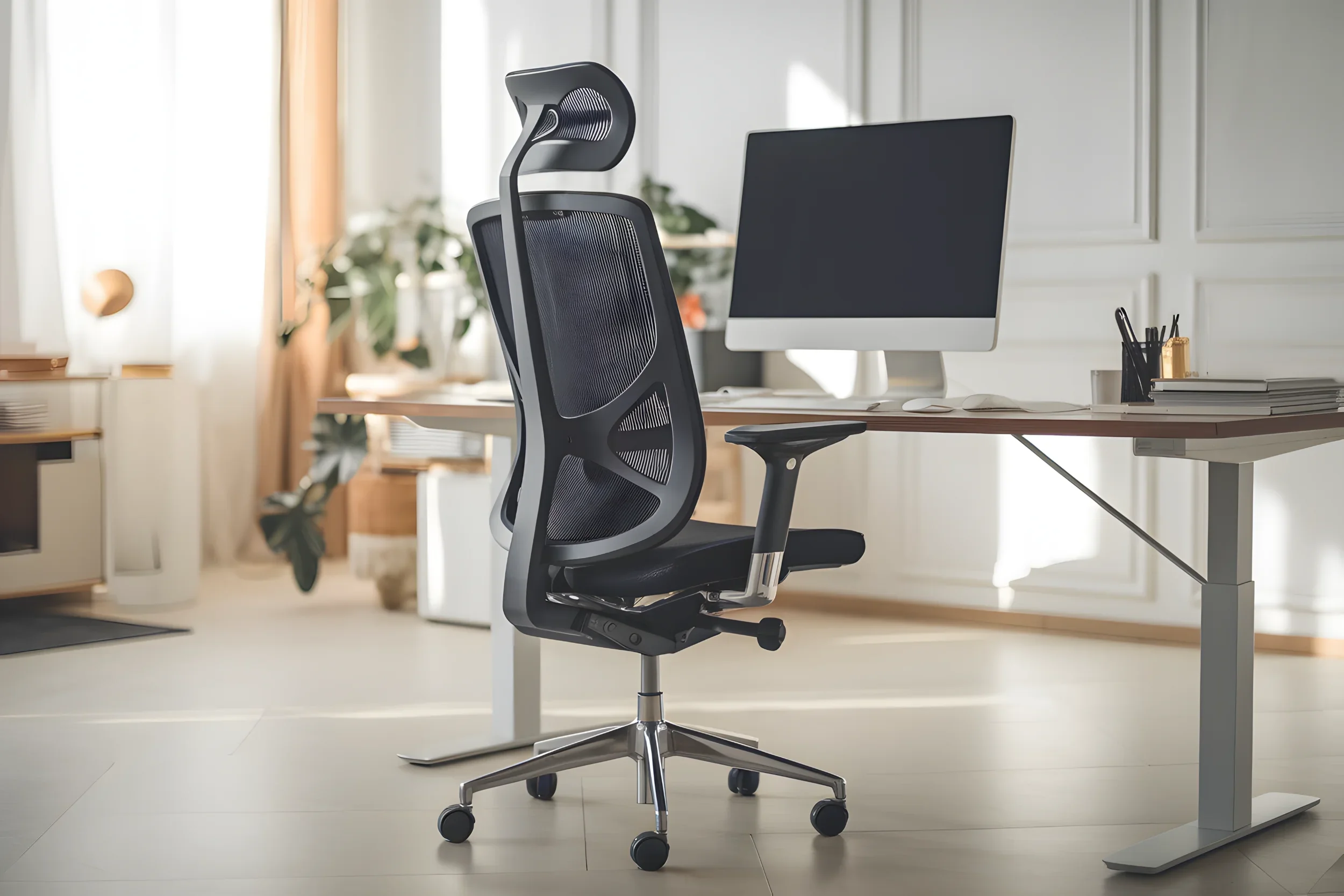
Most people have never been shown how their chair actually works. The first adjustment we make is almost always the same: sit your weight to the back of the chair. If the chair is correctly set, that position will make you sit upright without effort. The moment you slide forward, your pelvis tilts, your lower back rounds, your head moves forward, and everything from your upper trapezius to the base of your skull starts to load. We reset seat height, seat pan depth, backrest position, and armrest height so the chair is doing its job rather than fighting yours.
A note on armrests: in a correctly set chair, the arms should support the weight of the forearms so the shoulders can drop. Most people have them too low, too high, or not using them at all. A small adjustment here often produces an immediate reduction in shoulder and neck tension.
Where the chair itself is genuinely unsuitable, we will say so and make a recommendation for a different chair. Many offices have invested in high-end seating that was dimensioned for the average six-foot male. If you are smaller or shorter in the torso, you may be fighting the chair rather than being supported by it.

The Screen
In more than two decades of carrying out ergonomic assessments, we have never once needed to lower a screen. We raise them almost every time. Working with a screen at desk height forces the chin towards the chest for hours at a stretch, and the cumulative load on the cervical spine is significant. As a general guide, the top third of the screen should be at eye level; if you are already managing neck pain, we bring it higher. A monitor arm or a quality riser solves this inexpensively. If you rely on a laptop as your primary work screen, that is the problem: laptops are designed for 20 minutes on a train, not for a working day. Docked to an external screen with a separate keyboard, the ergonomic picture changes entirely.
The Mouse and Keyboard
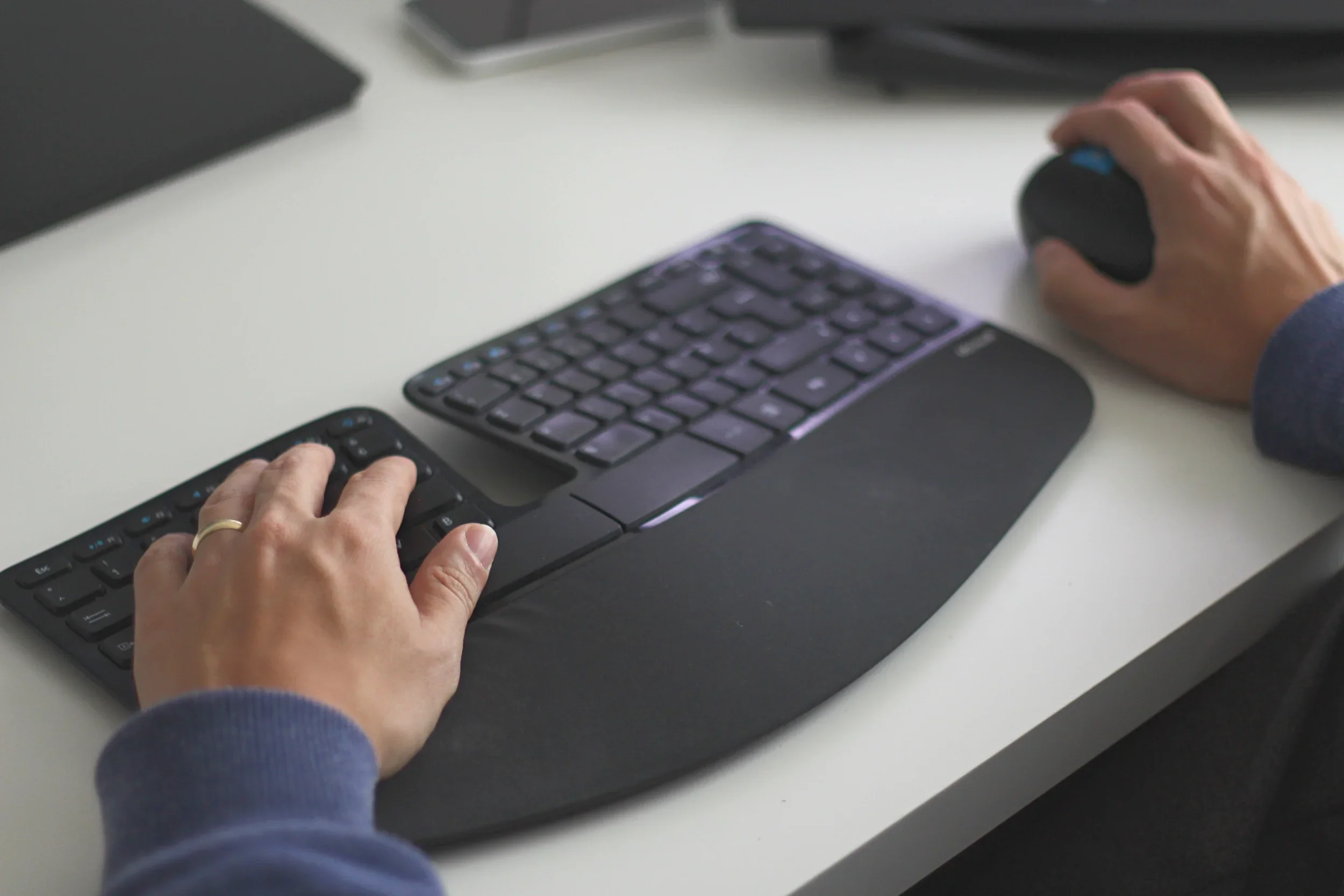
Reach is one of the most underestimated factors in desk-related upper limb and shoulder pain. We use a simple test: sit at the desk, bend the elbows to roughly 90 degrees, and sweep a semicircle in front of you. Everything you use regularly should sit within that arc. If the mouse is outside it, you are reaching with a slightly abducted, slightly internally rotated arm, every time you use it, all day. One practical fix we teach patients: once the mouse is in the correct position, mark the boundary with a small loop of tape on the desk. Every time your hand drifts over it, you will feel it and bring your arm back.
For anyone who spends significant time cross-referencing documents alongside a screen, a document holder placed between keyboard and screen brings reading material up to eye level and eliminates the sustained downward glance that loads the neck. Lawyers and editors in particular notice the difference quickly.

Everything Else
We also look at standing desk use (short bursts of 10 to 20 minutes, not hours at a stretch), tablet and phone habits, the bag you carry to work, and how you use your devices outside office hours. The neck does not clock off at six. If you are loading it for another two hours in the evening looking down at a screen on your lap, we need to know that.

Corporate and On-Site Assessments
We carry out on-site DSE and ergonomic assessments for companies across central London. A standard individual assessment takes around half an hour on-site. Where several members of staff need assessing, we batch those visits efficiently: we have worked with law firms, asset managers, and other professional services businesses to assess multiple employees in a single visit, producing a written report with equipment and setup recommendations that the company can act on.
For employers whose staff cannot easily attend a clinic, we also offer remote video assessments: a colleague with a phone provides a second camera angle if needed, adjustments are made live, and recommendations are documented. We sign off the assessment and you retain a record that satisfies your duty of care under DSE regulations.
To discuss a corporate assessment, call us on 020 3012 1222 or contact us.
When to Come to Us
Come to us when neck pain, shoulder tension, mid-back ache, or desk-related headaches are not resolving despite standard treatment or a company assessment. Come to us if your symptoms keep returning after a few days back at your desk. Come to us if you are returning to work after a period of absence and want to make sure the setup is right before the pain comes back. And come to us if you are an employer who needs a clinical assessment that goes beyond the online tick-box and produces a report you can act on.
Frequently Asked Questions
-
Online DSE questionnaires fulfil a legal requirement but they cannot observe how you actually sit and work. If you are still in pain after your company assessment, the source of the problem has not been found. A clinical assessment carried out by a physiotherapist who can examine your body as well as your setup is a different tool entirely.
-
Either works. If you come to us with neck, shoulder, or upper back pain that has a postural component, we will address your working setup as part of your assessment and treatment. You do not need to request it separately.
-
Usually not. Most improvements come from adjusting what you already have. Where a specific piece of equipment would make a meaningful difference, we will tell you exactly what and why.
-
No. You can book directly. Your initial assessment is one hour and costs £190. We accept Bupa, AXA, and Cigna International.
Book a Workstation Assessment at Physio Remedies, Mayfair
Our clinic is at the Lansdowne Club, 9 Fitzmaurice Place, Mayfair, central London, convenient for clients across the West End and City. For individual appointments, corporate enquiries, or on-site assessments, contact us below.
If you prefer to reach us directly: