
Physiotherapy in Mayfair, London
Back Pain Treatment in Mayfair, London
Our Approach to Back Pain Treatment
Back pain is the most common musculoskeletal problem we see, and the one most likely to have been managed poorly before someone reaches us. People arrive having been told to rest, having completed a generic exercise programme that did not hold, or having had a scan that frightened them without giving them any real answers. In most cases, what was missing was a precise diagnosis. Treating lower back pain as a single condition rather than a group of very different problems with different causes and different solutions is why so many people plateau.
At Physio Remedies in Mayfair, our approach is diagnosis first. The first question we ask is not how severe your pain is, but what is actually causing it. That answer determines everything else.

Why Chronic Back Pain So Often Does Not Get Better
Most people with persistent or chronic back pain have never received a specific diagnosis. They have received a label: disc problem, wear and tear, muscle strain. These descriptions say something about what a scan showed or what a brief examination suggested, but they do not explain why the back has become painful, why it is not resolving, or what treatment will actually work.
The distinction between disc-related pain, facet joint pain, sacroiliac joint dysfunction, and lumbar stenosis matters enormously for treatment. The exercises and manual therapy that help one condition can actively aggravate another. Someone whose back pain is driven by facet joint irritation is often worse with the flexion-based exercises routinely prescribed for disc problems. Someone with a disc herniation or slipped disc is frequently made worse by the extension exercises that help facet pain. Generic treatment applied to the wrong structure is not just unhelpful — it can significantly delay recovery.
We regularly see patients who have had months of physiotherapy, Pilates, or gym rehabilitation that has not worked, not because the treatment was poor, but because it was not targeted at the right problem. A thorough assessment is the foundation of everything we do.
How Is Your Lower Back Pain Affecting You?
It has been going on for months and is not improving
You have tried rest, you have tried exercises, and perhaps a course of treatment that helped initially before the improvement stopped. You are beginning to wonder whether this is simply something you have to manage rather than resolve.
It is affecting your sleep and your sport
You cannot find a comfortable position at night. Running, cycling, or training has had to stop or be significantly reduced. The things that keep you well physically and mentally are no longer accessible.
You cannot get through a working day without pain
Back pain from sitting is a constant presence. You are shifting position every twenty minutes, standing at your desk, moving around the office. By afternoon your concentration is gone.
You have had treatment elsewhere and stopped progressing
You are better than you were at the worst point, but you cannot get back to the activities that matter. You may have had a frightening scan report that has left you more anxious than informed. That gap between where you are and where you want to be is precisely where we specialise.
Our Approach to Back Pain Assessment and Treatment
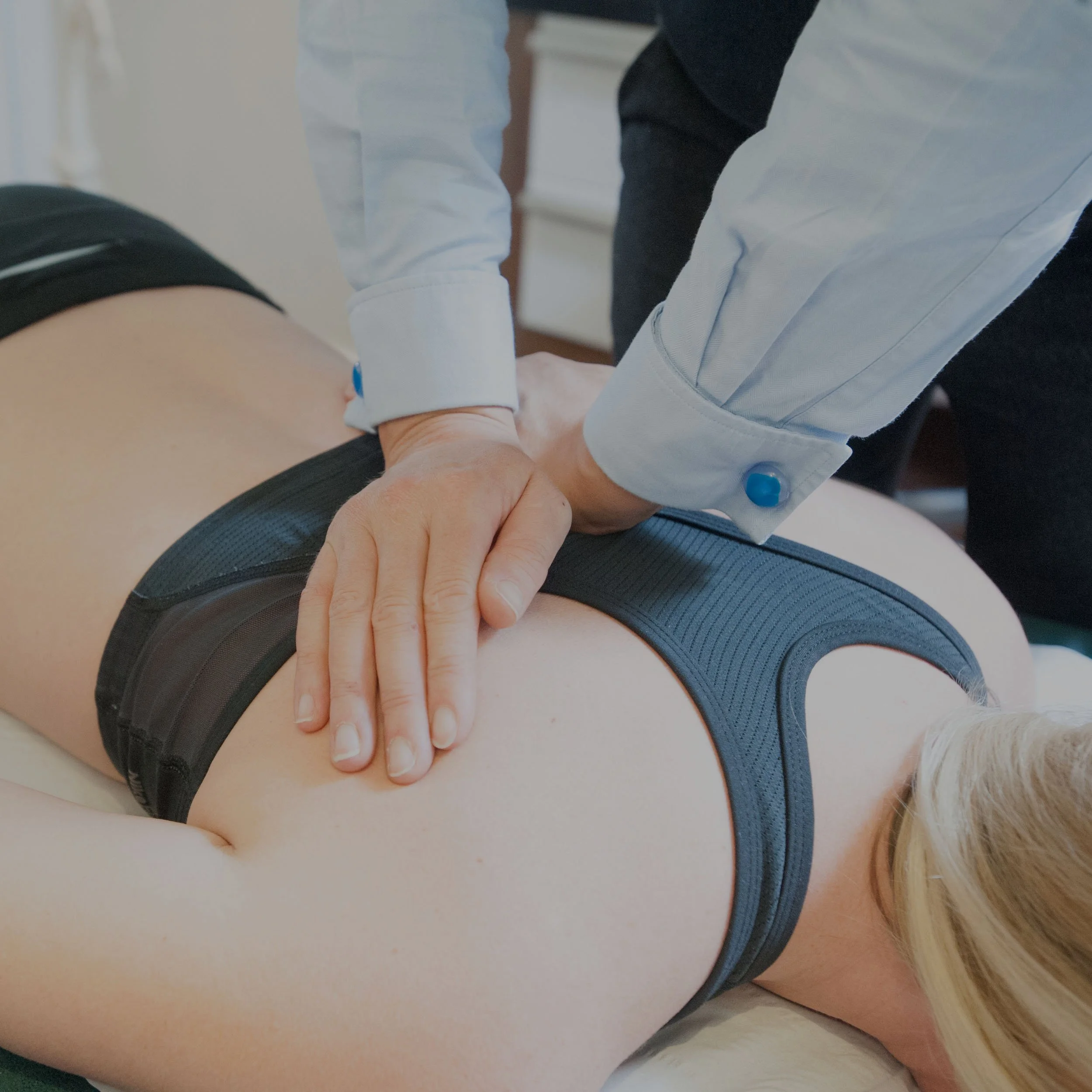
Your first appointment lasts an hour. We take a detailed history covering your work, posture, sport, previous treatment, and the pattern of what makes your back better or worse. The behaviour of your symptoms is often as diagnostically informative as any scan.
We carry out a thorough physical examination: spinal movement, neurological testing, muscle strength, joint assessment, and neural tension testing where leg symptoms are involved. We assess how you move, because the way your lumbar spine, pelvis and hips work together under load is frequently central to understanding why the problem developed and why it is not resolving.
At the end of your first appointment you will have a clear diagnosis, a clear explanation, and a specific treatment plan. We begin treatment in that same session.
Back Conditions We Treat
Sciatica
Shooting, burning or electric pain travelling from the lumbar spine or buttock down the leg, caused by compression or irritation of the sciatic nerve. We cover sciatica in full on its own page, including the important distinction between true nerve root sciatica and other causes of leg pain that are frequently mislabelled.
Slipped Disc
A disc herniation, or slipped disc, occurs when the soft inner nucleus of an intervertebral disc pushes through its outer wall. This can compress a nearby nerve root, producing the shooting or burning leg pain characteristic of sciatica, or it can cause localised lower back pain without leg involvement. Disc pain is typically worse with sitting and bending forward, and often better with walking or lying flat.
Facet Joint Pain
The facet joints are the small paired joints at the back of each vertebra. They are a common and consistently underdiagnosed source of lower back pain, in part because they do not always show clearly on standard MRI and are diagnosed primarily through clinical examination. The pattern of symptoms is the key: facet joint pain is characteristically a deep, aching stiffness felt over the affected joints, worse when arching the back and rotating, and significantly worse after periods of stillness. Many patients describe pronounced morning stiffness that gradually eases as they move around.
Back pain at work and posture-related pain
Sustained poor posture and back pain from sitting accumulate stress in spinal structures that eventually becomes painful. Extremely common in office and professional environments and highly responsive to treatment when the contributing factors are properly identified.
Acute back pain and muscle spasm
Sudden onset lower back pain, whether from a specific incident or waking up unable to move, often involves both joint and muscle components. We see acute presentations and can usually offer same-week appointments. Early, appropriate treatment consistently produces better outcomes than waiting for it to settle on its own.
Lumbar spinal stenosis
Age-related narrowing of the spinal canal producing leg symptoms worse with walking and standing and better with sitting or bending forward. Requires a different treatment approach from disc-related problems and does not inevitably require surgery.
Spondylolisthesis
When one vertebra slips forward on the one below, causing back pain and sometimes leg symptoms. Common in women over fifty and in younger athletes who repeatedly load the spine in extension. Responds well to stabilisation-focused physiotherapy in the majority of cases.
Do You Need a Scan for Back Pain?
Most lower back pain does not require imaging before we can begin effective treatment. The clinical examination is frequently more informative. If symptoms are not responding as expected, if we need to rule out serious pathology, or if we need to confirm a diagnosis before recommending an injection or surgical referral, we will arrange imaging promptly through our direct access pathways.
If you already have scan results, bring them. We will interpret them alongside our clinical findings. The same finding can mean something very different depending on the full clinical picture, and a radiology report read without that context can be misleading and unnecessarily alarming.
Our Experience
Much of the back pain we treat has nothing to do with sport. A large part of our caseload is persistent pain: people who have had the scans, the injections and more than one course of physiotherapy, and who need management that fits their working day rather than another exercise sheet. That means graded loading to rebuild confidence in movement, breathwork to settle a nervous system stuck on alert, and, where it helps, working alongside pain consultants, psychologists and GPs. Between our team, we have also treated back pain at Olympic, Paralympic and Commonwealth Games and across professional sport. Whichever you are, the clinical standard is the same.
When Back Pain Needs Urgent Attention
The vast majority of back pain is not medically serious. However, seek urgent medical attention if your back pain is accompanied by loss of bladder or bowel control, numbness in your inner thighs or genitals, or progressive weakness in both legs. These can indicate cauda equina syndrome, a surgical emergency. Also seek prompt medical assessment if back pain follows significant trauma, is accompanied by unexplained weight loss or fever, or if you are over fifty with new-onset pain that is not clearly mechanical. Once serious pathology has been excluded, we can proceed with assessment and treatment.
Frequently Asked Questions
Here are answers to some of the common questions we receive regarding back pain and treatment at Physio Remedies.
-
For almost all back pain presentations, gentle movement is better than rest. Bed rest has been shown consistently to slow recovery. That does not mean ignoring severe pain, but staying as active as your pain allows promotes healing, prevents stiffness, and maintains the muscle function your spine depends on. We will give you specific guidance on what is safe and helpful for your particular presentation.
-
Acute lower back pain from a specific incident often settles substantially within four to six weeks with appropriate treatment. Disc-related sciatica typically improves within six to twelve weeks. Chronic back pain that has been present for months or years takes longer but does respond to the right approach. Persistent pain that has not resolved with previous treatment is very often the result of insufficient diagnosis rather than an untreatable condition.
-
Recurrence is the most important issue in back pain management and the one most often neglected. People are treated until their pain settles and then discharged, without identifying the movement patterns, muscle imbalances, or loading habits that caused the problem. Without that work, the same stresses return to the same vulnerable structures. Understanding why your back became painful, not just treating the current episode, is central to what we do.
-
Degenerative disc disease describes age-related changes in the intervertebral discs that are present in a large proportion of entirely pain-free people. The presence of degeneration on a scan does not confirm it is the source of your pain, and it does not mean surgery is inevitable. We will interpret your scan findings in the context of your full clinical picture and give you an honest assessment of what they mean for you specifically.
-
The vast majority of lower back pain, including disc herniations and facet joint arthritis, does not require surgery. Fewer than ten per cent of people with disc-related back pain ultimately need surgical intervention. When surgery is genuinely the right answer we will say so directly and refer you to an excellent spinal surgeon. When it is not, we will explain clearly what conservative management can achieve and why.
-
No. You can book directly with us without a GP referral. If you need imaging, medication, an injection, or a surgical opinion, we will advise this and can refer you directly to the appropriate specialist.
Book Your Back Assessment
Meet Paul Martin · Meet Charlie Brahmbhatt · Meet Philip Harris · Meet Lucy Metcalfe
If lower back pain is affecting your work, sleep, sport, or daily life, and particularly if it has not resolved with previous treatment, book an assessment at Physio Remedies in the Lansdowne Club, Mayfair. We will give you a precise diagnosis, a clear explanation, and a treatment plan built specifically around your problem.
If you prefer to reach us directly: