

Shoulder Conditions
Shoulder Impingement Treatment and Physiotherapy in Mayfair, London
There is a specific moment that almost everyone with shoulder impingement describes in almost identical terms: lifting the arm between roughly shoulder height and ear height produces a sharp catch or ache, and then, above that range, the pain often eases. It is predictable enough to be relied upon, consistent enough to be reproduced in clinic, and distinctive enough to tell us quite precisely where to look. That predictability is actually encouraging. Mechanical problems with consistent patterns generally respond well to treatment that addresses the mechanics directly.
Shoulder impingement syndrome, also called subacromial impingement, is one of the most common shoulder presentations we see at our Mayfair clinic. It is also one of the most undertreated, not because the condition is complex, but because the mechanics driving it are rarely assessed thoroughly enough to treat them properly.
A note on terminology: most patients, GPs, and even some clinicians still use the term shoulder impingement. The British Elbow and Shoulder Society (BESS), the professional body for shoulder specialists, now prefers the term subacromial shoulder pain. This is a more accurate umbrella term that reflects the range of soft tissue structures involved and moves away from the idea that something is simply being mechanically pinched in a space too small. We use both terms throughout this page because impingement remains the most commonly searched term, but our assessment and treatment is built on the more current clinical understanding.
You Might Recognise Yourself Here…
The pain appeared gradually, with no clear injury. It catches when you lift your arm overhead or reach across your body. It wakes you when you roll onto that shoulder at night. You have had physiotherapy and perhaps a cortisone injection. The injection helped for a few weeks. The exercises made little difference. The pain is still there, and you are starting to wonder whether this is simply something you have to live with.
Perhaps you have been offered shoulder decompression surgery. You want to understand what physiotherapy can realistically achieve before committing to an operation.
Or you swim, play tennis or padel, do CrossFit or overhead lifting. The catch has slowly pulled you out of the sport you rely on for your mental as much as your physical health. You have been told to avoid overhead movements until it settles. It has not settled, and avoiding the movements has not resolved anything.

Why Your Shoulder Impingement Has Not Got Better
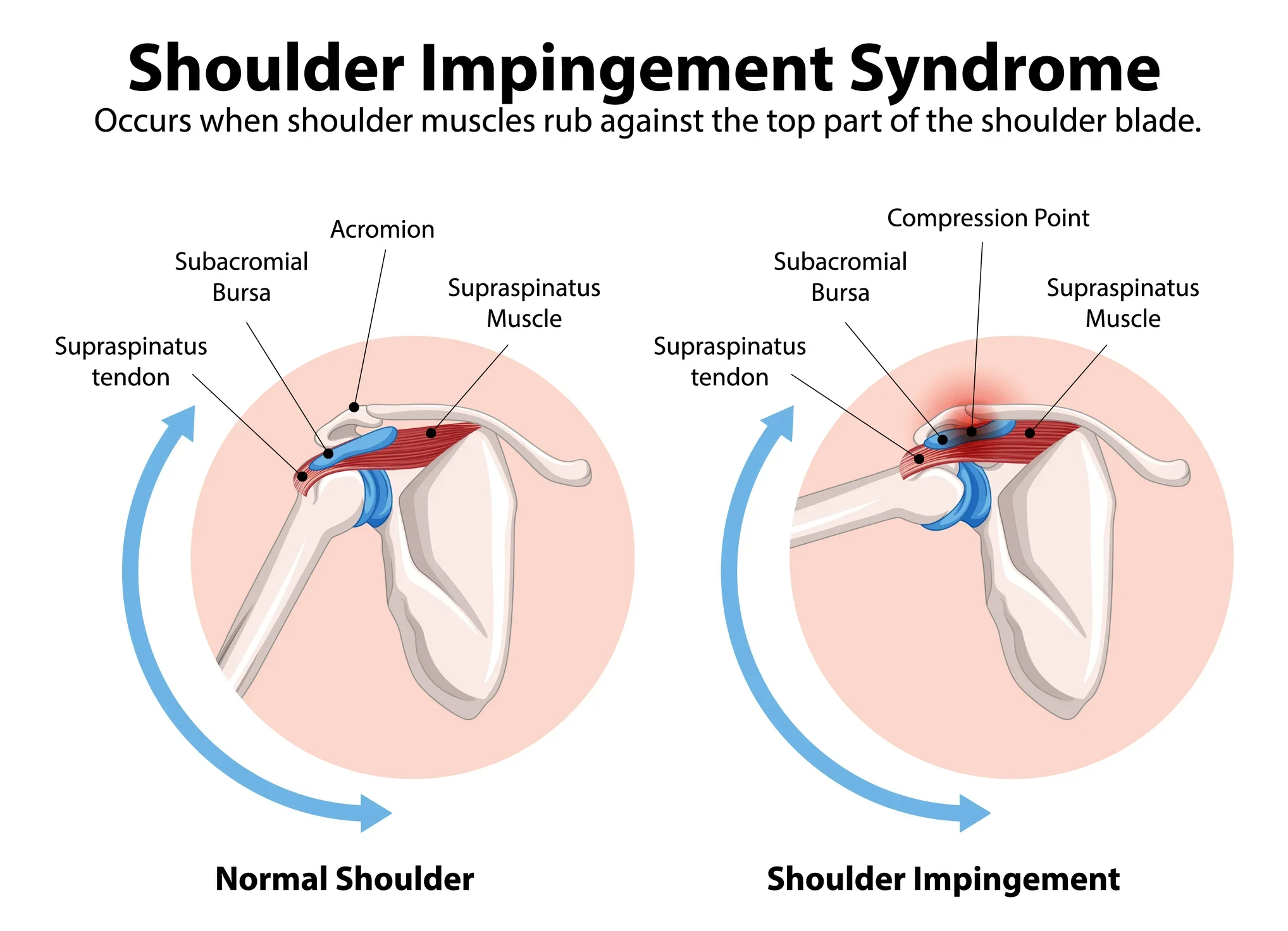
The name itself is part of the problem. "Impingement" implies something mechanical and structural: tissue being pinched in a space that is too small. This framing has dominated shoulder impingement treatment for decades, and it has led consistently to the wrong treatment decisions.
What is actually happening in most cases of subacromial impingement syndrome is a control problem, not a space problem. Your rotator cuff tendons and the bursa above them are being compressed not because the subacromial space is structurally narrow, but because the shoulder blade providing the platform for all shoulder movement is poorly positioned or poorly controlled. When the scapula tilts forward or rotates incorrectly, the space above the rotator cuff closes, the tendon and bursa are compressed, and you feel the familiar catch. Correct the scapular mechanics and the space returns. That is the treatment.
The reason most shoulder impingement treatment fails is that it goes straight to rotator cuff strengthening exercises without first establishing that scapular foundation. External rotation with a resistance band, done in a shoulder with poor scapular control, trains the rotator cuff in a position that perpetuates the problem. We see this pattern repeatedly: patients who have done months of prescribed exercises with no meaningful change, not because they were non-compliant, but because the exercises were addressing the wrong thing in the wrong sequence.
The other common miss is the thoracic spine. Full overhead movement requires thoracic extension and rotation. If your mid-back is stiff, as it often is after years of desk work or heavy training, your shoulder compensates by altering its mechanics, and impingement is frequently the result. We also routinely find that what appears to be subacromial pain is actually referred from the neck. Treating a shoulder that is not the primary source of pain resolves nothing.
Cortisone injections can be genuinely useful, but only as part of a properly structured plan. Used alone, they reduce inflammation in the bursa for a period of weeks, during which time nothing about the mechanics changes. When the effect wears off, the same mechanical environment recreates the same problem. The injection is a tool, not a treatment.
Our Approach to Shoulder Impingement Treatment
Assessment comes before everything, and assessment means watching you move. The standard clinical tests for impingement tell us that impingement is present. They do not tell us why, which is the only clinically useful question. To answer it, we need to watch how your scapula moves as you raise your arm, how your thoracic spine behaves, whether your neck is contributing, and what the specific movements of your work or sport demand from your shoulder.
Where we find scapular dyskinesis, the technical term for the poor scapular control that underlies most shoulder impingement, treatment addresses this directly and first. We correct scapular positioning, establish the rotator cuff activation that depends on it, and build movement sequencing in the right order: positioning, activation, controlled movement, then loaded progressive strengthening. Reversing this sequence, which is standard in generic shoulder programmes, is why those programmes produce limited change.
Thoracic mobility work is part of treatment for most patients with shoulder impingement. It is rarely discussed with patients, but restoring the range of thoracic extension and rotation that has been lost to desk posture often produces immediate change in shoulder symptoms. When you give the thoracic spine the mobility it needs, the shoulder stops compensating.
For subacromial bursitis and rotator cuff tendinopathy within the impingement picture that are not resolving with exercise rehabilitation alone, we use Piezowave2 focused shockwave therapy. Focused shockwave delivers therapeutic energy precisely to the affected tissue at the depth required and is substantially more effective for chronic bursa and tendon problems than the radial shockwave available at most London physiotherapy clinics. We use it selectively, where the clinical picture indicates it will make a material difference.
We also use VALD handheld dynamometry to measure rotator cuff strength objectively throughout rehabilitation. Progress tracked by objective data rather than by pain levels and perceived improvement is more reliable, more motivating, and more specific. When returning to overhead sport after shoulder impingement, we clear patients on the basis of measured strength symmetry, ninety percent of the uninjured side, not on the basis of how the shoulder feels on a given day.
Shoulder Impingement, Bursitis, and Calcific Tendinitis
Subacromial impingement syndrome covers several distinct but related presentations, and understanding which you have affects how we treat you.
Subacromial bursitis
Inflammation of the bursa between the rotator cuff and the bony arch above it. The bursa becomes thickened and reactive, amplifying the catching pain and restricting movement. Often develops alongside rotator cuff tendinopathy rather than alone. Responds to treatment of the underlying mechanical cause combined with targeted management of the inflammatory component.
Rotator cuff tendinopathy and tendinitis
Degenerative change or acute inflammation in the rotator cuff tendons, most commonly the supraspinatus, within the subacromial space. The two terms describe different stages of the same process: tendinitis is earlier and more inflammatory, tendinopathy is more chronic and degenerative. Both are addressed through progressive loading once the mechanical foundation is established, with focused shockwave for cases that are not responding to exercise alone.
Calcific tendinitis
Calcium deposits forming within the rotator cuff tendons, which can produce a severe and sometimes sudden exacerbation of shoulder impingement symptoms. Focused shockwave therapy is particularly effective at breaking down these deposits and restoring normal tendon function without surgery.

Shoulder Impingement in Perimenopausal and Menopausal Women
Subacromial bursitis and rotator cuff tendinopathy present disproportionately in women during perimenopause and menopause. Declining oestrogen levels increase systemic inflammation and reduce the resilience of connective tissue throughout the body, including the tendons and bursa of the shoulder. Tissue that previously tolerated the mechanical demands of sport and daily life becomes reactive under the same loads. If you are in this phase of life and your shoulder impingement arrived without any obvious change in activity or load, this hormonal context is worth mentioning at your assessment. It shapes how we progress your treatment and how we manage the inflammatory component.
Frequently Asked Questions About Shoulder Impingement
-
Yes, in the large majority of cases. Between seventy and ninety percent of people with subacromial impingement syndrome recover fully with appropriately delivered physiotherapy. The key word is appropriately: treatment that correctly addresses scapular mechanics and progressive rotator cuff loading, in the right sequence, rather than generic resistance band exercises prescribed without proper assessment.
-
With correctly targeted physiotherapy, most people see meaningful improvement within six to eight weeks. Full resolution and return to overhead sport or demanding physical activity typically takes three to six months. Longstanding cases, and those where the thoracic spine or neck is contributing, may take somewhat longer. We give you an honest timeline after your first assessment.
-
Repeated overhead activity in a shoulder with poor scapular control, long hours at a desk without postural breaks, swimming or racquet sport with poor technique, and sleeping on the affected side. Paradoxically, complete rest and avoiding all movement can also make shoulder impingement worse by allowing the surrounding musculature to decondition further. Activity modification rather than activity avoidance is the correct approach.
-
Injections can be a useful tool when pain levels are high enough to prevent rehabilitation from progressing, or when the bursa is acutely inflamed. They are not a standalone treatment. An injection that provides pain relief without subsequent physiotherapy to address the mechanical cause will see the pain return when the effect wears off. We will discuss whether an injection might benefit you and refer you through our clinical network if so.
-
Most cases can be diagnosed clinically without imaging. A scan is worth arranging if we suspect a significant rotator cuff tear, calcific deposits requiring intervention, or if your response to treatment is not as expected. If you already have imaging, bring it: we will interpret it in the context of your examination findings.
-
Surgery for straightforward subacromial impingement should not be the first resort, and in most cases it is not necessary. Where a thorough course of properly structured physiotherapy has not achieved adequate improvement, or where there is specific structural pathology, surgery may become appropriate. We will give you an honest clinical assessment of whether the physiotherapy has truly been optimised before concluding that surgery is the right step, and if it is, we will refer you to the right consultant.
-
The most common reason previous physiotherapy has not resolved shoulder impingement is that scapular mechanics were not addressed before rotator cuff strengthening, that the thoracic spine was not assessed, or that the programme was not specific to the demands of your work or sport. These are the areas we focus on from the first session.
Book Your Shoulder Impingement Assessment at Physio Remedies, Mayfair
We will match you with the right physiotherapist for your specific presentation and goals. If shoulder impingement or subacromial bursitis is affecting your sleep, your training, or your ability to work comfortably, we would be pleased to assess you at Physio Remedies in the Lansdowne Club, Mayfair. We are a short walk from Green Park and Hyde Park Corner stations.
If you prefer to reach us directly: