
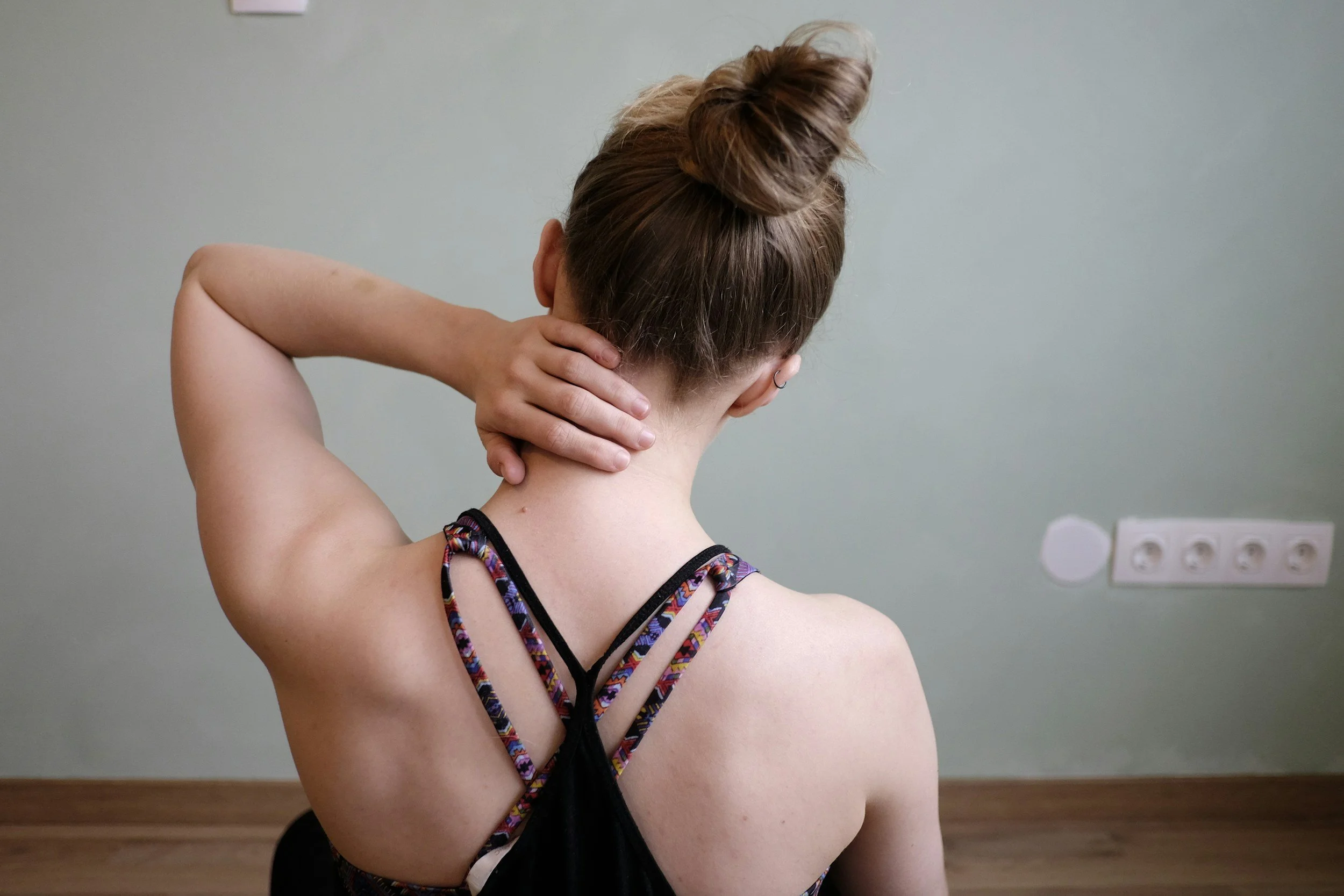
Neck Conditions
Cervical Radiculopathy (Trapped Nerve in the Neck) Treatment and Physiotherapy in Mayfair, London
Most people who come to us with cervical radiculopathy (a trapped or pinched nerve in the neck) have already been through several weeks of worsening symptoms before they understand what is happening. The pain radiating into the arm, the pins and needles that wake them at night, the grip strength that seems to have quietly left one hand: none of it quite fits the picture of a simple neck problem, and yet nobody has joined the dots for them.
Cervical radiculopathy, to use the clinical term, is what happens when a nerve root leaving the cervical spine becomes compressed or irritated. It is one of the most misunderstood conditions we see, partly because the symptoms often appear far from the neck itself, and partly because the standard response is frequently inadequate. Rest and painkillers address the discomfort, but they do nothing about the mechanics driving it.
At our Mayfair clinic, we diagnose precisely what is happening, which nerve root is involved, what is causing the compression, and what your arm and hand symptoms are telling us about severity. We begin treatment in the same session and build a structured plan to resolve the problem, not manage it indefinitely.
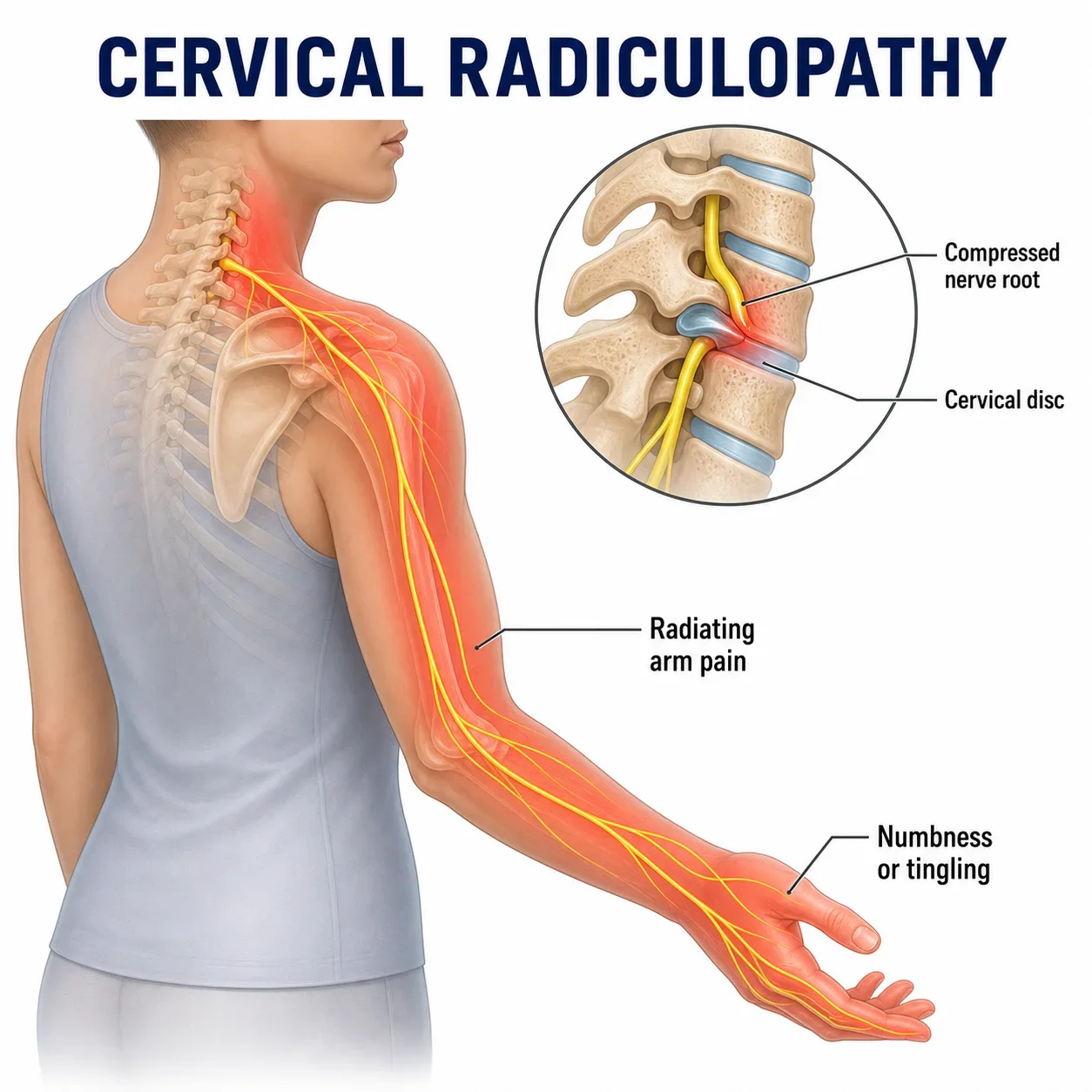

What is Cervical Radiculopathy?
The cervical spine consists of seven vertebrae running from the base of the skull to the top of the thoracic spine. Between each pair of vertebrae, nerve roots exit through small openings called foramina and travel outwards to supply the arm, hand, and fingers with both movement and sensation. When one of those nerve roots is compressed or irritated, the result is pain, tingling, numbness, or weakness that travels along the nerve's path, which is why the symptoms so often appear in the arm or hand rather than the neck.
The condition is sometimes called a pinched nerve, nerve root pain, nerve root compression, or radicular arm pain. All describe the same underlying mechanism: a nerve root under pressure, producing symptoms that follow a predictable distribution depending on which level of the spine is involved.
The most commonly affected levels are C6 and C7. A compressed C6 nerve root tends to produce symptoms into the thumb and index finger. C7 involvement typically affects the middle finger and triceps. Knowing which level is irritated matters clinically, because it guides both assessment and treatment.
What Causes a Trapped Nerve in the Neck?
Disc herniation
In younger patients and those with acute onset, a herniated cervical disc is the most common cause. The gel-like centre of an intervertebral disc can bulge or rupture and press directly on the adjacent nerve root. This often produces sudden, severe arm pain that feels disproportionate to any apparent injury. Disc-related cervical radiculopathy can be triggered by a single event, a heavy lift, a sudden movement, even a poor night's sleep in an awkward position, or it can develop gradually without any obvious cause.
Postural loading and sustained compression
Prolonged desk work, a forward head position, and hours spent looking at screens change the mechanical loading on the cervical spine in ways that gradually increase pressure on disc and nerve tissue. We see a significant number of cervical radiculopathy cases where the primary driver is occupational posture rather than any structural pathology on imaging. Treating only the neck without addressing what that person is doing for nine hours a day is a reliable way to achieve only partial recovery.
Degenerative change and bone spurs
In patients over fifty, the more common cause is cervical spondylosis: the age-related narrowing of the disc space and formation of bony outgrowths (osteophytes) that reduce the size of the foramina through which the nerve roots pass. This process tends to produce a more gradual onset, with symptoms that build over weeks or months rather than striking suddenly. The underlying change is not reversible, but the nerve irritation absolutely can be treated effectively.
Other contributing factors
Cervical radiculopathy can also follow whiplash injuries, direct trauma to the neck or shoulder, or prolonged static positions during activities like cycling in an aggressive position. In some cases it develops during or following illness, for reasons that are not yet fully understood
Cervical Radiculopathy Symptoms
The symptom pattern is distinctive, and recognising it early matters, both because early intervention tends to shorten recovery, and because the severity of neurological involvement guides urgency.
Pain in the neck, shoulder, and arm
The pain associated with a trapped nerve in the neck is usually qualitatively different from musculoskeletal pain. Patients often describe it as deep, burning, or electric. It commonly runs from the base of the neck across the shoulder and down the arm, sometimes reaching the hand and specific fingers. It can be severe enough to be genuinely disabling, and it is frequently worse with certain neck positions, particularly extension or rotation towards the affected side.
Pins and needles, numbness, and tingling
Altered sensation in a specific part of the hand or fingers is one of the most reliable indicators of nerve root involvement. Unlike the diffuse numbness associated with poor circulation, the sensory changes in cervical radiculopathy follow a dermatomal pattern, meaning they affect a predictable strip of skin corresponding to the involved nerve root. If the little finger is affected rather than the thumb and index finger, that points towards a different level of the spine, and a different diagnosis.
Weakness in the arm or hand
Reduced grip strength, difficulty lifting the arm, or loss of fine motor control in the fingers all suggest motor nerve involvement. Weakness is a more significant finding than pain alone and influences how urgently we move through the assessment and treatment plan. We measure grip strength objectively using VALD hand-held dynamometry, which allows us to compare both sides and track recovery with precision rather than impression.
Cervical radiculopathy and headaches
It is common for people with cervical radiculopathy to also experience headaches, typically arising from the base of the skull and radiating towards the back of the head or behind the eyes. The upper cervical nerve roots share pathways with the trigeminal system, which is why nerve irritation at C2, C3, or C4 level can produce referred head pain. If your headaches developed alongside neck and arm symptoms, they are very likely connected.
The shoulder abduction relief sign
A number of patients notice that lifting the arm overhead, resting the hand on top of the head, reduces arm pain. This is called the shoulder abduction relief sign and it is clinically significant. Raising the arm reduces tension on the irritated nerve root, and reproducing this pattern in assessment helps confirm the diagnosis.
Why Your Trapped Nerve Has Not Got Better
This is the question that matters most to the people we see, because many of them have already tried something, rest, anti-inflammatories, a course of physiotherapy, and found that improvement stalled or symptoms returned.
The source of the problem was never properly identified
Cervical radiculopathy is frequently confused with shoulder pathology, rotator cuff problems, or thoracic outlet syndrome. We regularly assess patients referred to us with apparent shoulder conditions and find that when we examine the neck and perform neurological testing, the shoulder is entirely normal and the real problem is at C6 or C7. Treating the wrong structure does not produce lasting improvement, regardless of how good the treatment is.
The reverse also happens: people present with what seems to be a neck problem, but careful neurological testing suggests the nerve compression is occurring at the elbow or wrist rather than the spine. Accurate diagnosis requires a full upper limb neurological assessment, not just a look at the neck.
Neurological assessment was incomplete
The gold-standard clinical assessment for cervical radiculopathy involves a cluster of specific tests: Spurling's compression test, the upper limb neural tension test, cervical distraction, and measurement of cervical rotation to the affected side. When this cluster is positive, the diagnostic accuracy is high. Without it, the clinical picture remains ambiguous, and treatment becomes guesswork.
Posture and load were not addressed
A nerve root can be decompressed through hands-on treatment and exercise, but if the person returns to eight hours a day in the position that loaded it in the first place, progress is always going to be limited. We address posture and workstation setup as part of treatment, not as an afterthought. Our clinic also provides formal ergonomic and DSE assessments when desk posture is a significant contributing factor.
The timeline was not managed realistically
Nerve tissue heals more slowly than muscle or tendon. Patients who expect rapid resolution often either push too hard and provoke a flare, or lose confidence in treatment that is actually working but slowly. Understanding the expected trajectory, including what is normal nerve pain behaviour versus a sign that something is not right, makes a significant difference to how people engage with their rehabilitation.
How We Diagnose and Treat Cervical Radiculopathy
Assessment
Your first appointment lasts one hour. We take a detailed history, not just of the neck, but of the pattern, behaviour, and timeline of all your symptoms. We examine the cervical spine, assess movement and joint mobility, and conduct a full upper limb neurological assessment: sensation testing, reflexes, manual muscle testing at each myotomal level, and the diagnostic test cluster described above.
We also look at contributing factors: posture, thoracic mobility, shoulder mechanics, and the demands of your work and sport. If you have already had imaging, bring the reports. If you have not, we will advise you at the end of the first session whether a scan adds meaningful information for your specific presentation.
One thing that distinguishes how we assess necks: we work with you seated rather than lying down. The neck behaves differently under the load of your own head. Assessing and treating in sitting shows us what is actually happening in the position you spend most of your day in, and allows us to observe how your posture, head position, and muscle control interact under real conditions.
A less-is-more approach to treatment
The cervical spine is genuinely sensitive, and one of the most consistent findings in clinical practice is that aggressive treatment tends to flare it up rather than settle it down. Forceful manipulation, heavy traction, or intensive hands-on techniques applied to an irritable nerve root frequently make things worse in the short term and erode trust in the process. Our approach is deliberately measured.
We focus on muscular release work, releasing the deep neck musculature, the suboccipital region at the base of the skull, and the soft tissue structures that are holding the cervical spine in a compressed, guarded position. This is precise, unhurried work. The aim is to create space and reduce the sustained muscle tension that is adding to nerve root pressure, without provoking the nerve further.
We also spend time on repositioning: helping you find the cervical spine's natural resting position and understand what is genuinely neutral for your neck rather than the habitual position you have defaulted to. This is often more informative than any amount of hands-on treatment, because it gives you a reference point to return to when symptoms flare between sessions.
Deep neck flexor work and gentle exercise
The deep neck flexors, the small muscles running along the front of the cervical spine, are consistently under-recruited in people with cervical radiculopathy. When these muscles are not doing their job, the larger superficial muscles compensate, and the cervical spine loads unevenly. Restoring deep neck flexor activity reduces the mechanical pressure on the nerve roots and improves the stability of the cervical spine under the load of daily activity.
We introduce this early, using gentle techniques that are well tolerated even when the nerve is irritable. A simple starting point is the head slide against a wall: standing with the back of the head lightly in contact with a smooth surface and gently sliding the head upwards, lengthening the cervical spine without forcing range. It sounds unimpressive and works reliably. The exercise teaches the deep neck flexors to engage without the neck going into the flexed, chin-forward position that compresses the posterior structures.
We build on this progressively as your symptoms settle, adding exercises that challenge cervical control under greater load and in positions more relevant to your work and sport.
Self-management from the start
We give you clear, practical self-management strategies from the first session rather than making you dependent on attending clinic for relief. That means specific advice on positions and activities to avoid, pillow and sleep positioning guidance tailored to your cervical level and symptom pattern, and self-release techniques you can use between appointments to manage flare-ups. When pain medication is appropriate, and sometimes it genuinely is, particularly to protect sleep quality in the early stages, we will say so clearly. A well-rested nervous system responds to treatment significantly better than an exhausted one.
The goal is that you leave the first appointment with a clear understanding of what is happening, why it is happening, and what you can do about it between sessions. Clarity reduces anxiety, and anxiety reliably amplifies nerve pain.
Neurodynamic rehabilitation
Neural mobilisation exercises are designed to restore the nerve's ability to move freely within its surrounding tissues. A nerve root under sustained compression can develop adhesions with adjacent structures that reduce its mobility and maintain irritability even after the initial compression has been resolved. Neurodynamic techniques address this specifically. They require precise execution and careful progression; done incorrectly, they can flare symptoms significantly. We teach you the technique in clinic and monitor your response before progressing.
Referral for imaging and specialist opinion
If symptoms are not improving as expected, we refer on promptly rather than persisting with physiotherapy alone. We have established relationships with consultant colleagues, sports doctors, spinal and neurosurgeons, and spine pain consultants, and can arrange imaging and a specialist opinion without the delays that come with starting from scratch. Injection treatments such as nerve root blocks or epidurals are sometimes needed to calm an irritable nerve and create the conditions in which rehabilitation can progress. Surgery is rarely required, but when it is, we will tell you clearly and make sure you reach the right person quickly.

How to Sleep with Cervical Radiculopathy
Sleep disruption is one of the most common complaints we hear from patients with a trapped nerve in the neck. Arm pain and pins and needles tend to worsen at night, for reasons that are largely mechanical: lying down changes the loading through the cervical spine, and sustained positions, particularly with the head turned towards the affected side or the neck flexed forward, compress the nerve root for hours at a time.
A few principles make a significant difference. Sleeping on your back with a supportive pillow that keeps the neck in a neutral position, neither flexed forward nor extended, tends to reduce nerve irritability overnight. A rolled towel inside the pillow case to support the natural cervical curve is often enough. Side sleeping is acceptable on the unaffected side; avoid sleeping on the affected side where possible.
The arms are important too. Many patients find that sleeping with the arm raised overhead (resting on a pillow above the head) significantly reduces arm pain, this is the same shoulder abduction relief mechanism described earlier. If this helps you, it is a useful short-term strategy, though it is not ideal for the shoulder itself over the long term.
We will give you specific positioning advice at your assessment, because what works depends on your cervical level and the nature of your symptoms. Avoid any position that provokes the arm tingling or burning, regardless of what the general advice suggests.
What Not to Do with Cervical Radiculopathy
Do not push through severe arm pain
Some discomfort during gentle movement is expected and acceptable. Pain that radiates strongly into the arm, or pins and needles that worsen significantly during an exercise, is a signal to stop and reassess. Neurological tissue under pressure is not the same as a muscle that benefits from being pushed harder. The principle of working into pain does not apply here.
Avoid sustained neck postures that load the affected level
Prolonged looking down at a phone or laptop, extended periods of neck rotation to one side, or sustained extension are all likely to increase nerve root compression and provoke symptoms. This does not mean you cannot move your neck, it means sustained static loading in provocative positions should be minimised, particularly in the early stages of treatment.
Do not ignore progressive neurological change
Increasing weakness in the arm or hand, or spreading numbness, warrants prompt assessment regardless of what else is happening. These signs suggest the nerve root is under increasing pressure, and the timeframe within which intervention makes the most difference is not infinite. Do not wait weeks to see if it settles on its own when motor function is declining.
Do not stretch aggressively in the hope of releasing the nerve
Self-help videos recommending aggressive neck stretching or nerve flossing for a trapped nerve are widespread, and many patients arrive having irritated their symptoms significantly with techniques they found online. Neurodynamic exercises are genuinely useful, but their precise execution and appropriate progression require clinical guidance. Poorly performed nerve mobilisation can flare an irritable nerve root considerably.

When to Come to Us
Come to us if you have arm pain, pins and needles, numbness, or weakness that you suspect may be coming from your neck. If you have already had physiotherapy that produced some improvement but stalled. If you have been told your symptoms might resolve on their own but they have not changed in several weeks. If your grip strength on one side feels weaker than the other. If the arm symptoms are disrupting your sleep, your work, or your sport.
Cervical radiculopathy has an excellent prognosis with appropriate treatment. The large majority of patients recover fully without surgery, but appropriate treatment means accurate diagnosis, the right manual therapy, properly executed neurodynamic rehabilitation, and a structured return to full activity.
Frequently Asked Questions
Here are answers to some of the common questions we receive regarding cervical radiculopathy treatment at Physio Remedies.
-
Not necessarily. Most presentations of cervical radiculopathy can be assessed and diagnosed clinically with high confidence. If you have already had MRI results, bring them, we will interpret them in the context of what we find on examination. If imaging would meaningfully change your management, we will tell you and arrange rapid access through our referral network.
-
The majority of acute disc-related cervical radiculopathy resolves substantially within six to twelve weeks of appropriate treatment. Degenerative causes, more established compression, or presentations with significant weakness tend to take longer. Nerve tissue recovers more slowly than muscle, and the timeline can feel frustrating when improvement is gradual but consistent. We give you honest, realistic targets from the outset rather than vague reassurance.
-
In the large majority of cases, yes. Even when disc herniation is causing significant nerve compression, the natural history of the disc is to resorb over time, and appropriate physiotherapy manages symptoms and maintains function during that process. Surgery is genuinely indicated in a minority of cases, primarily where there is significant progressive weakness or where conservative treatment has failed after an adequate trial. We will tell you clearly if we think you are heading in that direction.
-
Yes, and this is one of the most common misconceptions we encounter. Cervical radiculopathy frequently produces more pain in the arm than the neck. The neck may feel stiff or uncomfortable, but the severe pain is in the arm and hand, which leads people to assume the problem is in the arm itself. Full neurological assessment tells us where the nerve is being compressed.
-
Lower body and cardiovascular exercise can generally continue. Upper body activity depends on what it involves, overhead work, heavy pressing, or anything that loads the cervical spine directly needs to be modified or temporarily paused. We will give you specific guidance based on your presentation and your activity, not a blanket instruction to rest.
-
We accept Bupa, AXA, and Cigna International. Our initial assessment is £190 for one hour. Please contact us to confirm your cover before your appointment.
Book Your Cervical Radiculopathy Assessment at Physio Remedies, Mayfair
If you have arm pain, pins and needles, hand weakness, or a stiff neck with radiating symptoms, book an assessment at Physio Remedies in the Lansdowne Club, Mayfair. We are a short walk from Green Park and Berkeley Square.
If you prefer to reach us directly: