

Neck Conditions
Cervicogenic Headache Treatment and Physiotherapy in Mayfair, London
If you have been told you have migraines, tried the medication, and found it works sometimes but not consistently, and if your headaches reliably start at the back of your head rather than anywhere else, there is a reasonable chance the diagnosis is wrong. Your headaches may be cervicogenic: originating in your neck, not your head.
Cervicogenic headache is one of the most commonly misdiagnosed conditions we see. Patients arrive having been through the neurology pathway, sometimes for years, without anyone examining their cervical spine. Once the correct source is identified and treated, many notice improvement from the first session. The headaches themselves have not changed. The diagnosis has.
At our Mayfair clinic, we assess and treat cervicogenic headache as a specific clinical entity, with a treatment approach built around the joints and muscles of the upper neck rather than symptom management alone.
What is Cervicogenic Headache?
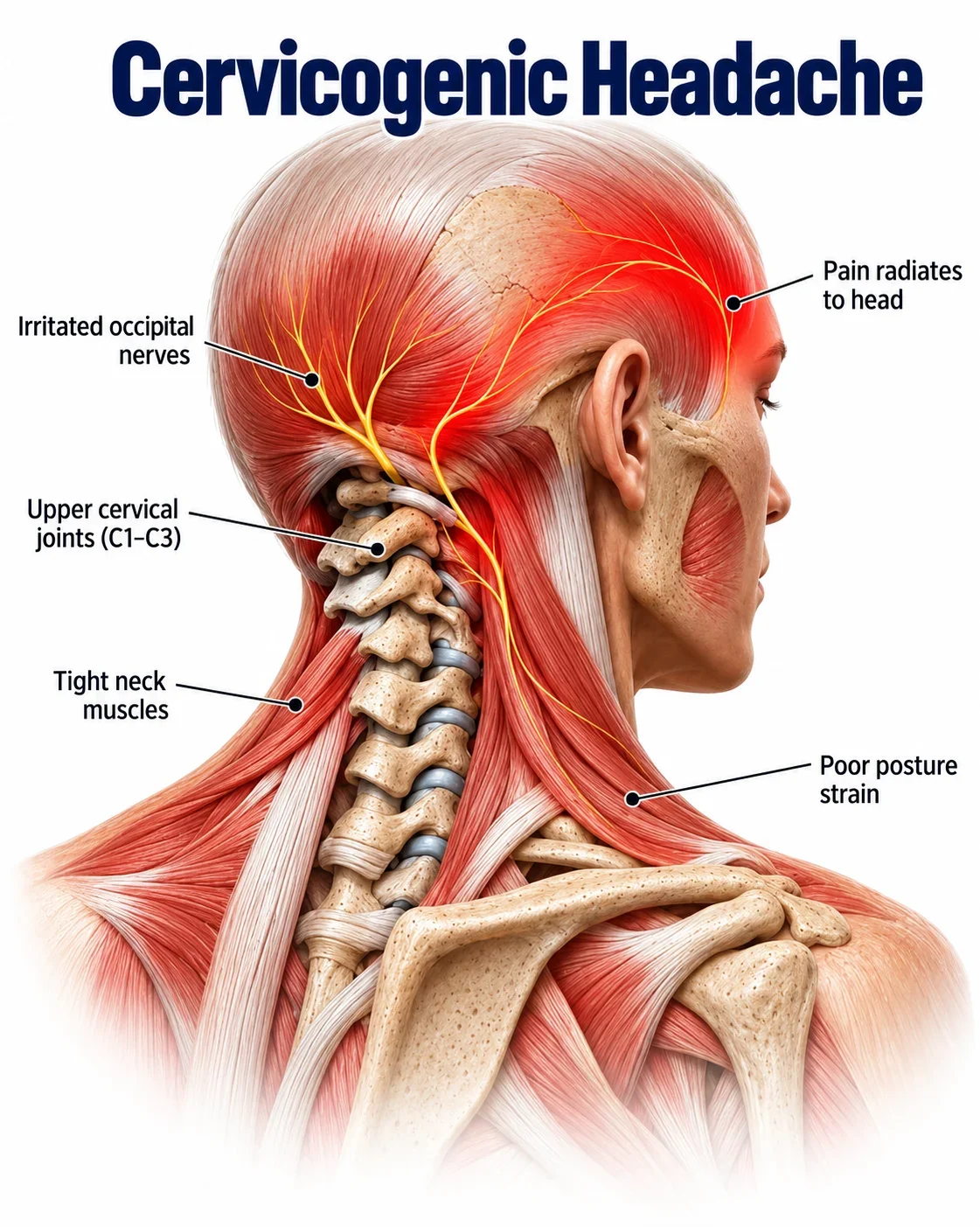
Cervicogenic headache is a secondary headache: one that originates not in the head itself, but in the structures of the upper neck. The joints, muscles, discs, and ligaments at C1, C2, and C3 are supplied by nerve roots that share pathways with the trigeminal nerve, which is responsible for sensation across the face and scalp. When these structures are irritated or dysfunctional, pain is referred upwards through this trigeminocervical pathway and felt as a headache.
Because the brain cannot always accurately locate the source of referred pain, it feels as though it is coming from the head. Pressing on the joints and soft tissue at the top of the neck, however, will often reproduce the headache immediately. This is one of the clearest clinical indicators that the neck is the source, and it is something we can demonstrate during your assessment.
Recognising Cervicogenic Headache: Symptoms and Patterns
The pattern is usually distinctive once you know what to look for. The headache is typically one-sided, starting at the occiput and spreading forward towards the eye or temple on the same side. It is a steady, dull ache rather than a throb. Unlike migraine, it is not typically worsened by physical activity, and it does not usually come with an aura.
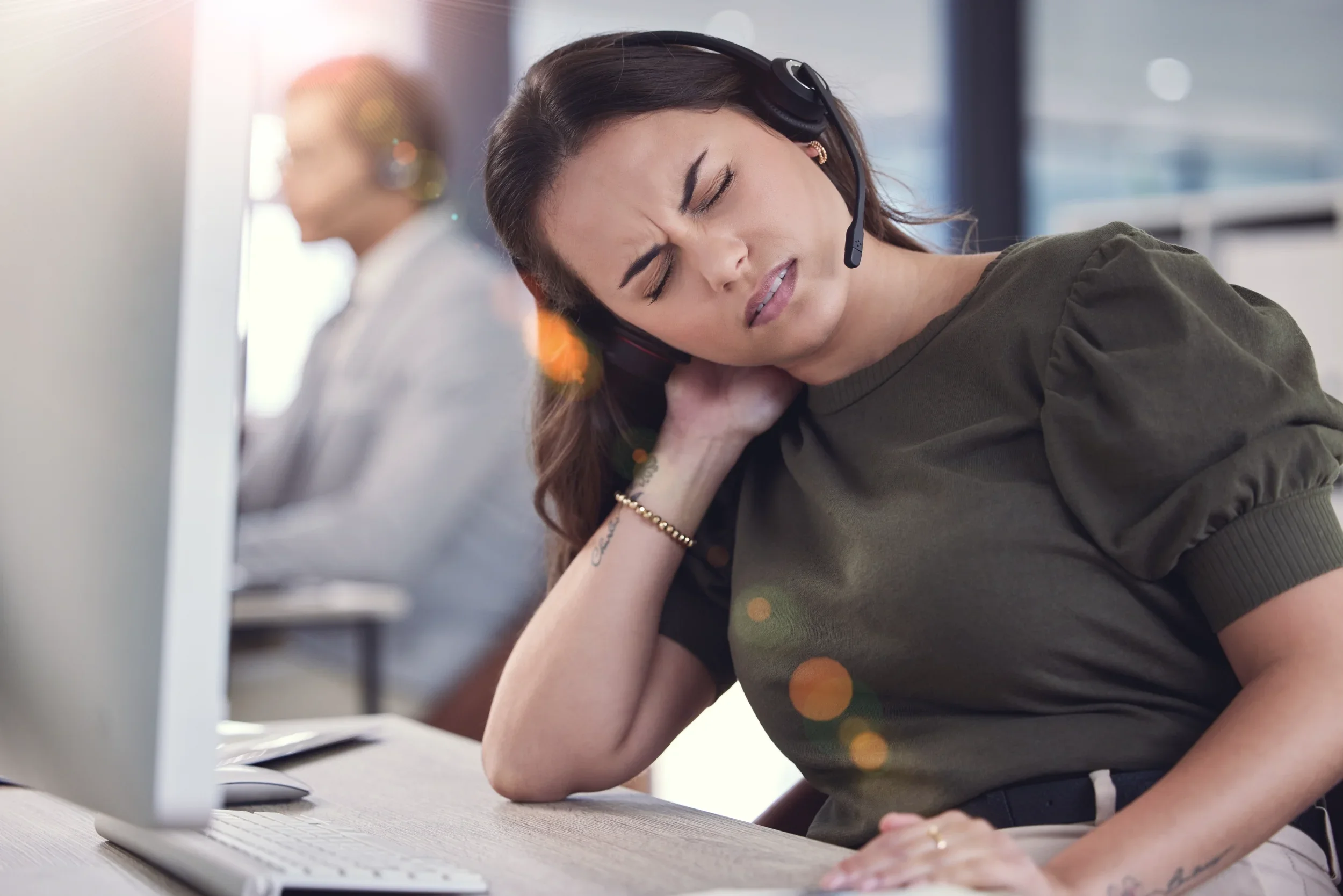
What makes it worse is sustained posture: a long drive, several hours at a screen, or sleeping awkwardly with the neck in a rotated or flexed position. Certain movements, particularly turning the head towards the affected side or looking upwards, often provoke it. When the headache eases after moving the neck or changing position, that is a meaningful sign.
Neck stiffness and reduced rotation to the affected side are almost universally present, though many patients have not connected these to the headache. Tenderness along the upper cervical muscles and at the occiput is characteristic. Some people also experience referred pain into the shoulder or upper arm on the same side.
⚠
When to seek urgent medical attention
A sudden, severe headache that is the worst of your life, or any headache accompanied by vomiting, confusion, loss of consciousness, problems with speech or swallowing, or sudden arm weakness or numbness, requires immediate medical attention. Go to A&E or call 999. These symptoms may indicate a serious underlying condition that needs urgent investigation, not physiotherapy.
Who Gets Cervicogenic Headache?
The condition is significantly more common in women than men, with peak incidence between thirty and sixty. Desk workers, particularly those spending long hours with the head held forward in front of the shoulders, are disproportionately affected. Drivers who spend extended periods turning to one side are also commonly seen. People who have had whiplash injuries, including relatively minor ones, frequently develop the condition in the months that follow as the injured joints become a persistent source of referred pain.
Cervicogenic headache and menopause
A meaningful proportion of the perimenopausal and menopausal women we see present with new or worsening headaches that have been attributed to hormonal changes or migraine, but which prove on assessment to be cervicogenic. Declining oestrogen reduces collagen quality in the cervical facet joint capsules and surrounding ligaments, making these structures more vulnerable to irritation under the same daily loads they previously handled without difficulty. Disrupted sleep compounds this: the deep neck muscles fatigue more quickly when rest is poor, and sustained tension through the upper neck increases.
Cervicogenic Headache, Tension Headache, or Migraine?
The overlap in symptom patterns is the primary reason cervicogenic headache goes undiagnosed. The table below sets out the key distinguishing features. No single feature is definitive in isolation, but the overall pattern is usually clear with thorough assessment.
| Cervicogenic Headache | Tension Headache | Migraine | |
|---|---|---|---|
| Location | One-sided, occiput spreading forward | Band-like, both sides | One-sided, often behind one eye |
| Onset | Gradual, posture or neck movement related | Gradual, stress or fatigue related | Can be rapid; may be proceeded by an ‘aura’ |
| Character | Dull, steady ache; non-throbbing | Pressing or tightening; non-throbbing | Throbbing or pulsating |
| Neck stiffness | Almost always present | Sometimes | Occasionally |
| Triggers | Sustained postures, screen time, neck movement | Stress, poor sleep, dehydration | Light, noise, hormones, certain foods |
| Light / noise sensitivity | Rarely | Sometimes mild | Commonly |
| Nausea | Occasionally | Rarely | Commonly |
| Relieved by neck treatment | Yes, often immediately | Partially | Less Likely |
| Who gets it | Women 30 to 60; desk workers; after whiplash | Very common across all ages | More common in women; often hormonal pattern |
Our Approach to Cervicogenic Headache Treatment
Assessment begins with a careful history covering the headache pattern, behaviour, and timeline, what makes symptoms better and worse, what has already been tried, and what your daily posture and screen time look like. We then examine joint mobility, shoulder movements, assess deep cervical flexor control, and establish whether the headache can be reproduced or relieved through specific movements and manual pressure. We also look at the lower cervical and thoracic spine, because restriction further down the chain frequently loads the upper levels. Workstation setup and daily postural habits are addressed as part of treatment, not as an optional extra.
A measured, hands-on approach
The upper neck is sensitive, and forceful treatment reliably makes cervicogenic headache worse. Our approach is deliberate and unhurried. We focus on releasing the deep suboccipital muscles and surrounding soft tissue, restoring mobility to the joints involved, and reducing the sustained muscular tension that keeps loading the irritated structures. We assess and treat in sitting rather than lying, because this is where the head sits under its own weight and where the postural patterns that drive the problem actually operate.
Self-management between sessions
From the first appointment, we give you specific strategies to manage between sessions: which positions to avoid, how to support the neck at night with pillows, self-release techniques for the suboccipital muscles, and brief postural corrections you can realistically carry out during a working day. When pain relief medication helps protect sleep quality during a difficult period, we will say so clearly. Understanding what is driving the problem, and having practical tools to manage it, reduces both anxiety and headache frequency between visits.
Deep neck flexor rehabilitation
In most patients with cervicogenic headache, the deep cervical flexors, the small muscles running close to the front of the spine, are under-recruited. When they are not doing their job, the larger superficial muscles around the occiput and upper neck take on more than they should, and the compressive load on the facet joints increases. Retraining these deep muscles is central to lasting improvement, not just symptom relief.
When physiotherapy is not sufficient on its own
If headaches are not responding as expected, we refer promptly to consultant colleagues rather than persisting. Cervical facet joint injections can both confirm the source and provide sustained pain relief, creating a window in which rehabilitation can make faster progress. Cervical epidural steroid injections are used where nerve irritation is a significant component. Surgery is rarely needed and is reserved for serious underlying structural pathology. We have direct referral pathways to sports doctors, neurologists, spinal consultants, and pain medicine specialists, and you will always leave with a clear next step.

Recovery: What to Expect
Many patients can experience a reduction in headache intensity or frequency after the first one or two sessions, but the ‘rehab’ part takes longer!
If you’ve had symptoms for a long time, it’s really important that the postural and muscular habits that have contribute to the problem are actually being corrected. Completing the deep flexor retraining and making sustainable adjustments to screen setup and sitting position substantially reduces the likelihood of symptoms returning. Stopping treatment when headaches settle, but returning to the same old working patterns is the the commonest reason headaches keep coming back.
Frequently Asked Questions
Here are answers to some of the common questions we receive regarding cervicogenic headache treatment at Physio Remedies.
-
The most reliable indicators are: one-sided headaches starting at the occiput, neck stiffness on the same side, worsening with sustained postures or neck movement, and improvement with position change. The strongest single indicator is whether firm pressure on the upper neck reproduces your headache. Accurate diagnosis requires a clinical examination, not symptom description alone, but if these features fit your experience, a cervical assessment is the logical next step.
-
Yes, and this is common. Migraine is diagnosed on symptom pattern, and GPs might not have the skill set or time for a detailed examination of the cervical spine during headache assessment. If your medication provides only partial or inconsistent relief, and if your headaches fit the pattern above, a cervical examination is worthwhile. The two conditions can also coexist: when they do, resolving the cervical component typically improves overall headache control considerably, even if migraine management is still needed alongside it.
-
In most cases, no. This is a clinical diagnosis: brain imaging is normal, and cervical imaging rarely changes management because degenerative findings are common in people without headaches. If the picture is complex or symptoms suggest a more serious cause, we will arrange appropriate imaging promptly.
-
For most patients, yes or close to it. The majority achieve lasting improvement through a combination of joint treatment, deep flexor rehabilitation, and sustained postural change. Those with significant degenerative change may need occasional maintenance, but regular, disabling headaches are not an expected long-term outcome of good treatment.
-
Most patients need six to ten sessions over eight to twelve weeks, alongside a home exercise programme. Early presentations often resolve more quickly. We will give you a clearer sense of your likely timeline at the end of your first appointment.
-
Almost certainly. Neck stiffness, upper shoulder tension, and cervicogenic headache frequently share the same driver: poor deep flexor control, restricted upper cervical joint mobility, and cumulative postural load. Treating the source addresses all of them together.
-
We accept Bupa, AXA, and Cigna International. Our initial assessment is £190 for one hour. Please contact us to confirm your cover before your appointment.
Book Your Cervicogenic Headache Assessment at Physio Remedies, Mayfair
We will match you with the right physiotherapist for your specific presentation. If recurring headaches are affecting your work, your sleep, or your daily life, and particularly if previous treatment has not produced lasting relief, we would be pleased to assess you at Physio Remedies in the Lansdowne Club, Mayfair. We are a short walk from Green Park and Hyde Park Corner stations.
If you prefer to reach us directly: