
Shoulder Conditions
SLAP Tear Treatment and Post-Operative Shoulder Rehabilitation in Mayfair, London
A SLAP tear is one of the few shoulder diagnoses where the scan report arrives before anyone has explained what it means, and where the finding itself may not be the reason your shoulder hurts. Both of those things need to be understood before any decision about treatment is made, because a labral tear on a report and a labral tear causing symptoms are not reliably the same thing.
That is not a reason to dismiss your pain. It is a reason to work out what is actually driving it, which is a clinical question rather than a radiological one.
You Might Recognise Yourself Here
You have a scan report in your hand that says superior labral tear, and an appointment coming up at which someone will ask whether you want surgery. Nobody has yet explained what the tear means, whether it explains your symptoms, or what happens if you do nothing.
Or you have had a SLAP repair or a biceps tenodesis. The wound healed, the sling came off, your range came back, and you were discharged. You still cannot serve, swim a full session, or press overhead with any confidence.
Or you have a deep ache inside the shoulder that you cannot point to, a click or clunk with rotation, and it appears at the top of your serve, in the catch phase of your stroke, or at the bottom of an overhead press. Your shoulder has never given way, but you have stopped fully trusting it under load.
What Is a SLAP Tear?
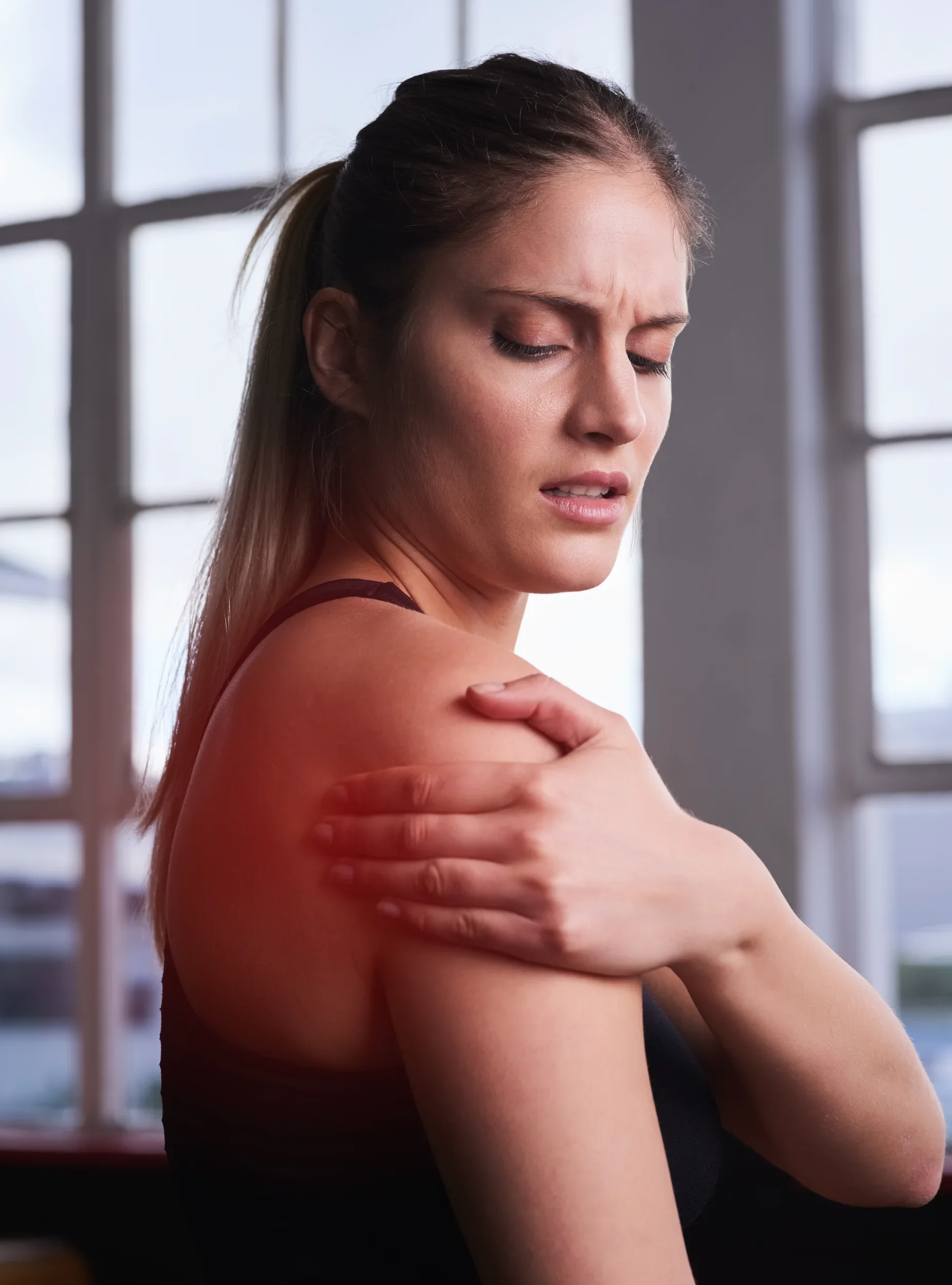
The shoulder socket is remarkably shallow, which is what gives the joint its extraordinary range of movement. To compensate, a rim of fibrous cartilage called the labrum runs around the edge of the socket, deepening it and giving the ligaments and capsule something to anchor into.
The long head of the biceps tendon attaches into the top of that rim. A SLAP tear is damage to this upper section at the biceps anchor, and the name is simply a description of where it sits: a Superior Labral tear running from Anterior to Posterior, or front to back. It is one specific type of shoulder labral tear, distinct from the labral damage that occurs lower in the socket after a dislocation.
What a SLAP Tear Feels Like
The symptom pattern is often frustratingly vague, which is part of why these are difficult to diagnose. Most people describe a deep ache inside the shoulder rather than pain they can point to. That is a useful distinction from AC joint problems, where you can usually place a fingertip directly on the sore spot. There is frequently a catching, clicking or clunking sensation deep in the joint, particularly with rotation.
Pain is typically worst in overhead positions, especially with the arm raised and rotated outwards. Tennis and padel players notice it at the top of the serve or smash. Swimmers feel it during the catch phase. Lifters feel it at the bottom of a press. Reaching behind you, or into the back seat of a car, is often uncomfortable, and lying on that side at night is often difficult.
Many people report a sense that the shoulder is not quite reliable under load without it ever actually giving way. Overhead athletes have also frequently lost some internal rotation on their dominant side, though this is rarely something people notice in themselves.
Does Your Scan Finding Explain Your Symptoms?
This is the question that changes everything that follows, and it is the one least often addressed.
Superior labral changes appear on scans in very large numbers of people whose shoulders are entirely comfortable. Studies of asymptomatic elite volleyball players and baseball pitchers have found MRI evidence of SLAP tears in close to half of shoulders with no history of pain at all, and in asymptomatic middle-aged shoulders the reported figures run considerably higher still. The labrum appears to adapt to years of overhead loading, and a good deal of what a scan picks up is that adaptation rather than injury.
The clinical literature is unusually direct about what follows from this: a superior labral finding on MRI is frequently incidental, it generates a great deal of avoidable anxiety, and it leads to operations that were never going to help. None of that means your pain is imaginary. It means the scan alone cannot tell you where the pain is coming from, and a great many shoulders labelled as SLAP tears hurt because of something entirely treatable sitting alongside the finding.
How SLAP Tears Happen
There are three routes, and knowing which applies to you shapes both your rehabilitation and, if it comes to it, the post-operative restrictions that otherwise feel arbitrary.
The classic overhead mechanism is called peel-back. In the late cocking position, with the arm raised and at maximal external rotation, a torsional force twists the base of the biceps and peels the posterosuperior labrum away from the socket. This is the tennis serve, the padel smash, the overhead throw.
Traumatic tears happen differently: a fall onto an outstretched hand, a sudden traction force through the arm, losing grip of something heavy, or a climber taking full bodyweight through one arm. Direct impact through an adducted shoulder in rugby or judo can do it too.
The third route is accumulated overhead load with no single incident, common in swimmers and in anyone lifting overhead regularly. It almost always travels alongside a tight posterior capsule.
Why Your Shoulder Has Not Got Better
The most common failure is that the tear gets treated instead of the shoulder. Once a scan carries the word tear, everything narrows to that structure, and the loss of internal rotation, the stiff mid-back, the scapula that is not controlling its position and the movement pattern that generated the load in the first place all go unexamined. The labrum is where the problem showed up. It is very rarely where the problem started.
The second is that glenohumeral internal rotation deficit, or GIRD, is missed. Years of overhead loading gradually tighten the tissue at the back of the joint. As internal rotation is lost, the humeral head shifts position in the socket during rotation and the peel-back force on the labrum increases. Rehabilitation that ignores the posterior capsule is asking the labrum to tolerate a load nobody has reduced.
The third is the scapula. Your shoulder blade is the platform the whole joint works from, and if it is not positioning and timing correctly, the labrum absorbs load it was never designed to take. Strengthening a shoulder on an unstable platform reinforces the pattern that caused the problem.
The fourth applies after surgery. Post-operative programmes are usually diligent about protecting the repair and restoring range, then stop. Range of movement is not the goal. Serving, swimming a full session and pressing overhead under fatigue are the goals, and the distance between those two points is where post-surgical shoulder rehabilitation most reliably falls short.
Our Approach to SLAP Tear Treatment
No single examination test proves a SLAP tear exists, so we assess what is actually generating your symptoms rather than trying to confirm a label. We measure internal rotation on both sides and quantify any GIRD. We assess thoracic mobility, scapular position and control, and whether your scapular and rotator cuff muscles are firing at the right moment rather than simply how strong they are. We check whether the biceps tendon is irritable where it joins the labrum. We then watch you perform the movement that provokes it: the serve, the stroke, the press.
We look well beyond the shoulder too. A tennis serve, a golf swing and a barbell press all generate power from the ground upwards. If your hips or thoracic spine cannot rotate properly, the shoulder makes up the difference and the labrum is unfairly loaded.
For most people, treatment starts with rehabilitation and for many it finishes there. The aim is not to heal the labrum. It is to reduce the load reaching it to a level the shoulder tolerates, then rebuild capacity so that level rises. In practice that means restoring internal rotation and posterior capsule length where GIRD is present, retraining scapular position and timing, building rotator cuff endurance rather than peak strength, and addressing the hip and trunk contribution to your sport.
Then we reload deliberately. Overhead positions come back under control, progressively, in the specific patterns your sport demands. A tennis player needs the late cocking position back with confidence. A lifter needs an overhead lockout that holds under fatigue. A swimmer needs the catch phase without the shoulder drifting into positions it cannot control.
We measure this rather than guess. VALD handheld dynamometry lets us compare rotational strength between sides objectively, and we look for at least ninety percent symmetry before signing off return to sport. Most people are cleared on how long it has been rather than on what they can actually do, which is precisely why so many go back and struggle.
If Surgery Is on the Table
Two operations are commonly offered depending on the injury: arthroscopic SLAP repair, or biceps tenodesis. Your scan may describe your tear as one of the following types.
Type 1. Fraying and wear along the free edge of the labrum with the biceps anchor still firmly attached. It is very common with age and frequently has nothing to do with your pain. Where it is treated surgically at all, the rough edges are simply tidied up.
Type 2. The most common symptomatic type. The labrum and its biceps anchor have lifted away from the rim of the socket, often after a dislocation or a significant traction injury. Where surgery is chosen, the labrum is reattached to bone with suture anchors, or the biceps tendon is moved lower down the arm in a tenodesis.
Type 3. A bucket-handle tear, where a fragment of labrum hangs into the joint while the biceps anchor stays put. This is the type that produces genuine locking, popping or clunking. Surgery involves removing the loose fragment and repairing whatever remains unstable.
Type 4. A bucket-handle tear where the damage extends up into the biceps tendon itself. Treatment is either repair of both the labrum and the tendon, or a biceps tenodesis.
Rarer types exist beyond these four, usually where a SLAP tear sits alongside instability elsewhere in the shoulder. What decides your treatment is not the number on its own. It is your symptoms, your age, your sport, how you respond to a properly structured course of rehabilitation, and what we find when we examine you. Where surgery is the right answer, we will say so plainly and get you in front of a shoulder surgeon we know and trust, quickly.
Post-Operative SLAP Repair Rehabilitation
The protected phase.
After a SLAP repair you will typically be in a sling for four to six weeks with external rotation deliberately limited. That restriction exists because external rotation in abduction reproduces the exact peel-back force that damaged the labrum, and the repair cannot tolerate it while healing. We work on everything else meanwhile: elbow and hand, scapular setting, gentle passive range within your surgeon’s limits, and keeping your lower body and cardiovascular fitness intact. Tenodesis recovery differs. The labrum has not been repaired, so range returns sooner, but biceps loading is restricted instead while the tendon heals into bone.
The restoration phase.
From around six weeks, range progresses and strengthening begins. Regaining external rotation is usually the slowest part after a repair and needs patience rather than force. This is also where the posterior capsule and GIRD work becomes important again, because the pattern that contributed to the tear has not disappeared just because the labrum has been reattached.
The loading phase.
From roughly three to four months, overhead work returns under load and we begin restoring the specific movement patterns of your sport rather than generic exercise.
Return to sport.
Overhead athletes are generally looking at six to twelve months for full return after a SLAP repair, and sometimes sooner after tenodesis. Gym-based lifting is often back before racquet sport, because a controlled press is a more forgiving demand than a serve. Progression is criterion-based rather than calendar-based: we test objectively at each stage, and if you are not meeting the marker we do not move you on.
Frequently Asked Questions
Here are answers to some of the common questions we receive regarding SLAP tear treatment at Physio Remedies.
-
Not necessarily. Superior labral findings appear on scans in a very high proportion of people with no shoulder pain at all, so the finding alone does not establish that it is causing your symptoms. In most cases a properly structured course of rehabilitation should come before any surgical decision.
-
Four to six weeks in a sling, meaningful strengthening from around six weeks, overhead loading from three to four months, and full return to overhead sport usually between six and twelve months. Recovery after a biceps tenodesis is often quicker because range is not restricted in the same way.
-
Because rotating outwards with the arm raised recreates the exact force that peels the labrum away from the socket, and your repair cannot withstand it while it heals. The restriction protects the surgery rather than being cautious for its own sake.
-
It depends on your age, your sport, the state of your biceps tendon, and what your surgeon finds. Tenodesis has lower reoperation rates and is increasingly favoured over the age of thirty-five. Your surgeon makes that call, but you should understand the reasoning behind it.
-
Almost always, with modifications. Lower body and cardiovascular work usually carries on unchanged. Overhead and pressing work is adapted rather than stopped, and we will be specific about exactly what changes.
-
The question worth asking is whether anyone measured your internal rotation, assessed your scapular control, and looked at how your sport generates load, or whether you were given rotator cuff exercises because the scan said labrum. The second approach treats the finding. The first treats the reason the finding became painful.
Book Your Shoulder Assessment at Physio Remedies, Mayfair
We will match you with the right physiotherapist for your specific problem and goals.
Whether you are holding a scan report you do not fully understand, deciding whether to have surgery, or recovering from an operation and stuck short of your sport, we would be pleased to assess you at Physio Remedies in the Lansdowne Club, Mayfair. We are a short walk from Green Park and Berkeley Square.
If you prefer to reach us directly: