
Shoulder Conditions
Rotator Cuff Injury Treatment and Physiotherapy in Mayfair, London
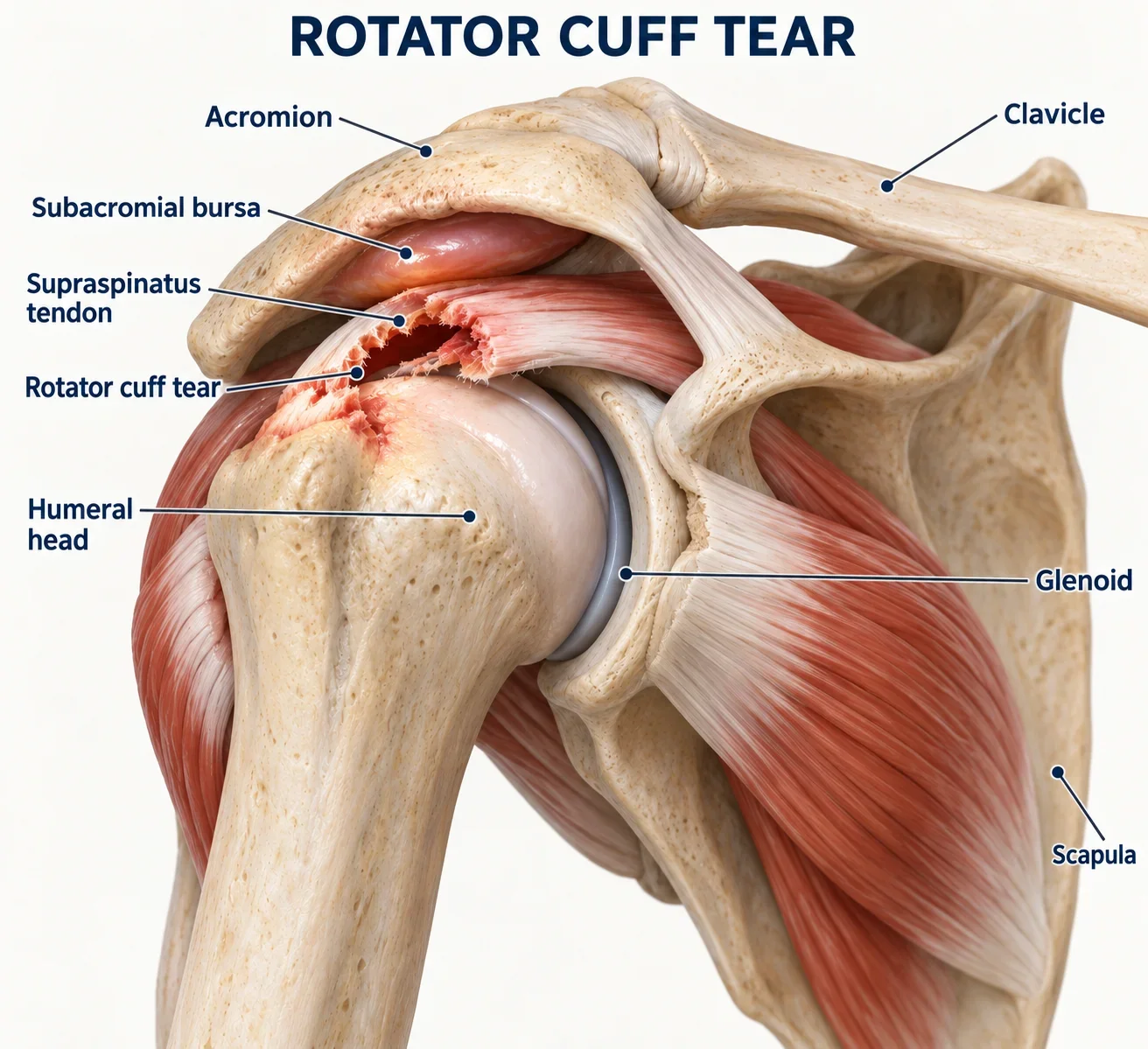
The rotator cuff is four muscles working in precise coordination to keep your shoulder functioning through every position your arm moves through. When a rotator cuff injury disrupts that coordination, whether through a sudden tear, gradual degeneration, or accumulated overload, the results are swift and significant: pain at rest, broken sleep, and an arm that can no longer do what you need it to do. What takes longer to establish, and what most treatment misses, is whether the structural problem your MRI shows and the functional problem you are living with are actually the same thing. Often they are not, and that distinction changes everything about how we treat you.
This is not unusual. Research consistently shows that a substantial proportion of people over fifty have full-thickness rotator cuff tears with no pain and no functional limitation whatsoever. The scan shows the tear. The patient has shoulder pain. These are sometimes the same problem. Sometimes they are not. Working out which is which, and what to do about it, is one of the most clinically important decisions we make.
You Might Recognise Yourself Here…
You fell, tackled, or landed awkwardly and felt something go in your shoulder. You have been told you have a rotator cuff tear and probably need surgery. You are not sure whether to proceed, and you want to know whether physiotherapy could get you back to your sport without an operation.
Perhaps you have already had rotator cuff surgery. Your wound healed, you went through the initial rehabilitation phases, but you cannot get back to swimming, golf, tennis, or rugby. You can reach overhead and lift a kettle. You cannot execute the movements that actually matter to you.
Or your shoulder has been painful for months, sometimes longer, with no clear injury. It aches at rest, wakes you at night, and hurts when you lift your arm overhead or reach across your body. Someone along the way gave you a set of resistance band exercises. You have done them conscientiously and seen very little change.
Why Your Rotator Cuff Has Not Got Better
The most common failure we see is treating the rotator cuff without first establishing the foundation it works from.
Your rotator cuff's job is to keep the head of your upper arm bone centred in the shoulder socket as your arm moves. It cannot do that job effectively if your scapula, the platform from which it works, is poorly positioned or poorly controlled. We regularly see patients who have done months of rotator cuff strengthening, faithfully and diligently, with no meaningful improvement, because nobody addressed their scapular mechanics first. Strengthening in a compromised position reinforces a compromised pattern.
The second common failure is inadequate loading. Rotator cuff tendons, like all tendons, respond to progressive load and need to be challenged systematically to rebuild capacity. Resistance band exercises at low load, repeated indefinitely, are not a rehabilitation programme. They are a starting point, and one that many treatment plans never advance beyond.
The third failure, specific to people who have had surgery, is rehabilitation that stops at basic function. Getting a patient able to dress themselves and reach a shelf is not the same as returning them to overhead sport or contact activity. The gap between those two endpoints is large, and it is where post-surgical rehabilitation most consistently falls short.
Finally, many rotator cuff problems are assessed in isolation. The shoulder is examined but the neck, thoracic spine, scapular control, and the specific demands of the patient's work or sport are not. A rotator cuff that becomes painful during a tennis serve may not primarily be a rotator cuff problem: it may be a thoracic rotation deficit, a scapular timing problem, or a chain of load transmission errors that happens to express itself at the shoulder. Treating the shoulder without understanding how it is being used resolves very little.
Our Approach to Rotator Cuff Treatment
We begin every rotator cuff assessment by establishing two things: what the shoulder is actually being asked to do, and what the scan shows versus what the physical examination reveals. These are often different, and the difference matters.
The physical examination covers range of movement, specific rotator cuff strength tests, scapular positioning and control, thoracic mobility, and postural patterns. We then watch the patient perform the movement causing them problems: the serve, the tackle, the swimming stroke, the overhead lift. Watching someone move in the context of their sport or work reveals things that standard clinical tests cannot.
Treatment begins with the scapula. We establish scapular positioning, activate the rotator cuff in available ranges, and build movement sequencing on that foundation. The process is activation, control, then loaded movement. Only once the platform is right do we progress to systematic, progressive rotator cuff strengthening.
For rotator cuff tendinopathy that is not responding to exercise rehabilitation, we use Piezowave2 focused shockwave therapy. Focused shockwave delivers energy precisely to affected tendon tissue at the depth required, and produces consistently better outcomes for chronic tendon problems than the radial shockwave available at most London clinics. We use it selectively, where it is genuinely indicated, rather than as a routine add-on.
Throughout rehabilitation, we use VALD handheld dynamometry to measure rotator cuff strength objectively between your injured and uninjured sides. Relying on pain levels or perceived effort to guide return-to-sport decisions is insufficiently precise. Objective strength data tells us whether you are recovering as expected, where deficits remain, and when you are genuinely ready to return to your activities. Our threshold for return-to-sport clearance is ninety percent of the strength of your uninjured side. Below that, the risk of re-injury is unacceptably high.
Types of Rotator Cuff Problem We Treat
-
Rotator Cuff Tendinopathy
Degenerative changes in one or more of the four rotator cuff tendons, most commonly the supraspinatus. Often presents as a dull ache at the outer shoulder, worse with overhead activity and when lying on the affected side. There is no structural tear, but the tendon has lost capacity and needs systematic progressive loading to rebuild it. This responds well to appropriate physiotherapy and, in persistent cases, to focused shockwave therapy.
-
Subacromial Bursitis
Inflammation of the bursa, the fluid-filled cushion between the rotator cuff and the bony arch above it. Often accompanies tendinopathy rather than occurring in isolation. Pain is typically sharp and reproducible on specific movements, particularly lifting the arm between sixty and one hundred and twenty degrees. Treatment addresses both the inflammatory component and the underlying mechanics that created the problem.
-
Partial Rotator Cuff Tear
A tear affecting part but not all of the tendon thickness. Can occur acutely after a fall or tackle, or develop gradually from cumulative overload. Many partial tears are successfully managed without surgery, particularly where the remaining tendon has good integrity and the patient responds to progressive loading. The decision on whether to proceed conservatively or surgically depends on the extent of the tear, the patient's age, and their activity requirements.
-
Full Thickness Rotator Cuff Tear
A complete tear through the tendon. Not all full-thickness tears require surgery: in less active patients, and those whose primary goal is comfortable daily function rather than sport, conservative management with strengthening of the surrounding musculature can produce excellent outcomes. In active patients returning to overhead or contact sport, surgical repair is often the appropriate route. Where surgery is recommended, pre-operative conditioning with us significantly improves the outcome.
-
Post-Surgical Rotator Cuff Rehabilitation
The protected phase after rotator cuff repair, typically six to twelve weeks depending on the repair, must be respected absolutely. The subsequent phases, however, must be progressive and goal-directed. We work through systematic strength restoration, tracking progress objectively with VALD dynamometry, and clear patients for return to sport on the basis of measured strength symmetry and functional testing, not on the basis of time elapsed since surgery.
Pre-Operative Conditioning
If you are planning rotator cuff surgery, physiotherapy beforehand is not optional. Research consistently shows that patients who arrive at surgery with stronger surrounding musculature, better scapular control, and established movement patterns recover faster and achieve better outcomes post-operatively. We work with a significant number of patients in the weeks before planned rotator cuff repair, and the difference their pre-operative conditioning makes to their rehabilitation trajectory is consistently significant.
Rotator Cuff Tendon Health and Menopause
Rotator cuff tendons are connective tissue, and connective tissue is significantly affected by the decline in oestrogen that occurs during perimenopause and menopause. Women in their late forties and fifties present with rotator cuff tendinopathy at a rate that reflects this hormonal context: the tendon is more vulnerable, the inflammatory response more pronounced, and the response to loading less predictable than in younger patients. We take this seriously. Treatment for menopausal rotator cuff tendinopathy is adapted to the hormonal context, progressing more carefully and considering the broader picture of connective tissue health. If you are perimenopausal or menopausal and developing shoulder pain, please mention this at your assessment.
When Physiotherapy Is Not Enough
Some rotator cuff tears, particularly large or complete tears in active patients, do require surgical repair. We are not opposed to surgery where it is the right course of action. We have direct working relationships with orthopaedic shoulder surgeons we trust and recommend personally, and we have rapid access to imaging and consultant appointments when the clinical picture suggests that conservative management is unlikely to be sufficient. You will not leave our clinic without a clear next step.
Frequently Asked Questions About Calcific Tendinitis
-
Not necessarily. Many partial tears, and some full-thickness tears, respond very well to physiotherapy. The decision depends on the size and nature of the tear, your age, your activity goals, and how you respond to a properly structured conservative programme. We will give you an honest clinical assessment and, where surgery is the appropriate route, refer you promptly to the right consultant.
-
Partial tears can heal or stabilise with appropriate rehabilitation. Full-thickness tears do not repair themselves in the same way, but strong surrounding musculature can compensate effectively, particularly in patients who are not returning to high-level overhead or contact sport. Age and activity level both significantly affect this decision.
-
For tendinopathy without a tear, meaningful improvement typically occurs within eight to twelve weeks of appropriate rehabilitation, with full resolution in three to six months. For post-surgical rotator cuff repair, return to daily activities takes six to twelve weeks. Return to sport typically takes six to twelve months, depending on the extent of the repair and the demands of the sport.
-
When you reach ninety percent of the rotator cuff strength of your uninjured side on objective dynamometry testing, and when sport-specific functional testing confirms you can execute the required movements safely and with confidence. We do not clear patients for return to sport on the basis of time elapsed since injury or surgery.
-
Not always. Many rotator cuff problems can be assessed and diagnosed clinically. If the examination suggests a significant tear, or if your response to treatment is unexpected, we will arrange imaging promptly through our established referral network. If you already have scan results, bring them: we will interpret them in the context of what we find on examination.
-
The question is whether previous treatment got you to basic function without progressing you toward your actual goal. If you can reach overhead but cannot serve, swim competitively, or tackle with confidence, that final phase is precisely what we specialise in. We also frequently find that scapular mechanics and kinetic chain factors have not been properly addressed, which is why the tendon problem persists despite exercise compliance.
Book Your Rotator Cuff Assessment at Physio Remedies, Mayfair
We will match you with the right physiotherapist for your specific problem and goals. If a rotator cuff injury is affecting your work, sleep, sport, or daily activities, we would be pleased to assess you at Physio Remedies in the Lansdowne Club, Mayfair, and develop a rehabilitation plan that gets you back to what matters. We are a short walk from Green Park and Hyde Park Corner stations.
If you prefer to reach us directly: