

Shoulder Conditions
Frozen Shoulder Treatment in Mayfair, London
Frozen shoulder rarely announces itself. There is no fall, no tackle, no moment you can point to. The shoulder simply starts to ache, then to stiffen, and over a few months you lose the ability to do things you never used to think about: reaching for the seatbelt, getting an arm into a coat sleeve, lifting a bag into the overhead locker. Then the night pain arrives, and with it the broken sleep that makes everything else harder.
Frozen shoulder, known medically as adhesive capsulitis, is common, genuinely painful and frequently mismanaged. Too many people are told to wait it out for eighteen months to two years; others are given stretches that make it worse. At Physio Remedies in Mayfair we treat frozen shoulder in men and women alike, with particular experience in people with diabetes or raised blood sugar and in women going through perimenopause and menopause. Every physiotherapist on our team is a senior clinician who treats frozen shoulder regularly, so whoever you see, you get the same stage-specific approach.
You Might Recognise Yourself Here
Your shoulder has been getting steadily stiffer for months with no obvious cause. You can no longer reach behind your back, and you cannot lie on either side at night. You have been told it will sort itself out, and you are running out of patience.
Or your shoulder stiffened after a spell in a sling, a wrist fracture, or an operation such as heart or breast surgery, and it has never loosened since.
Or you assumed you had pulled something in the gym. You trained around it, then through it, and it has only become tighter. You have type 2 diabetes, or your GP has mentioned that your blood sugar is creeping up, and nobody has connected the two.

What Is Frozen Shoulder?
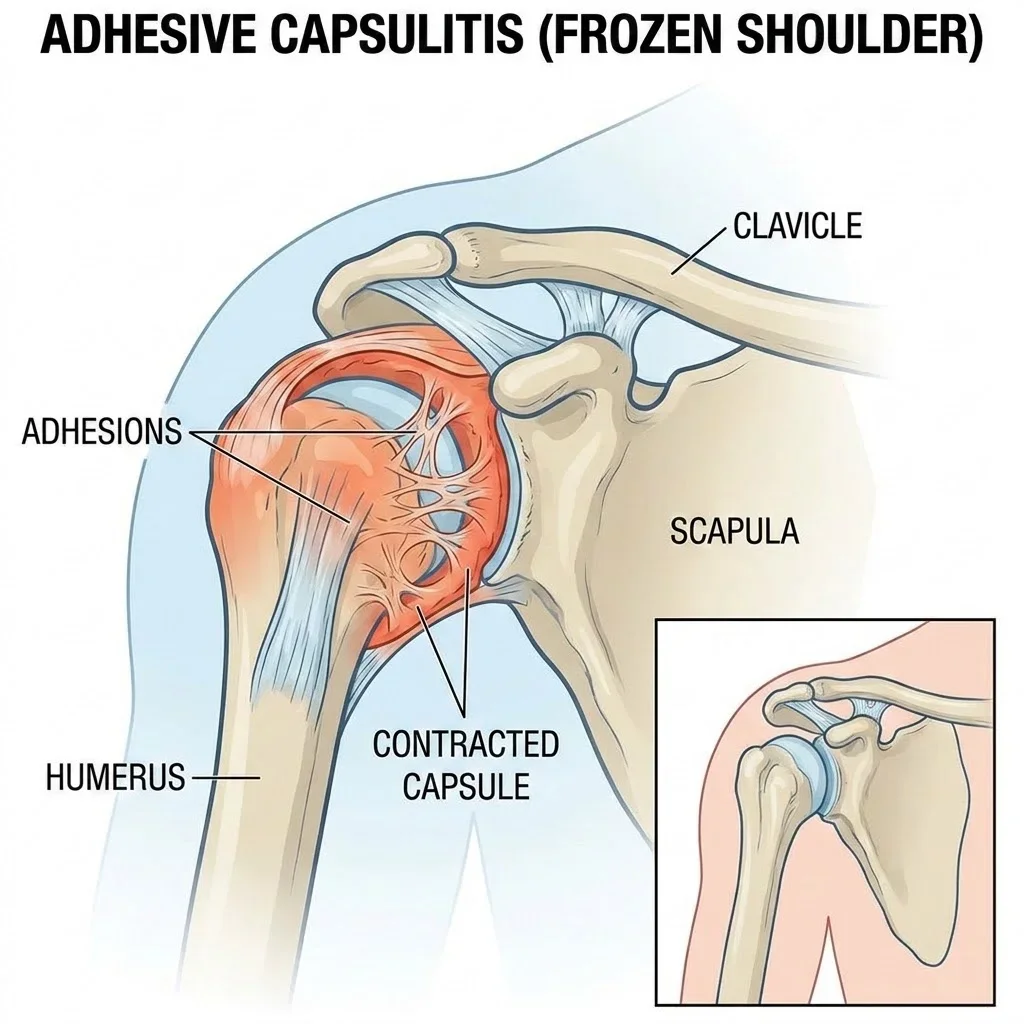
Your shoulder joint is wrapped in a capsule of connective tissue, a flexible envelope that normally has plenty of slack to let the arm move in every direction. In frozen shoulder, that capsule becomes inflamed, then thickens and contracts. The slack disappears and movement is lost in a characteristic pattern: turning the arm outwards goes first and most severely, followed by lifting it out to the side and reaching behind your back.
Frozen shoulder affects roughly two to five people in every hundred at some point, usually between the ages of forty and sixty. It is more common in women, but it is not a women's condition. Men develop it too, and in our experience they are often slower to be diagnosed because the stiffness is put down to a gym strain or a rotator cuff problem.

Is It Frozen Shoulder, or Something Else?
The most telling feature of frozen shoulder is that the shoulder is stiff even when someone else moves it for you. With a rotator cuff problem, the arm is painful and weak when you lift it yourself, but when we move it gently for you, the range is usually still there. In frozen shoulder it is not. Arthritis of the shoulder joint can look similar, which is why an X-ray is sometimes worthwhile, and pain referred from the neck can imitate shoulder pain, so we examine the neck as a matter of routine. Shoulder pain accompanied by fever, unexplained weight loss or a past history of cancer should always be seen promptly by a doctor.
Night pain is one of the hallmarks. An inflamed capsule has nowhere to go when you lie on it, and without the distractions of the day the nervous system registers pain more sharply. Many people cannot lie on either side, even when only one shoulder is affected.
The Three Stages of Frozen Shoulder
The freezing stage is dominated by pain. The shoulder aches constantly, night pain builds, and movement starts to go. It usually lasts between two and nine months.
The frozen stage is dominated by stiffness. The pain often eases a little, but the shoulder feels locked. It can last four to twelve months, and it is often when people finally seek help.
The thawing stage brings a gradual return of movement over many months, sometimes years.
The familiar advice that frozen shoulder resolves by itself within eighteen months to two years is more optimistic than the evidence. Long-term studies find the average episode lasts around two and a half years, and roughly four in ten people are left with some pain or restriction long afterwards. Most of those lingering symptoms are mild, but mild is relative if it means you still cannot serve, swim front crawl or reach the top shelf.
Who Gets Frozen Shoulder, and Why?
Diabetes and Blood Sugar
Diabetes is the strongest known risk factor. People with type 1 or type 2 diabetes are several times more likely to develop frozen shoulder, the risk rises with higher blood sugar, and the condition tends to be more severe, slower to resolve and more likely to affect both shoulders. The mechanism appears to involve sugar binding to collagen and stiffening it. Prediabetes is common and often undiagnosed, so if you have not had your blood sugar checked recently, we will usually suggest asking your GP for an HbA1c test.
Menopause
The peak age for frozen shoulder sits squarely across the perimenopausal and menopausal years, and across our team we see it in perimenopausal women more often than in almost any other group. Falling oestrogen affects collagen quality and increases inflammation, and broken sleep, loss of muscle mass and changes in blood sugar regulation all add to the risk. Both shoulders are frequently affected, one after the other. Treatment needs adapting to that context, and we cover it in depth on our frozen shoulder in menopause page, including what the current evidence says about HRT.
Frozen Shoulder in Men
Men are less likely than women to develop frozen shoulder, but more likely, in our experience, to be told it is something else. A typical story is a man in his fifties who assumes he has strained his rotator cuff, trains through it for months, and is given strengthening exercises that only aggravate an inflamed capsule. When we see frozen shoulder in a man, we look carefully at blood sugar, cholesterol, thyroid function and any history of Dupuytren's disease, the thickening in the palm that gradually curls the fingers, which shares biological features with frozen shoulder and is considerably more common in men.
After Surgery, Injury or a Spell in a Sling
Any period in which the shoulder barely moves can set frozen shoulder off: a sling after a fracture, recovery from heart, breast or neck surgery, or a long hospital stay. Thyroid disease is also linked. Having frozen shoulder on one side raises the chance of developing it on the other, sometimes years later.

Why Your Frozen Shoulder Has Not Got Better
The most common failure we see is treating every stage the same way. A shoulder in the painful freezing stage needs calming, not stretching: pushing hard into an inflamed capsule provokes more inflammation, more night pain and often more stiffness. A shoulder in the frozen stage, by contrast, needs sustained, progressive work to regain range, and gentle exercises repeated indefinitely will not achieve that.
The second failure is mistaking frozen shoulder for something else. Strengthening programmes designed for rotator cuff problems or impingement are poorly tolerated by a frozen capsule. The third is ignoring what is driving it: if your blood sugar is poorly controlled, your thyroid is out of balance, or you are sleeping four hours a night, your shoulder is recovering against a strong headwind. The fourth is waiting too long to consider an injection. In the freezing stage, a well-timed injection can reduce pain enough to protect sleep and let rehabilitation begin.
Our Approach to Frozen Shoulder Treatment
Your first appointment lasts an hour with one of our senior physiotherapists. We take a detailed history, including your general health, blood sugar, thyroid and any recent surgery, examine your shoulder, neck, upper back and shoulder blade, confirm the diagnosis and identify the stage. Treatment starts in the same session. We measure your range of movement at every visit and use VALD handheld dynamometry to measure strength, so progress is tracked objectively rather than guessed at.
Throughout, we keep you active. Lower body, core and cardiovascular training carry on, and upper body work is modified rather than stopped. Tennis, golf, swimming and Pilates can usually continue in some form. Stopping everything is rarely the right advice.
In the freezing stage, the priority is pain and sleep. Gentle manual therapy and movement within comfortable limits preserve the range you have without provoking the capsule, alongside specific advice on sleeping positions, supporting the arm with pillows and timing pain relief to protect your night.
In the frozen stage, the work becomes progressive rather than aggressive: sustained stretching you can tolerate, joint mobilisation, and strengthening within the range you have, so that when movement returns you can use it. A sharp increase in night pain tells us we have pushed too hard.
In the thawing stage, we step up the mobilisation and rebuild overhead reach, end-range strength and the specific demands of your work or sport, using the private gym at the Lansdowne Club.
Injections and Hydrodilatation for Frozen Shoulder
When physiotherapy alone is not making enough progress, we work closely with consultant musculoskeletal radiologists, sports physicians and orthopaedic surgeons in London. A corticosteroid injection is most useful in the painful freezing stage. Hydrodilatation is an ultrasound-guided procedure in which a larger volume of sterile fluid, usually with a steroid and local anaesthetic, is injected into the joint to stretch the tight capsule, and it can be particularly valuable in the frozen stage.
Either procedure opens a window, and what happens in the following weeks decides whether the gain is kept, so we see you promptly afterwards to build on it. Steroid injections can raise blood sugar for a few days, so if you have diabetes we will talk this through with you and your doctor beforehand. Not everyone needs an injection, and we will tell you honestly whether it is worth considering.
When Surgery Is Worth Discussing
Most people with frozen shoulder never need an operation. The largest trial of frozen shoulder treatment to date, the UK FROST study published in The Lancet in 2020, compared early structured physiotherapy with a steroid injection against manipulation under anaesthesia and keyhole capsular release. At twelve months, neither operation outperformed the physiotherapy pathway, and capsular release carried a higher risk of complications. For shoulders that remain severely painful and restricted despite well-structured treatment, we will say so clearly and refer you promptly to a shoulder surgeon we trust.
Frequently Asked Questions
Here are answers to some of the common questions we receive regarding frozen shoulder treatment at Physio Remedies.
-
Left to run its course, frozen shoulder typically lasts around two and a half years, and roughly four in ten people are left with some pain or stiffness afterwards. With treatment matched to the stage, many people regain sleep and useful movement considerably sooner.
-
Yes. It is more common in women, but plenty of men develop it, particularly those with diabetes or raised blood sugar, thyroid problems or Dupuytren's disease, or after a period of immobilisation. If your shoulder is stiff even when someone else moves it, it is worth a proper assessment.
-
Quite possibly, if you are in your forties or fifties and going through perimenopause or menopause. Falling oestrogen makes the shoulder capsule more susceptible, and treatment needs adapting accordingly. Our menopause shoulder page explains the connection in detail.
Read more -
Neither extreme. Complete rest makes stiffness worse, but forceful stretching during the painful freezing stage usually inflames the capsule further. As a rule of thumb, sharp pain or worse night pain means ease off.
-
Up to one in five people go on to develop it in the other shoulder, and the risk is higher with diabetes or during menopause. Once a shoulder has fully recovered, it very rarely freezes again.
-
Usually not. Frozen shoulder is diagnosed clinically. An X-ray can help rule out arthritis, and if you already have imaging, bring it and we will interpret it alongside our examination.
-
Your initial assessment lasts one hour and costs £190. We accept Bupa, AXA, and Cigna International. Please check your cover with your insurer before your appointment, as some policies require a GP referral.
Book Your Frozen Shoulder Assessment in Mayfair
Meet Paul Martin · Meet Charlie Brahmbhatt · Meet Philip Harris
All of our physiotherapists treat frozen shoulder. We will match you with the one best suited to your goals, whether that is sleeping through the night again, returning to your sport, or managing frozen shoulder alongside diabetes or menopause. If frozen shoulder is costing you sleep, sport or simply the ability to get dressed without wincing, do not wait for it to thaw on its own. Come and see us at Physio Remedies in the Lansdowne Club, a short walk from Green Park and Berkeley Square.
If you prefer to reach us directly: