

Neck Conditions
Neck Pain Treatment and Physiotherapy in Mayfair, London
Most people with neck pain who have had an MRI arrive at our clinic carrying the report like a verdict. A disc bulge. Degenerative changes. Cervical spondylosis. What they are rarely told is that these findings are present in the majority of people over forty who have no neck pain whatsoever. Research published in the American Journal of Neuroradiology found disc degeneration in 87% of asymptomatic adults over forty, and bone spurs in 69%. The scan shows the structural changes. It does not tell you whether those changes are responsible for your pain. That is a clinical question, and it requires a clinical assessment rather than an imaging report read in isolation.
At our Mayfair clinic, we assess what is actually driving your neck pain rather than treating what a scan says should be there. For the majority of patients, that means mechanical dysfunction: the cumulative load of desk hours, sustained screen posture, and the demands of City working on a structure designed for movement rather than stillness. For others it means a nerve root under pressure producing arm symptoms, or a whiplash injury being managed too passively to recover well. In each case, the starting point is understanding the real source of the problem.
The Patients We See
Your neck has been stiff and aching for months. By mid-afternoon the muscles across your upper back and shoulders are wound tight, and by evening you have a headache starting at the base of your skull. You sit at a desk for ten or more hours a day. You have had massages that help briefly. Nobody has explained what is actually driving the problem.
Perhaps you were in a road traffic accident or a collision in sport. Your neck was manageable at first and worsened in the days that followed. You have been told to rest. The evidence says something different.
Or you have pain that runs from your neck into your shoulder, arm, or hand — tingling, numbness, sometimes weakness in specific fingers. You have been through shoulder and arm investigations that found nothing. The symptoms are coming from your cervical spine, and until that is properly assessed, they will not resolve.
Where Neck Pain Treatment Most Often Falls Short
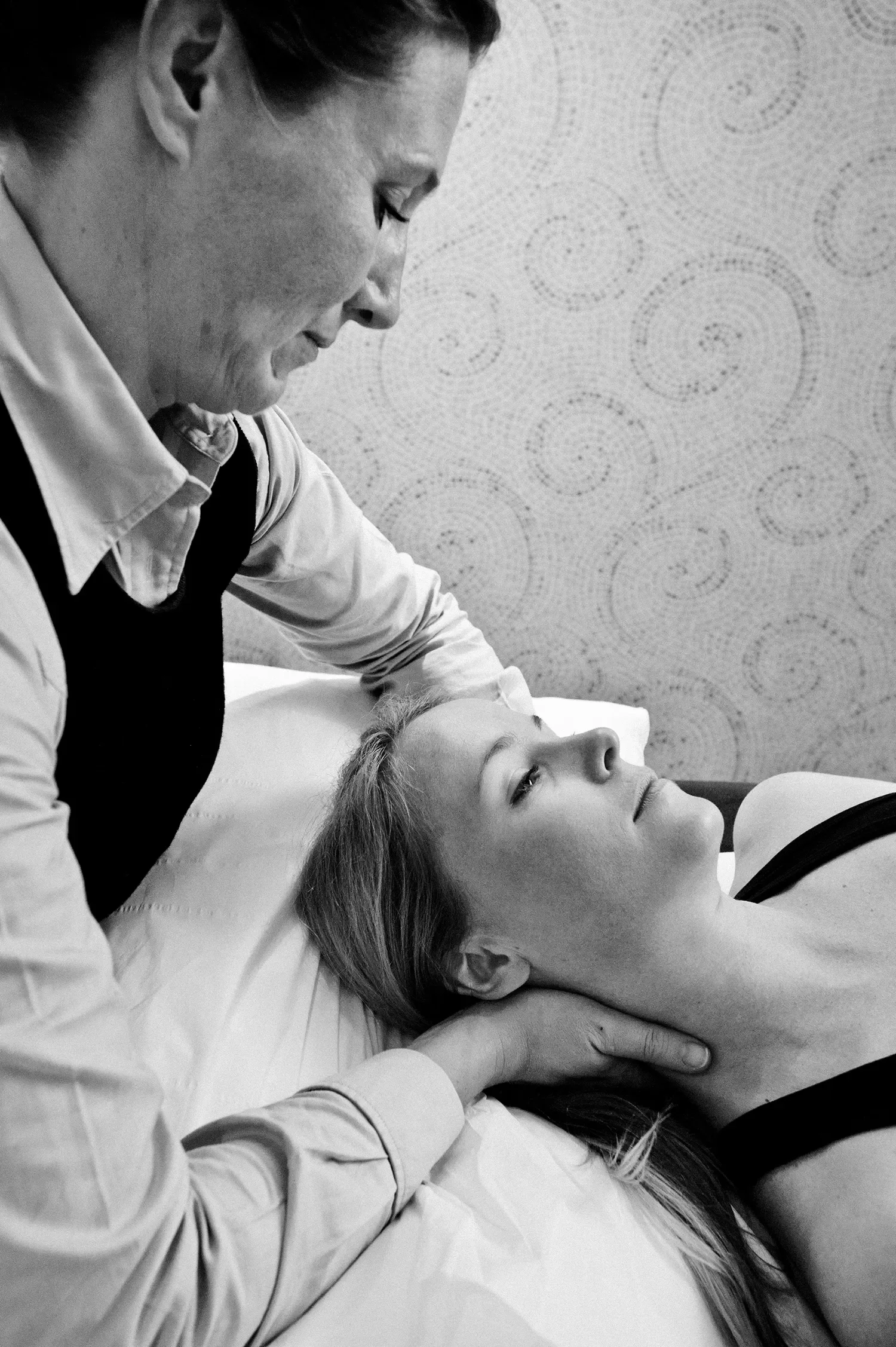
The most common failure is treating the superficial muscles when the problem is deeper. The muscles visible and tender at the back and sides of the neck — the upper trapezius, the levator scapulae — tighten in response to a deeper dysfunction: the failure of the deep cervical flexors, the small stabilising muscles running close to the spine, to control the cervical segments properly. Releasing the superficial muscles through massage provides temporary relief. Retraining the deep stabilisers addresses the underlying problem. Most neck pain treatment stops at the first step.
The second common failure is ignoring the thoracic spine. Full cervical range of movement depends on adequate mobility through the thoracic vertebrae directly below. A stiff mid-back — almost universal in people who sit for long hours — forces the cervical spine to compensate. We treat the thoracic spine in almost every patient we see with neck pain. It is routinely assessed and routinely not treated elsewhere.
The third failure is posture advice without a viable way to follow it. Telling someone who works a twelve-hour day to sit up straight is not useful. The deep cervical flexors fatigue before the end of a morning, and willpower cannot sustain good posture once the supporting muscles have given out. We give patients strategies that work within their actual working day: brief, frequent position corrections rather than sustained posture-holding; workstation adjustments that reduce load rather than relying on effort to manage it.
For patients with arm and hand symptoms, many courses of physiotherapy treat the cervical joints without adequately assessing neural tension: the mobility of the nerve as it travels from the spine through the shoulder and down the arm. A restricted nerve that is not addressed through neural mobilisation will continue producing symptoms regardless of how well the joints are moving
Our Approach to Neck Pain
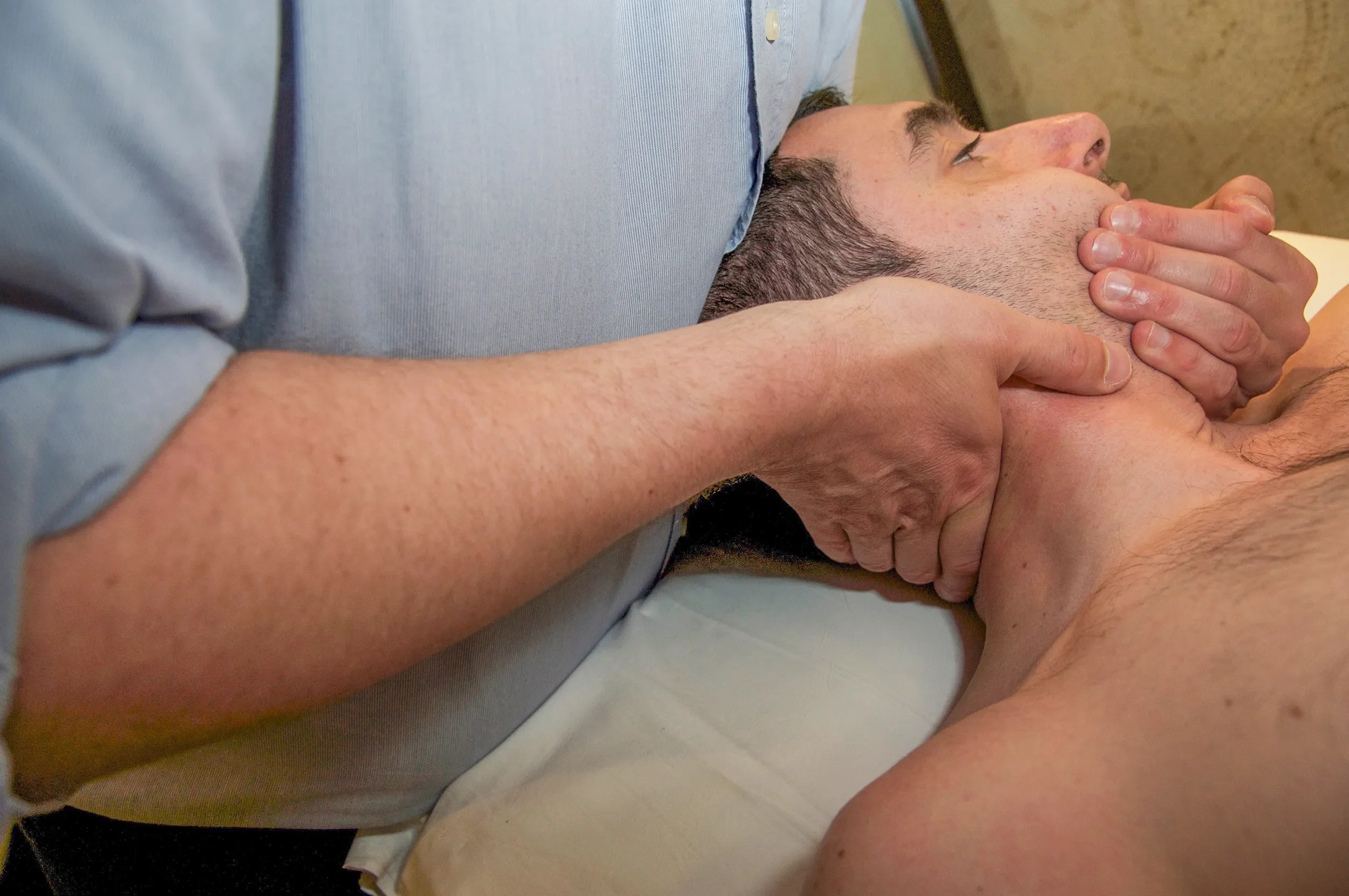
Assessment begins with your history: how the pain started, what makes it better and worse, what you have tried, and what your daily demands actually look like. We then examine cervical and upper thoracic joint mobility at each level, the neurological status of the upper limb, neural tension, and deep cervical flexor control. We look at how you sit, how you carry your head, and if relevant, how you perform the specific movements from your sport or work that provoke symptoms.
Treatment combines manual therapy to restore joint mobility and reduce muscle guarding with a targeted exercise programme addressing deep cervical flexor endurance, thoracic mobility, and scapular control. For patients with nerve root symptoms, we add neural mobilisation and monitor neurological signs carefully throughout. For desk workers, we give practical workstation and habit guidance specific enough to actually be implemented.
We also consider the broader picture. Neck pain is unusually sensitive to stress: the muscles of the neck and upper shoulder are among the first structures to respond to elevated cortisol. Understanding this helps patients make sense of why their neck is reliably worse on Monday morning and why a weekend away consistently settles it.
Frequently Asked Questions
Here are answers to some of the common questions we receive regarding neck pain treatment at Physio Remedies.
-
In most cases, no. Disc degeneration, bone spurs, and other cervical changes seen on imaging are present in large proportions of people without any neck pain. A scan tells us what is structurally present; it does not tell us what is causing your symptoms. Clinical assessment is more informative for most presentations. We recommend imaging when there are significant or progressive neurological signs, when we need to rule out serious pathology, or when the response to treatment is unexpected. If you already have scan results, bring them: we will interpret them in the context of what we find clinically.
-
The most common reasons: the deep cervical stabilisers have not been addressed, only the superficial muscles; the thoracic spine has not been assessed or treated; neural tension has been overlooked in patients with arm symptoms; or the postural and loading habits driving the problem have not changed. Massage and pain relief manage symptoms. They do not rebuild the muscular control the cervical spine needs for long-term stability.
-
Yes. Cervicogenic headaches originate in the upper cervical spine rather than the head itself and are frequently misidentified as tension headaches or migraines. They typically produce a one-sided headache starting at the base of the skull and spreading forward, often accompanied by neck stiffness. Specific cervical joints, most commonly C1-C2 and C2-C3, refer pain into the head through the trigeminocervical pathway. These headaches respond well to manual therapy targeting the upper cervical spine combined with deep flexor rehabilitation.
-
Yes. The nerve roots supplying the arm exit the spinal cord at each cervical level, and when they become compressed or irritated they produce symptoms in the part of the arm they supply. Which fingers are affected, where the pain travels, and which movements reproduce or ease symptoms help identify which nerve root is involved. Most cases of cervical radiculopathy resolve with conservative management. If you have arm or hand symptoms that have not been explained by shoulder or elbow investigations, a cervical assessment is the logical next step.
-
Acute mechanical neck pain, present for less than six weeks, often improves significantly within two to four weeks with appropriate treatment. Chronic neck pain, where postural habits and desk loading are ongoing contributors, takes longer: eight to twelve weeks of treatment combined with sustainable daily habit changes is a more realistic expectation. Cervical radiculopathy typically shows meaningful improvement within six to twelve weeks of well-directed conservative management.
-
Yes, and in most cases it is essential. The cervical spine is stabilised by muscular control, and rest or avoidance of movement accelerates the deconditioning of the deep flexors the neck depends on. The key is starting with exercises matched to your current tolerance and progressing them systematically. We give you a programme specific to your presentation rather than a generic sheet.
-
It can, particularly if the postural and loading habits that caused it remain unchanged. The risk of recurrence is substantially lower in patients who complete the full rehabilitation programme including the deep cervical flexor strengthening phase, rather than stopping when acute symptoms settle. We give all patients a clear picture of what long-term neck health looks like so that any recurrence is managed early rather than allowed to become chronic again.
-
No. You can book directly with us. If you need imaging, medication, an injection or surgical assessment, we will advise this and refer you directly to the appropriate specialist.
Book Your Neck Pain Assessment at Physio Remedies, Mayfair
We will match you with the right physiotherapist for your specific presentation. If neck pain, stiffness, headaches, or arm symptoms are affecting your work, your sleep, or your daily life, we would be pleased to assess you at Physio Remedies in the Lansdowne Club, Mayfair. We are a short walk from Green Park and Hyde Park Corner stations.
If you prefer to reach us directly: