
Muscle Conditions
Triceps Pull & Tear Treatment in Mayfair, London
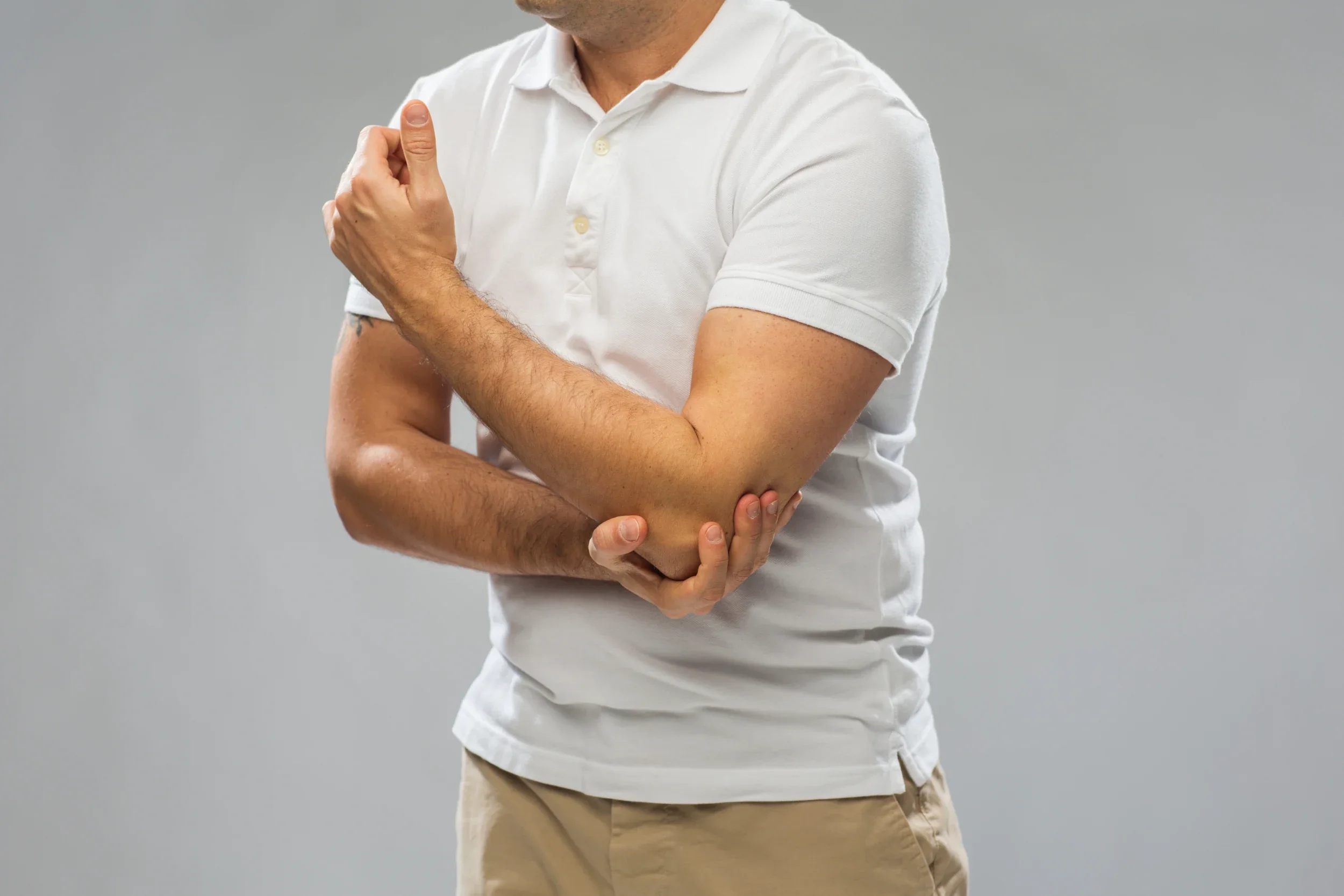
It usually happens on a set you should probably have skipped. The last reps of heavy dips, a tired overhead press, a set of skull crushers after a long week, or a serve or throw when the arm was already fatigued, and something grabs in the back of the upper arm. Sometimes you finish the session and only notice it later. By the next morning, pushing yourself up from a chair, opening a heavy door or doing a press-up is sharp and sore in one spot, and straightening the arm against resistance feels weak.
That is a tricep strain, also called a pulled tricep or a torn tricep muscle. It is a tear of some of the muscle fibres at the back of the upper arm, and it is one of the more common upper body muscle injuries we see in people who lift, play racquet sports, throw, climb or play contact sport. The good news is that the great majority of tricep strains recover fully within weeks with the right rehabilitation. The frustrating part is how often they come back when people return to heavy pressing too soon.

What Is a Tricep Strain?
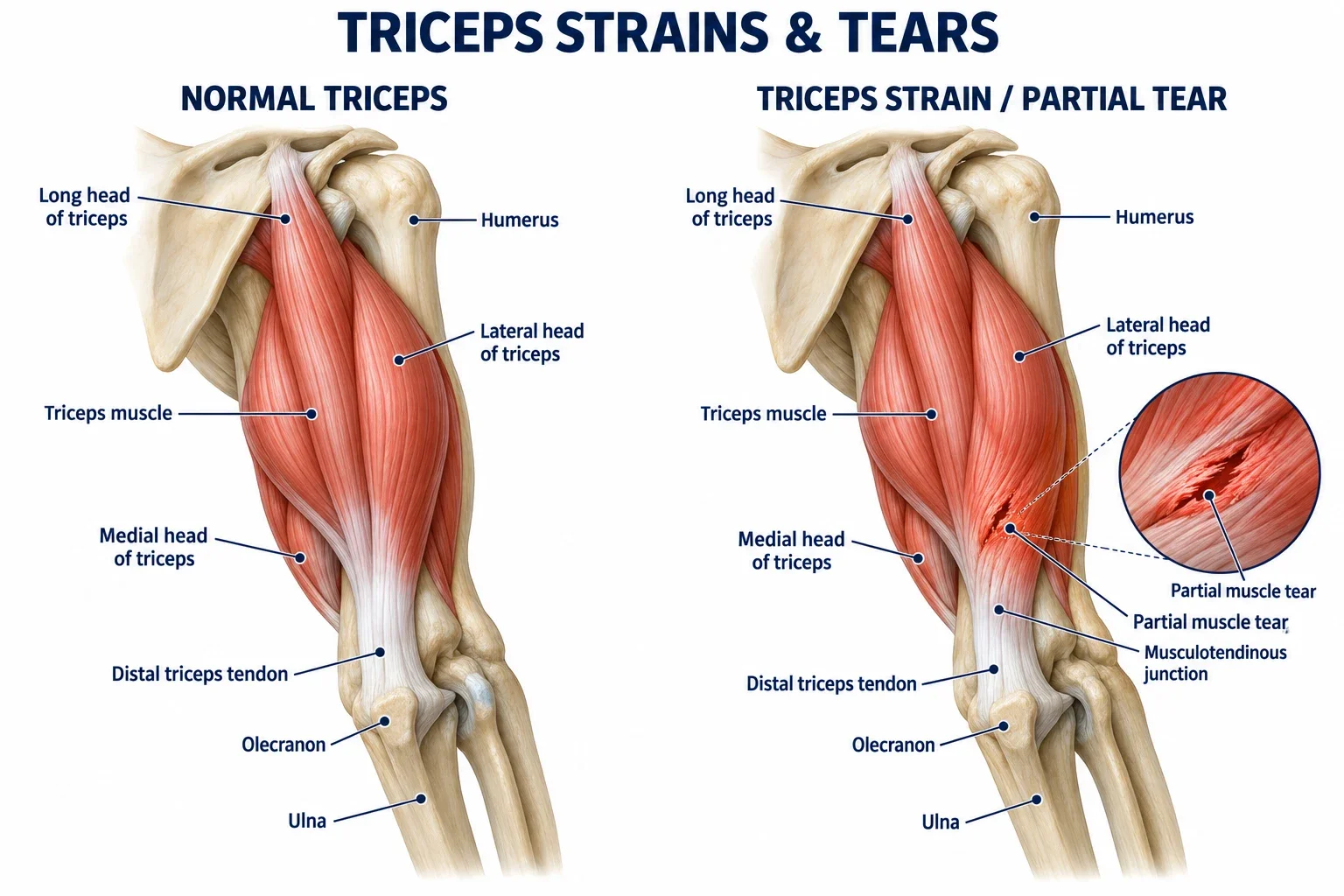
The triceps is the muscle at the back of your upper arm, and the only muscle that straightens the elbow. It has three heads that merge into one tendon at the point of the elbow. Much of its hardest work is done as a brake: controlling a bar or dumbbell on the way down, catching your bodyweight on your hands, or slowing the arm at the end of a throw or serve. Most tricep strains happen during exactly that braking action, when the muscle is lengthening under load.
Where the strain sits depends on how it happened. The long head starts at the shoulder blade and crosses the shoulder, so throwers, swimmers and tennis and padel players tend to strain it higher up, towards the back of the shoulder, often when the arm is overhead. The lateral and medial heads start on the arm bone, and strains there, usually from pressing, dips and push-ups, are felt lower down, in the middle or lower half of the back of the arm. Strains typically occur where the muscle fibres blend into tendon tissue within the muscle.
Strains range from mild, where a small number of fibres are overloaded and the arm still works with some discomfort, through moderate, with more fibres torn and clear pain and weakness pushing, to severe, where a larger part of the muscle is torn.

Is It a Strain or Just Sore?
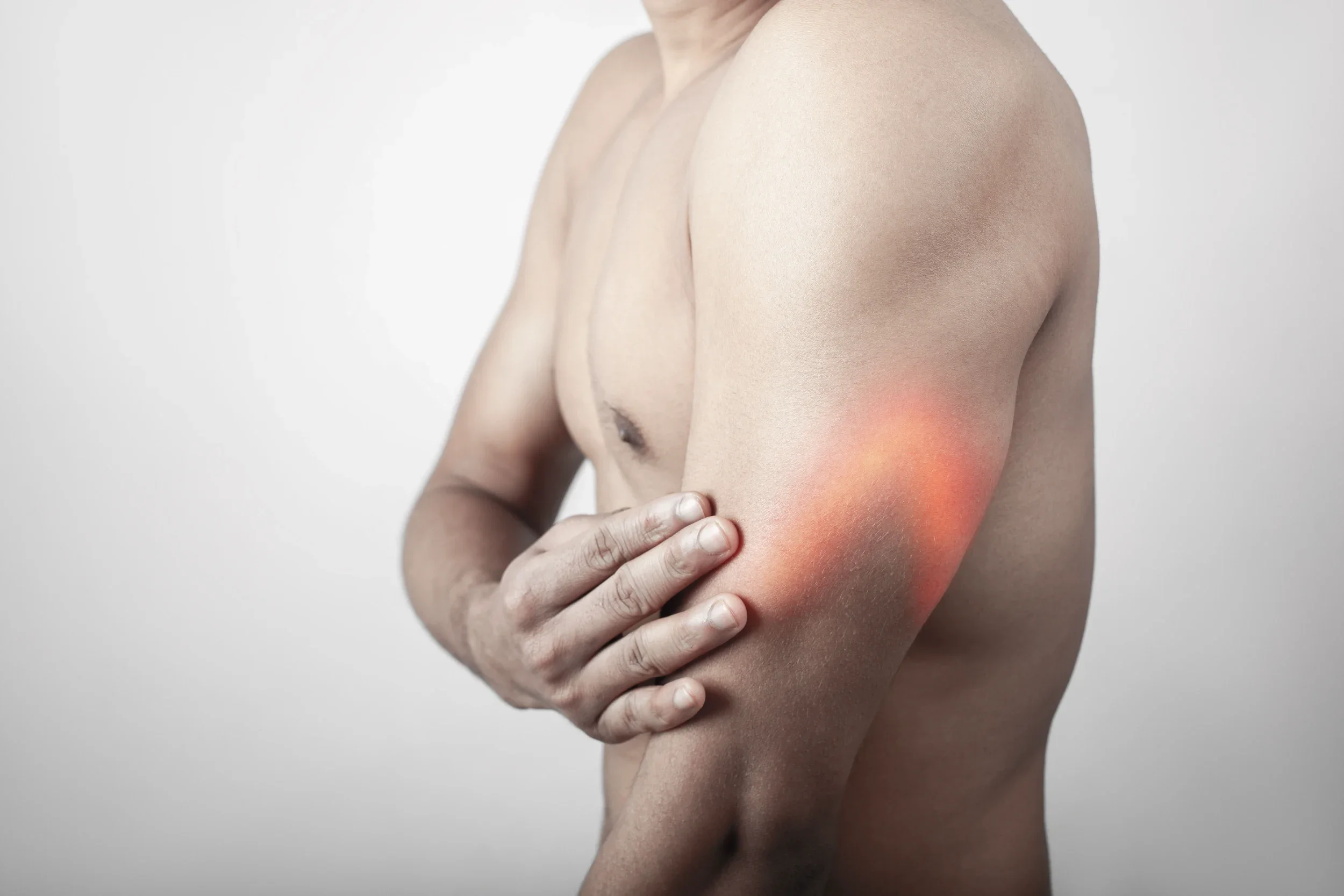
After a hard session of dips, push-ups or pressing, sore triceps are normal. Delayed onset muscle soreness usually affects both arms, builds over the day or two after training rather than during it, feels diffuse rather than pinpoint, and eases as you warm up and move. A tricep strain is different: it starts at a specific moment, usually in one arm, sits in one tender spot, and hurts when you straighten the elbow against resistance or press your hand into a wall.
One exception matters. Extreme soreness and swelling in both arms after an unusually intense session, such as a dips or press-up challenge or a first class after months off, particularly with dark, cola-coloured urine, can be a sign of rhabdomyolysis, a breakdown of muscle that can affect the kidneys. That needs same-day assessment at A&E, not physiotherapy.
How Tricep Strains Happen
In the gym, most tricep strains happen in the lowering phase of dips, bench press, close-grip bench and overhead pressing, or in isolation exercises such as skull crushers and overhead extensions. The common threads are fatigue, a sudden increase in weight or volume, returning to heavy work after a break, and moving too quickly on the way down. Racquet players and throwers strain the triceps as the elbow snaps straight at the end of the serve or throw, and climbers and gymnasts load it heavily in mantles, support holds and dips. In rugby and other contact sports, fending off a tackler or landing on an outstretched arm can strain the muscle as it braces. Understanding how your strain happened tells us what needs to change so it does not happen again.
When It May Be More Than a Muscle Strain
Occasionally, the injury is at the tendon where the triceps attaches to the point of the elbow, rather than in the muscle. The clues are pain right at the back of the elbow rather than in the arm, a pop at the time of injury, swelling or bruising around the elbow, a soft dip just above the bony point, and marked weakness straightening the arm overhead. These injuries are uncommon, but they can be missed because the arm often still straightens partly. If that sounds like you, please call us the same day so we can examine it and, if needed, arrange imaging quickly.
If your pain followed a fall onto the hand or elbow, an X-ray should come before any rehabilitation to rule out a fracture. And arm pain accompanied by chest tightness, breathlessness or sweating needs 999, while a whole arm that is swollen, heavy and bluish needs same-day medical assessment for a clot.
Where Is the Pain? Problems That Mimic a Tricep Strain
Not all pain at the back of the arm is a strained muscle. Where you feel it, and how it started, points us in the right direction.
High up, at the back of the shoulder
In overhead athletes, pain at the back of the shoulder that spreads into the upper triceps can be a long head strain, but it can also come from the rotator cuff, the back of the shoulder joint, or a nerve compressed behind the shoulder. Our shoulder pages cover these in more detail.
At the point of the elbow
Pain just above the point of the elbow that has built up over weeks of pressing and dips is usually triceps tendinopathy, an overloaded tendon rather than a strained muscle, and it needs a tendon loading approach. A soft swelling sitting on the point of the elbow is olecranon bursitis. Sharp pain at the back of the elbow each time it snaps straight, common in boxers, martial artists and fast bowlers, suggests impingement at the back of the joint.
Down the back of the arm, with no clear injury
An ache or weakness in the triceps that arrived without a moment of injury, especially with tingling in the middle finger or symptoms that change as you move your neck, often comes from the C7 nerve root in the neck. We always check the neck when the story does not fit a strain.
On the inside of the elbow, with tingling
Tingling in the ring and little fingers comes from the ulnar nerve. Occasionally the inner edge of the triceps flicks over that nerve as the elbow bends and irritates it, which can feel like a triceps problem but needs a different plan.
How We Treat a Tricep Strain
Your first appointment lasts an hour. We take a detailed history, examine the arm, elbow, shoulder and neck, compare your pressing and elbow straightening strength with the other side, and grade the strain. You leave with a clear diagnosis, a realistic timeline and rehabilitation already started.
In the first few days, the aim is to settle the injury while keeping the elbow and shoulder moving comfortably. Avoid stretching the triceps, heat and deep massage over the sore spot during this period, as they can aggravate healing fibres. Loading starts early and gently, with isometric pushes into a wall or table at a comfortable effort, because muscle heals better when it is asked to work. Where the arm is too sore to load normally, blood flow restriction training allows useful strength gains from very light weights.
As the pain settles, we rebuild strength through progressively more range and load: elbow extension exercises with bands and cables, then dumbbells, with slow and controlled lowering, because the lowering phase is where most strains happen. For long head strains, we gradually introduce overhead positions. Pressing returns in stages that limit how deeply the elbow bends under load, starting with floor presses and board presses before full-range bench press, then close-grip work, and finally dips and deep push-ups, which load the triceps at its most vulnerable position. We work on the shoulder blade, rotator cuff and upper back alongside, because the triceps presses from that platform.
The final phase is built around what you do: heavier and faster pressing and plyometric push-ups for lifters, graded serving and throwing for overhead athletes, mantles and support work for climbers, fending and falling practice for rugby players, and punching volume for boxers and martial artists.
Why Tricep Strains Come Back
The most common reason is returning to heavy dips or full-range bench pressing because the arm feels fine, before strength has genuinely returned. Pain often settles well ahead of strength, and dips in particular put a recovering triceps under more load than most people realise. Other causes are ramping up training volume too quickly after the injury, skipping the slow lowering work that rebuilds the muscle’s braking capacity, and not addressing why the strain happened in the first place, whether that is fatigue, programming or technique. Afterwards, keeping some controlled triceps work in your routine and building volume gradually after breaks go a long way to preventing a repeat.

How We Know You’re Ready
We measure elbow straightening strength on both sides with VALD handheld dynamometry, with the arm by your side and overhead, because a deficit in the overhead position is common after triceps strains and easily missed. For athletes, we also test upper body power before clearing explosive pressing, throwing or contact. Return to heavy lifting and sport requires at least 90% of the strength of your uninjured side, alongside confident, pain-free performance of the movements you actually need, rather than a set number of weeks.
Frequently Asked Questions
Here are answers to some of the common questions we receive regarding triceps strain and pulls physiotherapy at Physio Remedies.
-
A pulled tricep usually starts with a sudden grab or sharp pain in the back of the upper arm during pressing, dips, throwing or serving. Afterwards there is a tender spot in the muscle, pain when you straighten the elbow against resistance, and sometimes mild swelling or bruising. If the pain is right at the point of the elbow rather than in the arm, please get it checked promptly.
-
Muscle soreness after training usually affects both arms, builds over a day or two, and eases as you move. A strain starts at a specific moment, usually in one arm, and sits in one tender spot that hurts when you push or straighten the elbow against resistance.
-
A mild pulled tricep often settles within one to three weeks, and a moderate strain within roughly three to six weeks. A more severe strain, or one involving the tendon tissue within the muscle, can take six to ten weeks or more. Your grading and strength testing give a far more reliable timeline than these ranges.
-
Start gentle loading within days rather than resting the arm completely, avoid stretching, heat and deep massage early on, keep the elbow moving, and rebuild pressing gradually through a limited range before returning to full-range bench press and dips. Going back to heavy pressing too soon is the main cause of setbacks.
-
Not in the first few days. Stretching and deep massage over a fresh strain can aggravate the healing fibres. Gentle movement is helpful, and we will tell you when specific range work and soft tissue treatment are appropriate.
-
Not in the early stages. Dips and deep push-ups load the triceps with the elbow fully bent, which is its most vulnerable position. We usually bring them back late in rehabilitation, once shorter-range pressing is comfortable and strong.
-
Yes, with changes. Lower body training, most pulling exercises and cardio can usually continue, and we will show you which pressing variations are safe at each stage so you can keep training rather than stopping entirely.
-
If it came on gradually and sits just above the point of the elbow, it is most likely triceps tendinopathy rather than a muscle strain, and it needs a different loading approach. If it started suddenly with a pop or swelling at the elbow, it should be assessed promptly.
-
Usually not. Most tricep strains can be diagnosed and graded on examination. We recommend imaging if the injury seems to involve the tendon at the elbow, if you have had a fall onto the arm, or if recovery is not going as expected, and we can arrange it quickly.
-
Not for a fresh muscle strain. Where persistent pain at the back of the elbow turns out to be triceps tendinopathy, focused shockwave can be a useful addition to a progressive loading programme.
-
An hour-long initial assessment costs £190 and covers your examination, objective strength testing and the start of your treatment. We accept Bupa, AXA and Cigna International; please check your cover before your appointment.
Tricep Strain Physiotherapy in Mayfair, London
Meet Paul Martin · Meet Charlie Brahmbhatt · Meet Philip Harris
Whether it is a pulled tricep from the gym, a strain from serving or throwing, or pain in the back of the arm you cannot quite explain, we would be pleased to assess you at Physio Remedies in the Lansdowne Club, Mayfair, a short walk from Green Park and Berkeley Square, and get you pressing, throwing and training confidently again.
If you prefer to reach us directly: