
Muscle Conditions
Hamstring Tear Treatment in Mayfair, London
You were sprinting for a through ball, lunging for a drop shot, or pushing hard at the end of a run, and something at the back of your thigh gave. Some people describe it as being shot or kicked from behind. You pulled up, the leg would not do what you asked of it, and over the next day or two walking became awkward and bruising began to appear.
That is a hamstring tear, also called a hamstring strain or a pulled hamstring. It is one of the most common injuries in sport, and one of the most likely to come back if it is rehabilitated badly. Most tears recover well with the right physiotherapy. A small number, where the tendon has pulled away from the bone, need a surgical opinion quickly, and recognising those early makes a real difference to the outcome.
Pulled, Strained, Torn or Ruptured: What Do They Mean?
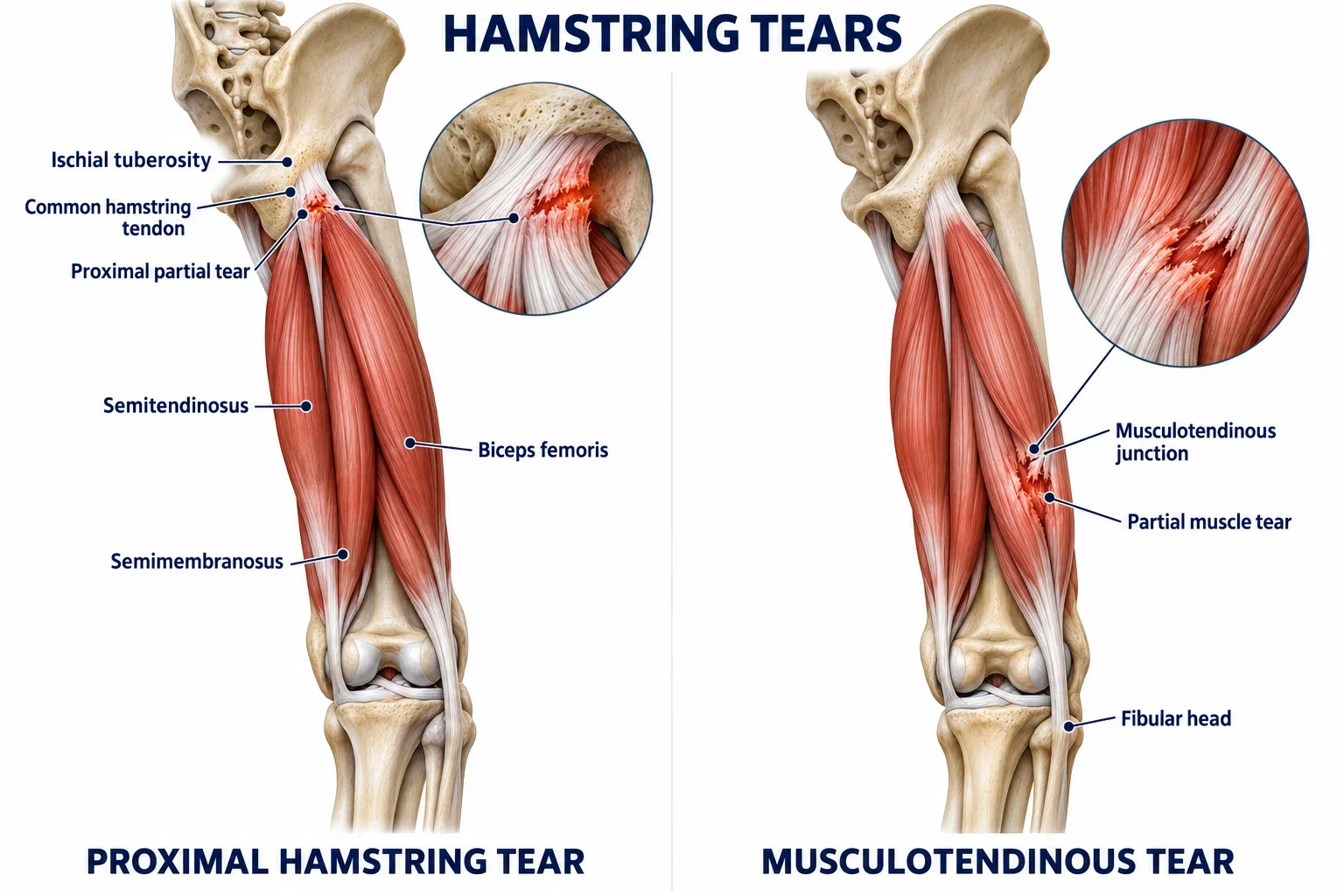
These words describe the same injury at different points on a scale. A pulled or strained hamstring usually means a smaller amount of damage to the muscle fibres. A tear implies more, and a rupture means the muscle or its tendon has been completely disrupted. In practice, where the injury sits matters as much as how big it is.
Most hamstring tears happen where muscle fibres blend into tendon, typically in the outer hamstring (biceps femoris) during high-speed running, when the muscle is working hardest to slow the swinging leg. Some injuries extend into the tendon itself. A small number occur right at the top, where the tendon attaches to the sit bone, and in the most severe of those the tendon pulls away from the bone completely.
Hamstring tears and ruptures are graded according to the British Athletics Muscle Injury Classification, the system now used across UK elite sport. It rates severity from 0 to 4 and, crucially, records whether the damage involves the tendon. Injuries that extend into the tendon take significantly longer to recover and are more likely to recur, which is why two people told they have a grade 2 tear can have very different timelines. Knowing which one you have is the basis of an honest recovery plan.
Is It Actually a Tear?
A true hamstring tear has a moment. You can usually name the stride, the kick or the lunge in which it happened. The pain is typically in the back of the thigh rather than right at the sit bone, and bruising often follows within a few days.
If your pain crept up over weeks, sits deep in the lower buttock where you sit, and is worst after a long day at a desk or a drive, you almost certainly have not torn anything. That pattern points to a tendon problem at the sit bone, proximal hamstring tendinopathy, which needs a completely different approach. Pain in the back of the thigh with tingling, or with no clear injury at all, may also be coming from your lower back or the sciatic nerve. Our assessment tells these apart before any treatment begins.

When a Hamstring Rupture Needs Urgent Attention
A complete tear of the hamstring tendon from the sit bone, known as a proximal hamstring avulsion, often happens in ways people do not associate with serious injury: slipping on a wet floor with the leg shooting forward, a water-skiing fall, an accidental splits, or a sudden lunge while the knee is straight. It is not only an athlete’s injury, and it is common in active people in their forties, fifties and beyond.
The warning signs are a sudden pop or tearing sensation high up near the buttock, extensive bruising that spreads down the back of the thigh, sometimes as far as the knee, difficulty walking normally, weakness bending the knee, and occasionally tingling down the leg. If this sounds like you, please call us the same day.
Timing matters. Where surgical repair is the right choice, it is generally more straightforward and more successful when carried out within the first few weeks. We have direct relationships with orthopaedic surgeons who specialise in these injuries and can arrange MRI and consultant review within days. Not every avulsion needs an operation, and for some people carefully managed rehabilitation gives a good result, but that should be an informed decision made quickly, not a default reached because weeks have passed.
Do I Need a Scan?
For most minor hamstring strains, no. A careful examination of where it hurts, how strong the hamstring is, and how far it will move tells us most of what we need to know. We recommend an MRI when we suspect a significant tear, tendon involvement or an avulsion, when you are an athlete who needs a precise return date, or when recovery is not following the expected course.
It is worth knowing that most healed hamstring injuries still show changes on MRI at the point players are fit to return. We do not wait for a clear scan before progressing you. We wait for measurable strength and demonstrated speed.
Why Hamstring Tears Come Back
Recurrence is the real problem with hamstring injuries, and it is usually predictable. The commonest reason is returning when the leg feels fine rather than when it is strong. Pain settles long before strength and length return, and the first flat-out sprint on a weakened hamstring is exactly the situation that tore it originally.
Close behind is rehabilitation that never goes near top speed. Jogging, gym work and stretching do not prepare a hamstring for maximal sprinting; only gradually reintroduced sprinting does. We also see tears aggravated by aggressive early stretching and deep massage over the injury, and repeat injuries that happen because nobody addressed why the first one occurred: a sudden jump in sprint volume, fatigue late in matches, weakness at long muscle lengths, or poor control of the pelvis and trunk.

How We Treat a Hamstring Tear
Your first appointment lasts an hour. We establish exactly how the injury happened, examine the hamstring, hip, pelvis and lower back, measure your strength against the other side, and grade the injury. You leave with a diagnosis, an expected timeline, and a rehabilitation plan already started.
In the first days, the aim is to protect the healing tissue without shutting the leg down. We will get you walking normally as soon as it is comfortable, advise on ice and pain relief for comfort, and steer you away from stretching or deep massage over the tear while it is fresh. Gentle loading starts early, often with isometric holds, because muscle heals stronger when it is asked to work.
As healing progresses, strength work becomes heavier and moves towards the positions where hamstrings tear: long muscle lengths, eccentric control, and loading at both the hip and the knee. Nordic hamstring curls come in once the tissue is ready, as they are among the best-supported exercises for reducing the risk of future hamstring injury. We build gluteal strength and trunk control alongside, because the hamstring cannot be treated in isolation from the pelvis it attaches to.
Running is reintroduced in stages, from easy jogging to accelerations and then to genuine top speed, because sprinting is what you need to be ready for. The final phase is built around your sport: repeated sprints and kicking for footballers, contact and change of direction for rugby players, reaching lunges for squash, tennis and padel players, and hill and speed work for runners.
Measuring Readiness, Not Counting Weeks
Throughout your rehabilitation we use VALD handheld dynamometry to measure hamstring strength at the knee and hip on both sides, at more than one muscle length, so we know precisely where any deficit remains. For athletes, VALD ForceDecks lets us look at force and power in single-leg and jumping tests before we clear high-speed work.
Our threshold for return to sport is at least 90% of the strength of your uninjured side, alongside confident, repeated sprinting at close to full speed and a clean response the following day. We do not clear anyone on the basis of weeks elapsed, because the calendar is not what tears hamstrings.
Rehabilitation After Hamstring Surgery
If you have had a proximal hamstring repair, we work to your surgeon’s protocol and communicate with them throughout. Protocols vary, and many surgeons now allow earlier weight-bearing than was once the norm, but the principles are consistent: protect the repair early, restore normal walking, then rebuild strength progressively and test it objectively before any return to running or sport. Return to sport after an avulsion repair typically takes around six months, sometimes longer, and the quality of the rehabilitation in that time largely determines how complete the recovery is.
What About Shockwave Therapy?
We do not use shockwave on fresh hamstring tears or avulsions, as it has no role in treating acute injuries. Occasionally, months after an injury, persistent pain develops at the tendon attachment on the sit bone. That is a different problem with its own treatment approach, and in those cases focused shockwave can be a useful part of the plan.
Frequently Asked Questions
Here are answers to some of the common questions we receive regarding hamstring tear physiotherapy at Physio Remedies.
-
The terms overlap, but the signs of a more significant tear are a clear moment of injury, bruising appearing over the following days, difficulty walking normally, and marked weakness when you try to bend your knee against resistance. A mild strain usually lets you walk fairly comfortably within a day or two. If you are unsure, an assessment will grade it properly.
-
Usually, yes, and gentle walking within comfort helps recovery. If you cannot walk without a significant limp, have extensive bruising, or felt a pop high up near the buttock, get it assessed promptly, as these can indicate a more serious tear.
-
Ice is fine for comfort in the early days. Avoid stretching and deep massage over the injured area while it is fresh, as both can aggravate healing tissue. Flexibility returns through progressive strengthening, and we will tell you when specific range work is appropriate.
-
As a rough guide, minor strains take one to three weeks, moderate muscle tears three to eight weeks, and injuries involving the tendon often eight to twelve weeks or more. A surgically repaired avulsion typically takes around six months before return to sport. These are broad ranges; your grading and strength testing give a far more reliable timeline.
-
Not for most strains. We recommend one when a significant tear, tendon involvement or avulsion is suspected, when a precise return date matters for your sport, or when progress stalls, and we can arrange it quickly.
-
Very rarely. Muscle tears, even large ones, are treated with rehabilitation. Surgery is considered mainly when the tendon has pulled away from the bone, and even then the decision depends on the extent of the injury, your age and your goals. If surgery is a possibility, we will get you a specialist opinion within days.
-
When you have reached at least 90% of the strength of your other side on objective testing, can sprint repeatedly at close to full speed without apprehension, and the leg responds well the next day. Not before, whatever the calendar says.
-
Finish the rehabilitation properly, including top-speed running, then keep a small amount of hamstring strength work, such as Nordic curls, in your routine for good. Build sprint volume gradually at the start of a season, and pay attention to fatigue late in matches and training blocks.
-
Your initial assessment is £190 for one hour, including a full examination, strength testing and the start of your treatment. We accept Bupa, AXA and Cigna International; please check your cover before your appointment.
Hamstring Tear Physiotherapy in Mayfair, Near Green Park
Meet Paul Martin · Meet Philip Harris · Meet Sarah Lawson
If you have torn your hamstring, or you are not sure whether you have, we would be pleased to assess you at Physio Remedies in the Lansdowne Club, Mayfair, a short walk from Green Park and Berkeley Square. If you suspect a rupture, please call rather than book online, so we can see you and arrange any imaging as quickly as possible.
If you prefer to reach us directly: