

Muscle Conditions
Biceps Strain & Tear Treatment in Mayfair, London
You caught a heavy box as it slipped, lowered the last rep of a heavy curl, held a lock-off on a climbing wall, or grabbed a suitcase tumbling from an overhead locker, and something in the front of your arm gave. For some people it is a sharp pull in the muscle. For others there is a distinct pop at the elbow or the shoulder, followed by bruising and a biceps that suddenly looks the wrong shape.
That is a biceps injury, and it can mean very different things. A bicep strain, sometimes called a pulled bicep, is a tear of the muscle fibres, and it recovers well with the right physiotherapy. A torn bicep tendon is a different injury altogether: at the shoulder it is often managed without surgery, but at the elbow it is time-critical, and getting a surgical opinion within days rather than weeks can decide how much strength you get back. Arm pain can also come from the neck, the shoulder, the circulation and occasionally the heart, which is why an accurate diagnosis comes first.

Bicep Strain, Pulled Bicep or Torn Bicep: What Do They Mean?
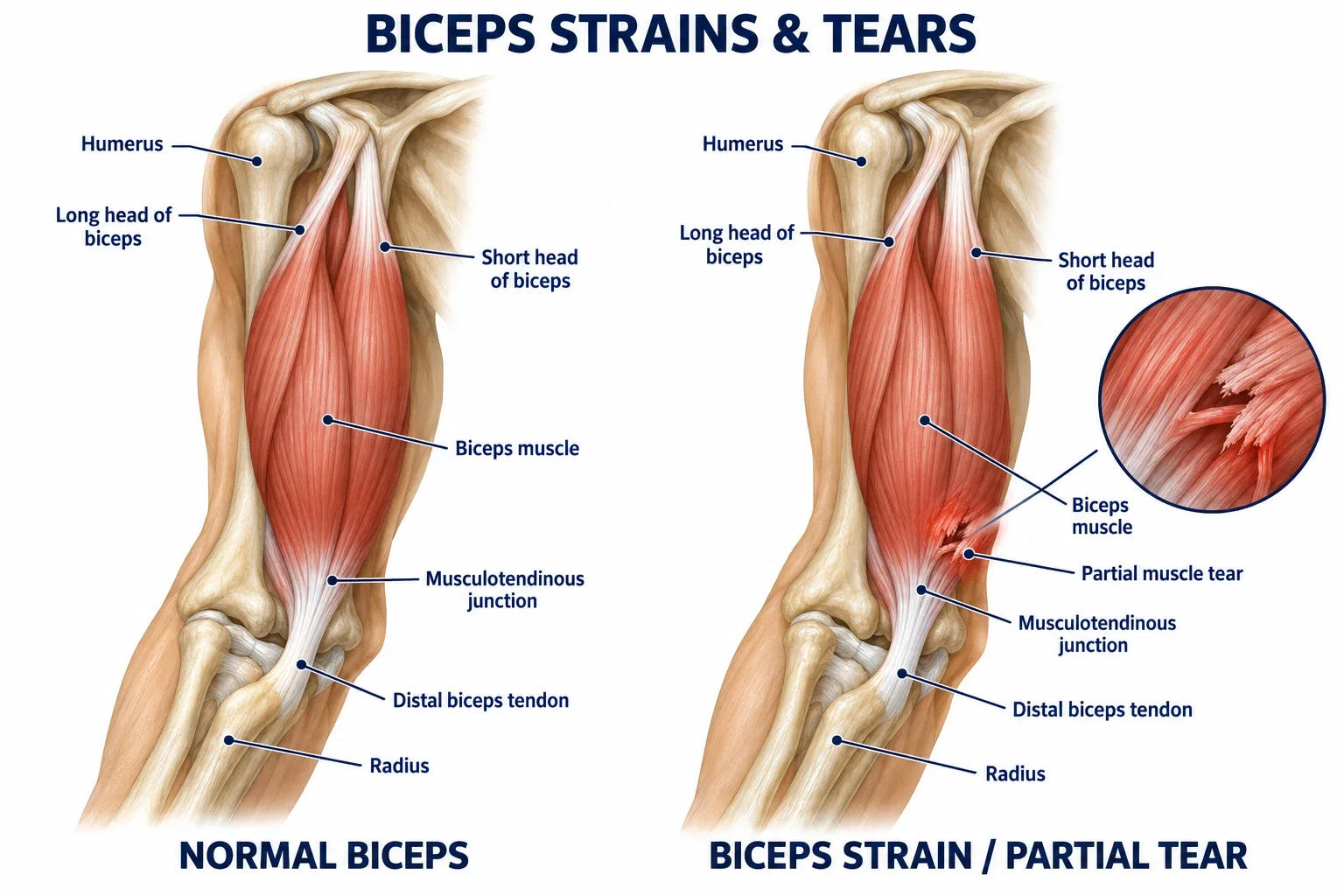
Your biceps has two heads at the top, both attaching to the shoulder blade, and a single tendon at the bottom that attaches to the forearm just below the elbow. It bends the elbow, but its most powerful job is turning the palm upwards, the movement you use to turn a key or a screwdriver. Injuries fall into three broad groups.
A bicep strain is a tear within the muscle itself. These are less common than strains in the legs and usually follow a sudden heavy load while the muscle is lengthening: lowering a weight, catching something heavy, or a climbing or gymnastics move. Pain and tenderness sit in the belly of the muscle, and most recover within weeks.
A tear of the long head tendon at the shoulder usually happens in people over forty, often after years of shoulder wear, and sometimes with surprisingly little pain. The muscle drops towards the elbow, creating the familiar bulge known as a Popeye sign. Because the short head still attaches, strength is largely preserved, and most people do well without an operation.
A distal biceps tendon rupture, where the tendon tears away from the forearm at the elbow, is the one to take seriously. It typically happens in men in their thirties to fifties, lifting something heavy with the elbow bent, and is more common in people who lift weights. There is usually a pop at the elbow, bruising in the elbow crease, and weakness turning the palm up. The muscle bunches higher up the arm.

When a Torn Bicep Needs Urgent Attention
If you think you have torn the tendon at your elbow, please call us the same day. A distal biceps rupture does not heal back onto the bone by itself, and without repair people typically lose around a third of their strength turning the palm up and a fifth to a quarter of their elbow bending strength. Repair is most straightforward in the first two weeks or so, because the tendon retracts and scars as time passes and a delayed repair may need a tendon graft. We can confirm the diagnosis with specific clinical tests in minutes and arrange imaging and a surgical opinion within days.
Arm pain that comes with chest tightness, breathlessness, sweating or nausea, or arm pain brought on by exertion that settles with rest, can be a sign of a heart problem: call 999. Severe, swollen and very painful arms after an unusually intense session, such as a pull-up challenge or a first class after a long break, together with dark, cola-coloured urine, can indicate rhabdomyolysis, a breakdown of muscle that can damage the kidneys: go to A&E the same day.
When Thigh Pain Needs Urgent Attention
A quadriceps tendon rupture, where the tendon tears away from the top of the kneecap, can feel like a severe quad strain. It typically happens in people over forty during a stumble, a missed step or landing awkwardly, and it leaves you unable to straighten the knee or lift the straight leg off the bed, often with a gap just above the kneecap. It needs urgent assessment, because repair works best within days. A similar injury can occur to the patellar tendon below the kneecap. Call us the same day and we will arrange imaging and a surgical opinion quickly.
In teenagers, kicking or sprinting can pull a fragment of growing bone away from the pelvis where rectus femoris attaches, and a limp with pain in the thigh or knee can be a sign of a slipped growth plate at the hip. Both need an X-ray, and the second needs it urgently. A young person with thigh or knee pain and a limp should never simply be treated for a strain.
A swollen, warm and tender thigh or leg without a clear injury may be a deep vein thrombosis and needs same-day medical assessment; call 999 if you become short of breath or develop chest pain. And very rarely, after a heavy blow, pressure builds within the thigh: severe, escalating pain with a tense, hard thigh is a reason to go to A&E.
Other Problems That Masquerade as a Bicep Injury
More often, front-of-arm pain that does not behave like a strain is coming from somewhere else.
Pain referred from the neck
Irritation of the C5 and C6 nerve roots in the neck refers pain, aching and weakness into the biceps, sometimes with little neck pain at all. Clues include tingling or numbness towards the thumb, pain that is worse with certain neck positions, and weakness without any moment of injury. We check your neck and nerve function as a routine part of every arm assessment.
Problems at the elbow
Gradual pain in the elbow crease that builds with lifting, pulling or turning the forearm is more often distal biceps tendinopathy or a partial tear than a strain. Partial tears in particular tend to creep up rather than arrive with a pop, and are easily mistaken for a muscle problem.
Problems at the shoulder
Pain at the front of the shoulder that travels down into the biceps is often coming from the long head tendon where it runs through a groove at the top of the arm, from a SLAP tear of the labrum where the tendon attaches, or from the rotator cuff. These need shoulder-focused treatment rather than muscle strain rehabilitation, and our shoulder pages cover them in detail.
Do I Need a Scan?
For most bicep strains, no. A careful examination, including specific tests for the tendon at the elbow and shoulder, usually tells us what is injured and how badly. We recommend imaging whenever a distal tendon rupture or a significant partial tear is suspected, when the diagnosis is unclear, or when recovery is not following the expected course. MRI is the most reliable test for tendon injuries at the elbow, ultrasound is useful and quick, and a vein scan is essential if a clot is possible. We can arrange all of these rapidly.

How We Treat a Bicep Strain
Your first appointment lasts an hour. We establish exactly how the injury happened, rule out the problems above, examine your arm, elbow, shoulder and neck, measure your strength against the other side, and confirm whether you have a muscle strain or a tendon injury. You leave with a diagnosis, an expected timeline, and either rehabilitation already started or an urgent surgical referral in progress.
For a muscle strain, the early aim is to protect the healing fibres without letting the arm stiffen. We steer you away from stretching, heat and deep massage over the injury while it is fresh, keep the elbow and shoulder moving within comfort, and start gentle loading with isometric holds. Strength work then progresses to curls and supination exercises through increasing range, with controlled lowering, which is where most bicep strains happen. Where full load is not yet tolerated, blood flow restriction training lets us build strength with much lighter weights.
We work on the shoulder, shoulder blade and grip alongside, because the biceps depends on both ends of the arm. The final phase rebuilds what you actually do: heavy pulling and deadlifts in the gym, lock-offs and dynamic moves for climbers, catching and lifting for work, or rowing, judo and jiu-jitsu, where gripping and pulling against resistance are constant.
For a long head tendon tear managed without surgery, rehabilitation restores shoulder and elbow strength, eases the cramping in the muscle that some people notice with heavy use, and returns you to lifting with confidence. Most people regain good function within two to three months.
Rehabilitation After Bicep Tendon Repair
After a distal biceps repair, we work to your surgeon’s protocol and stay in contact with them throughout. Modern repairs are strong enough to allow early protected movement, which helps prevent the elbow stiffness that used to be the main complication. Most people return to desk work within one to two weeks, begin strengthening at around six to eight weeks, and return to heavy lifting and sport at four to six months. The rehabilitation in that period determines how much turning strength and confidence you regain.

Measuring Readiness, Not Counting Weeks
Throughout your rehabilitation, we use VALD handheld dynamometry to measure elbow bending and forearm turning strength on both sides, along with shoulder and grip strength, so we can see precisely where any deficit remains. Turning strength is the one most often overlooked after biceps injuries, and the one that matters most for everyday tasks and for sports that involve gripping and pulling.
Our threshold for return to heavy lifting and sport is at least 90% of the strength of your uninjured side, alongside confident, pain-free performance of the specific movements your sport or work demands. We do not clear anyone on the basis of weeks elapsed.
What About Shockwave Therapy?
We do not use shockwave on a fresh bicep strain or a tendon rupture. Where persistent pain at the elbow crease or the front of the shoulder turns out to be biceps tendinopathy rather than a tear, focused shockwave can be a valuable part of treatment alongside progressive loading.
Frequently Asked Questions
Here are answers to some of the common questions we receive regarding biceps strain and tear physiotherapy at Physio Remedies.
-
A bicep strain usually causes pain and tenderness in the middle of the muscle, with the arm still working, if uncomfortably. A torn tendon more often causes a pop at the elbow or shoulder, bruising, a change in the shape of the muscle, and at the elbow, obvious weakness turning the palm upwards. If you are unsure, please get it assessed promptly, because a tendon tear at the elbow is time-sensitive.
-
When the long head tendon tears at the shoulder, the muscle drops towards the elbow and forms a rounded bulge, often called a Popeye arm. When the tendon tears at the elbow, the muscle bunches up higher on the arm and there is usually bruising in the elbow crease and down the forearm.
-
A bicep strain in the muscle heals well with rehabilitation. A complete tendon tear does not reattach itself. At the shoulder, that often does not matter much, and most people regain good function without surgery. At the elbow, it usually does, which is why an early surgical opinion is important.
-
For a muscle strain, no. For a long head tendon tear at the shoulder, usually not. For a complete tear at the elbow, surgery is generally recommended for active people who want to keep their strength, ideally within the first couple of weeks. The decision depends on your age, your arm dominance and what you need the arm to do.
-
As a rough guide, minor bicep strains take one to three weeks and moderate tears three to six weeks. A long head tendon tear managed without surgery usually allows good function within two to three months. After a repaired distal biceps rupture, return to heavy lifting typically takes four to six months.
-
Keep the arm moving within comfort, avoid stretching, heat and deep massage in the first few days, start gentle loading early, and rebuild strength fully before returning to heavy lifting. Most lost time comes from going back to heavy curls, pull-ups or climbing too soon and injuring the muscle again.
-
Usually, with changes. With a bicep strain, most lower body training and many upper body exercises can continue while the arm recovers. If there is any possibility of a tendon tear at the elbow, stop heavy pulling and lifting until it has been assessed.
-
Not for most strains. We recommend imaging whenever a tendon rupture at the elbow or a significant partial tear is suspected, or when progress stalls, and we can arrange it within days.
-
Swelling of the whole arm, particularly with heaviness, a bluish colour or prominent veins across the chest, can be a sign of a clot in the main arm vein and needs same-day medical assessment. Severe pain and swelling after an unusually hard session with dark urine needs urgent assessment for rhabdomyolysis. Neither is a bicep strain.
-
Your initial assessment is £190 for one hour, including a full examination, strength testing and the start of your treatment or referral. We accept Bupa, AXA and Cigna International; please check your cover before your appointment.
Bicep Strain Physiotherapy in Mayfair, London
Meet Paul Martin · Meet Philip Harris · Meet Charlie Brahmbhatt · Meet Lucy Metcalfe
If you have a bicep strain or a torn bicep, or you are not sure what is causing your arm pain, we would be pleased to assess you at Physio Remedies in the Lansdowne Club, Mayfair, a short walk from Green Park and Berkeley Square. If you felt a pop at the elbow, please call rather than book online so we can see you quickly.
If you prefer to reach us directly: