
Knee Conditions
Patellar Tendinopathy (Jumper’s Knee) Treatment in Mayfair, London
Most patients who come to us with pain below the kneecap have been told they have patellar tendonitis and advised to rest, ice it, take anti-inflammatories and stretch the quadriceps. Many have been resting for months. Most are worse for it than when they started.
Patellar tendinopathy, which is what jumper’s knee actually is, is a capacity problem in a structurally altered tendon, not an inflammatory one. There is no significant inflammation to settle. Rest does not repair the tendon. It lowers its capacity further, so returning to sport hurts more than it did before you stopped. Stretching the quadriceps pulls on the tendon at precisely the point that is most sensitive, and rarely helps.
What the patellar tendon needs is progressive load, applied in the right order and finished properly. The reason most patellar tendinopathy treatment fails is not that the exercises were wrong. It is that the programme stopped at the strengthening stage and never trained the tendon to store and release energy at speed, which is exactly what jumping, landing, decelerating and changing direction demand of it. A tendon that is strong in the gym and untrained for that is a tendon that hurts again in the first week back. We take the tendon to the end of that process, not to the point at which it stops hurting during a squat.
Is It Actually Your Patellar Tendon?
Pain at the front of the knee is one of the most frequently misdiagnosed presentations in the lower limb, and patellar tendinopathy is both over-diagnosed in people who do not have it and missed in people who do. Getting this right at the outset determines everything, because the loading programme that resolves a patellar tendon will irritate a fat pad, and the treatment that settles patellofemoral pain will do very little for a tendon.

What Patellar Tendinopathy Actually Looks Like
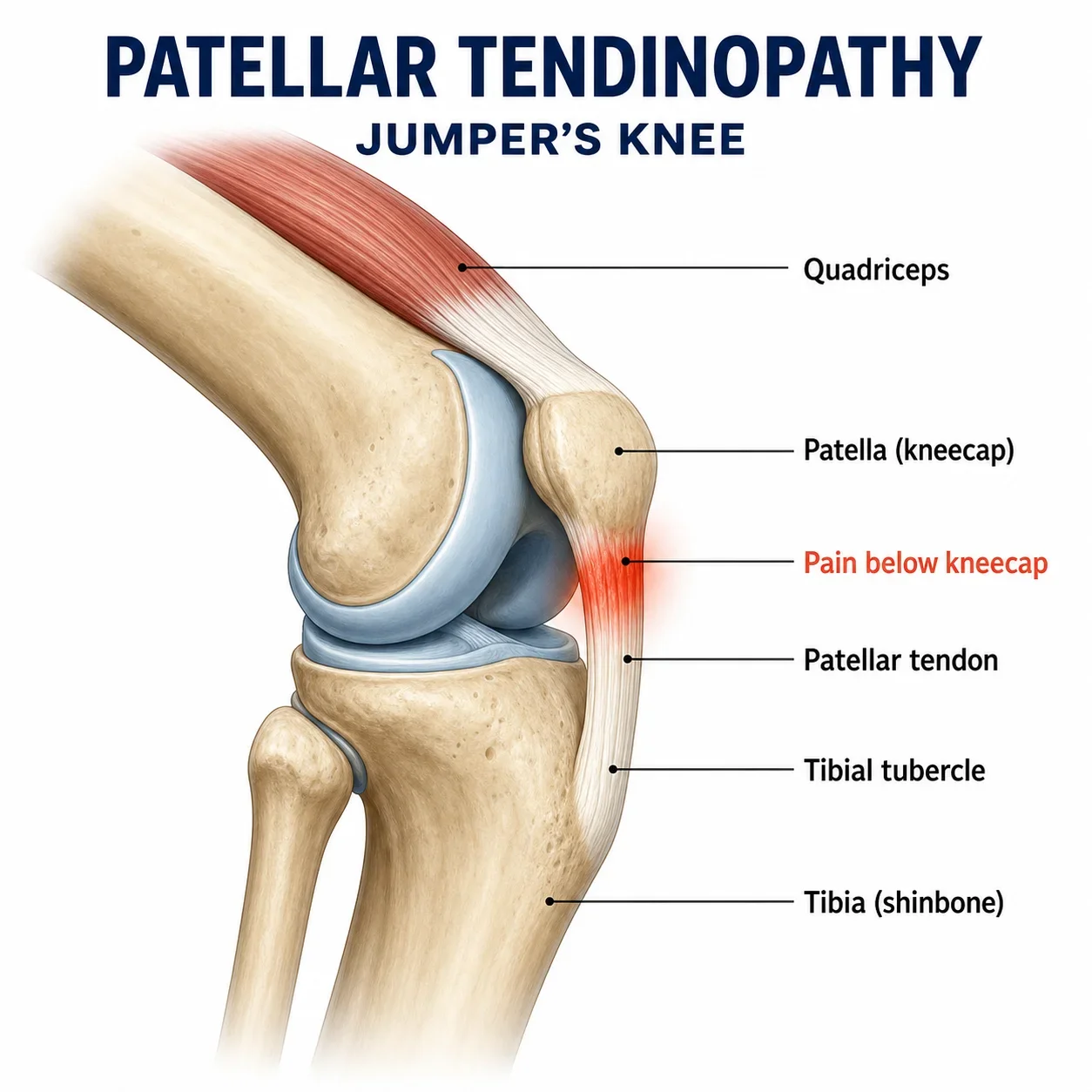
True patellar tendinopathy has a recognisable signature. The pain is precisely localised, almost always to the lower pole of the kneecap where the tendon attaches, and most people can point to it with a fingertip rather than a flat hand. It is dose dependent: it appears with jumping, landing, deceleration, changing direction and deep squatting, and it tracks closely with how much of that you have done. It commonly warms up during a session and is at its worst the following morning. It does not usually trouble you while you are sitting still, and the knee does not swell.
One clinical check is particularly useful. Tenderness over the tendon reduces markedly, and often disappears completely, when the knee is bent to ninety degrees and the tendon is placed under tension, compared with the same point examined with the leg straight. That pattern points at the tendon rather than the structures around it, and it is one of the more reliable discriminators available without a scan.
What Else Causes Pain at the Front of the Knee
Patellofemoral pain is more diffuse, felt around or behind the kneecap rather than at one point, and it is provoked by prolonged sitting, stairs and hills rather than by explosive loading. Fat pad irritation produces pain either side of the tendon that is worse when the knee is pushed into full extension, which is why standing for long periods and locking the knee out are the usual complaints. Quadriceps tendinopathy sits above the kneecap rather than below it and behaves similarly to patellar tendinopathy but loads differently. In adolescents, pain at the lower pole of the kneecap or over the bony bump below it is more likely to be growth related traction at the growth plate, which needs a different conversation about load and time rather than a tendon programme.
Imaging deserves a word of caution here. Abnormal looking patellar tendons are extremely common on ultrasound and MRI in jumping athletes who have no pain at all, so a scan report describing tendon thickening or degenerative change does not by itself explain your symptoms. We interpret imaging against what the examination shows rather than the other way round.
Why Your Patellar Tendon Has Not Got Better
Rest was the treatment
This is the single most common reason people arrive still symptomatic after months. Tendons lose capacity quickly when they are unloaded, and the quadriceps loses it faster still. A short period of reduced loading is legitimate when a tendon is acutely reactive and flared, but weeks or months of relative rest simply lower the ceiling. You return to your sport with a tendon less capable than the one that became painful in the first place, which is why so many people find the pain comes back within days of restarting and conclude that they need to rest for longer. That cycle can run for years.
Only the knee was treated
The patellar tendon is loaded by what happens above and below it. Restricted ankle dorsiflexion is one of the most consistently identified factors in patellar tendinopathy, because an ankle that cannot bend far enough forces the knee to absorb a greater share of every landing. Calf strength does the same job: a weak calf transfers load upwards. Hip and gluteal control determines whether you land in a position the knee can tolerate. Landing mechanics matter more than almost anything else, and stiff, upright landings load the tendon substantially more than the alternative. Treating the tendon while leaving all of that unchanged means treating the symptom and leaving the cause.
The programme never reached the energy storage phase
Strengthening a tendon and preparing it for sport are different projects. Heavy slow resistance work builds the capacity of the tendon and the quadriceps, and it is essential, but it trains the tendon at low speed. Jumping, landing and cutting require the tendon to act as a spring, absorbing force rapidly and returning it, and that is a distinct quality that has to be trained specifically before you go back. Most rehabilitation programmes finish at the point where heavy squats and leg press are comfortable. That is roughly two-thirds of the way through the job, and the last third is where sport actually happens.
Nothing was measured
Without objective testing there is no way to know whether a tendon is ready. We use VALD hand held dynamometry to measure knee extensor strength against the uninjured side throughout the programme, and VALD ForceDecks to assess jump and landing performance, which for this condition matters more than strength testing alone. ForceDecks shows us how force is distributed between legs during a countermovement jump and a drop landing, and how quickly it is produced. Athletes routinely pass a strength test while still offloading the injured side during landing, and that asymmetry is invisible to the eye and to the athlete. It is also precisely what causes the problem to return.
Focused Shockwave Therapy for Patellar Tendinopathy
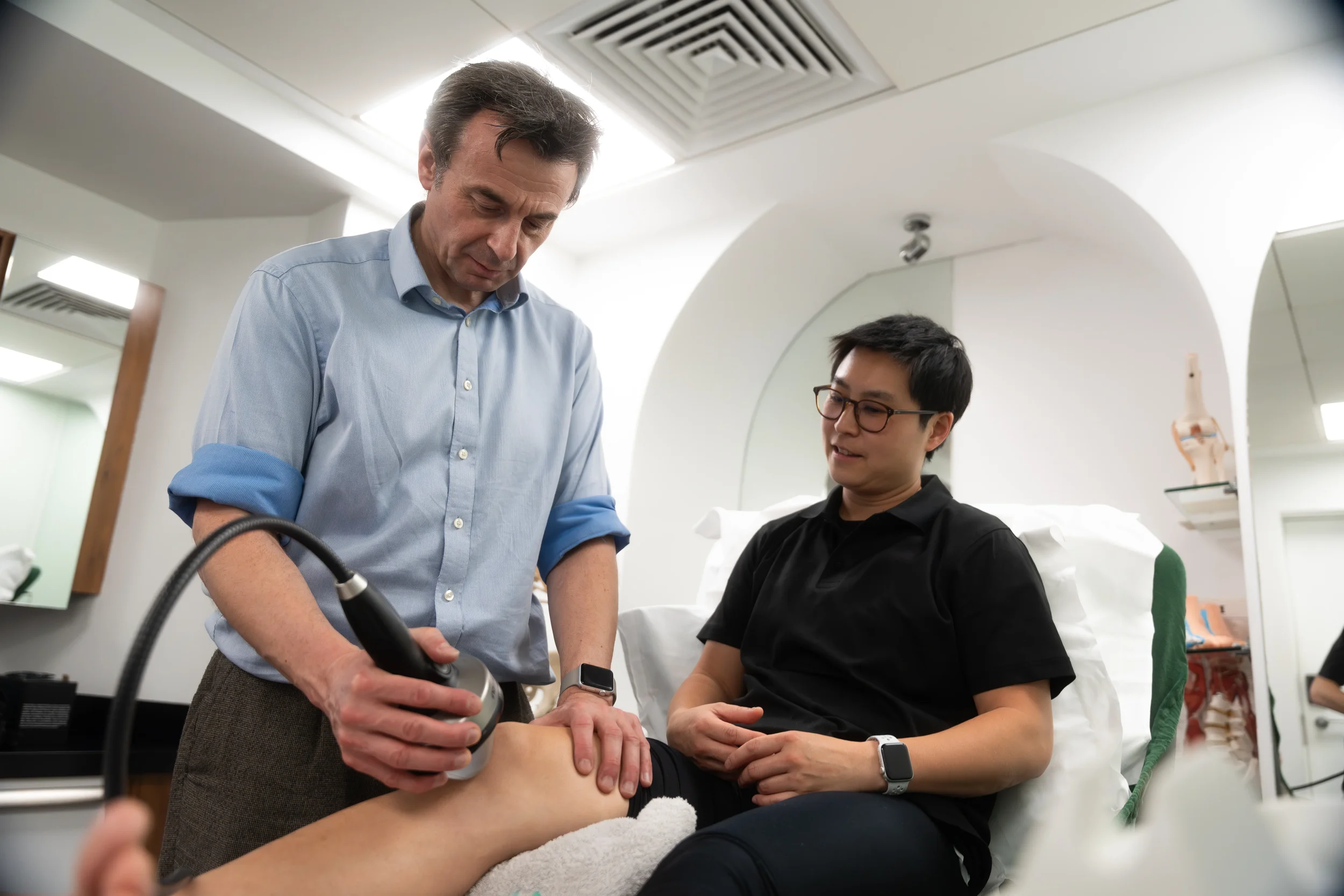
Our Mayfair clinic uses the Piezowave2 focused shockwave system, one of a small number of focused devices in central London. The distinction between focused and radial shockwave is relevant here for a specific anatomical reason.
The degenerative change in patellar tendinopathy characteristically sits in the deep posterior fibres of the tendon, immediately behind the lower pole of the kneecap, rather than in the superficial tissue you can feel from the front. Radial shockwave, which is what most clinics use, disperses pressure outwards from the applicator across a broad and relatively shallow area. It does not concentrate energy at that depth. Focused shockwave delivers energy to a defined focal point at a specified depth, which allows the affected part of the tendon to be targeted directly.
We are deliberate about how we use it. The evidence for shockwave in patellar tendinopathy is less emphatic than for some other tendons, and it is not a substitute for loading. We use it for chronic cases that have plateaued despite a well executed loading programme, as an adjunct that runs alongside the programme rather than in place of it. If a tendon has not been properly loaded yet, shockwave is not the missing ingredient.
Our Approach to Patellar Tendinopathy
Assessment: Why the Tendon Became Symptomatic
The first question is not how bad the tendon is. It is what changed. Training load errors are behind the majority of these presentations: a jump in volume, a change of surface, a return to pre-season, a new sport, a period off followed by an abrupt restart. We establish that history in detail, then examine the tendon itself, ankle dorsiflexion range, calf and quadriceps strength, hip control, and how you actually land and decelerate. We measure knee extensor strength bilaterally with VALD dynamometry and, where appropriate, take baseline jump and landing data on ForceDecks. That gives us numbers to work back from rather than an impression to work towards.
We also establish where the tendon sits on the reactive to degenerative spectrum, because an acutely irritable tendon that has flared in the last fortnight needs a different starting point from one that has been grumbling for two years. Applying a chronic loading programme to an acutely reactive tendon is a reliable way to make someone worse, and it is a common error.
The Loading Programme
Heavy isometric holds come first where pain is limiting. Sustained contractions against a fixed resistance reduce tendon pain for a period afterwards, which does two things: it makes the rest of the programme tolerable, and for athletes who are mid-season it creates a window in which they can continue to train and compete. This is one of the more useful tools available in tendon rehabilitation and one of the least used.
From there the programme moves to heavy slow resistance work through the quadriceps and the full lower limb, performed at controlled tempo two to three times a week, progressed on the basis of how the tendon responds over the following twenty four hours rather than how it felt during the session. Where the tendon is too reactive early on to tolerate meaningful load, Blood Flow Restriction training allows us to build quadriceps strength at low absolute loads without provoking the tendon.
The third phase is the one most programmes never reach. Once strength has been rebuilt, we introduce energy storage loading: jumping, hopping, landing, deceleration and change of direction, progressed systematically in volume and intensity, with landing mechanics coached rather than assumed. This is deliberately the phase that most closely resembles your sport, and it is where the tendon learns to do the job that made it painful in the first place. The strength work continues alongside it rather than stopping when it begins.
Return to Sport
We clear athletes on the basis of measurement rather than time elapsed. Knee extensor strength should be at least ninety per cent of the uninjured side on dynamometry, jump and landing asymmetry on ForceDecks should be within ten per cent, and the tendon should be settled in the twenty four hours after a full loading session rather than reactive. We then reintroduce training volume before intensity, and competition after both. Between us the team has worked at Olympic and Commonwealth Games and in professional rugby, and the thing elite sport teaches you about tendons is that the temptation to clear someone because they look fine in training is always present and is almost always wrong.
Injections, and When Physiotherapy Is Not Enough
Corticosteroid injection into the patellar tendon deserves specific comment, because it is still offered and we would generally advise against it. It reliably reduces pain for a matter of weeks, but the trial evidence comparing it against progressive loading found notably worse outcomes at six and twelve months in the injected group. Removing the pain from a tendon while leaving its capacity unchanged encourages a return to full loading that the tissue is not prepared for. There are narrow circumstances in which it has a role, and we will discuss them honestly if they apply to you, but it is not a shortcut.
For tendons that genuinely do not respond to well delivered loading and shockwave, we have direct access to sports medicine physicians and orthopaedic surgeons with a specific interest in tendon problems. High volume injection and platelet rich plasma are available through our referral network, and surgical debridement exists for the small number of cases that exhaust everything else. We can arrange imaging and specialist appointments within days rather than weeks. We accept Bupa, AXA and Cigna International.

Frequently Asked Questions
-
Tendinitis describes an inflammatory condition. In chronic pain below the kneecap, which is what most people have by the time they seek treatment, the tendon shows structural and degenerative change rather than significant inflammation. This is not a semantic distinction. It explains why rest, ice and anti-inflammatory medication produce short lived relief at best, and why loading is the treatment.
-
Not in the way it is usually meant. Backing off the specific activity that is flaring the tendon for a short period is reasonable when it is acutely reactive. Stopping training altogether for weeks or months reduces the capacity of the tendon and the quadriceps, so you come back to sport less prepared than when you left it. The aim is to change what you load and how much, not to stop loading.
-
Usually yes, and often you should. Most patellar tendons can be rehabilitated while the athlete continues to play, provided the aggravating volume is managed rather than the sport abandoned. Heavy isometric holds before training or competition give a useful window of reduced pain. We will tell you honestly if your presentation is one of the minority that requires a genuine break.
-
Generally no. Stretching the quadriceps increases tension through the patellar tendon at the point that is already sensitive, and it does not address the underlying capacity problem. If restricted ankle dorsiflexion is limiting your squat depth or your landing mechanics, that is worth addressing specifically, and it is a different thing from routine quadriceps stretching.
-
They are one useful exercise, not a protocol in themselves. The decline position increases load through the patellar tendon, which is why it is used, but the eccentric decline squat programme that circulated widely for years is not superior to heavy slow resistance work and is poorly tolerated by some athletes in season. What matters is that load is progressive, sufficient and correctly staged, not which single exercise is used.
-
Recent onset cases with symptoms under three months typically improve meaningfully within six to eight weeks of appropriate loading. Long standing cases take longer, and three to six months of structured rehabilitation is a realistic expectation. If there has been no meaningful change after twelve weeks of well executed treatment, we reassess the diagnosis and the programme rather than continuing.
-
Not usually to begin treatment. Patellar tendinopathy is a clinical diagnosis and the examination is more informative than the scan, particularly because abnormal patellar tendons are so common in asymptomatic jumping athletes. We arrange ultrasound or MRI when the presentation is atypical, when we need to exclude something else, or when a decision about injection or surgery is being made.
-
We would generally advise against it for this tendon. Pain relief is real but short lived, and outcomes at six and twelve months are worse than with progressive loading. If pain is preventing you from starting a loading programme at all, there are better options to discuss first.
-
Some people find a strap reduces pain during activity, and there is no harm in using one for that purpose. It changes how load is distributed across the tendon temporarily. It does not build capacity, so it belongs alongside a loading programme rather than instead of one.
-
Often not. In growing athletes, pain at the lower pole of the kneecap or over the bony bump below the knee is more commonly traction at the growth plate rather than tendinopathy, and it is managed differently, with more emphasis on load management through the growth period. It is worth having assessed properly rather than treated as an adult tendon problem.
Book Your Patellar Tendinopathy Assessment in Mayfair
If pain below your kneecap has not responded to rest, stretching or previous physiotherapy, your first appointment lasts one hour. We will confirm whether the tendon is genuinely the problem, measure quadriceps strength and landing performance objectively, identify why it has not resolved, and give you a programme with specific targets and a defined endpoint. The assessment costs £190.
If you are searching for patellar tendinopathy treatment, jumper’s knee physio or knee tendon pain treatment in London, we are based at the Lansdowne Club in Fitzmaurice Place, Mayfair, a few minutes’ walk from Green Park station and Berkeley Square.
If you prefer to reach us directly: