

Knee Conditions
Meniscal Tear Treatment in Mayfair, London
A meniscal tear on a scan report is a finding, not automatically the explanation for your pain. Image the knees of people in their fifties who have never had a day of trouble and a substantial proportion will show tears, sitting there silently. The one on your report may well have been there long before your symptoms started.
You may be wondering whether you need an operation, and if not, whether you can get back to being active and pain free.
For most people, probably yes. In the case of a meniscal tear coming on gradually without a significant injury event, large randomised trials comparing keyhole surgery against proper strengthening have found no meaningful advantage to the operation at one year or at two. Trying rehabilitation first does not appear to cost you anything if you later go ahead anyway. Since trimming a meniscus removes tissue you do not get back, and raises the long term risk of arthritis in that part of the knee, it is worth finding out what your knee can do before anyone operates on it.
A minority do need surgery, and they matter just as much: a knee that is genuinely locked, a tear at the root where the meniscus anchors into bone, a repairable tear in a young athlete. Spotting those quickly is as much our job as keeping everybody else out of theatre, and we will tell you plainly which group you are in.
You Might Recognise Yourself Here
You twisted your knee playing football, or caught an edge skiing. It swelled overnight, it hurts along the joint line, and squatting or turning on it makes you wince. An MRI has confirmed a meniscal tear and an arthroscopy has been mentioned. You want to know, honestly, whether rehabilitation can get you back onto the pitch or the mountain, and what you lose by trying that first.
Or you have already had the arthroscopy. Recovery was quick and, for a while, better. But the ache has returned, the knee still swells after tennis, your thigh is visibly smaller than the other one, and nobody has been able to tell you why.
Or nothing happened at all. You are in your fifties, your knee has grumbled for months, it aches on stairs and getting out of the car, it puffs up after a long walk, and the scan has come back describing a degenerative tear and some early wear. You have been told to take ibuprofen and avoid impact. That has taken the edge off it without changing anything, and you would like to know what happens next.
What Your Meniscus Does, and Why It Is Worth Keeping
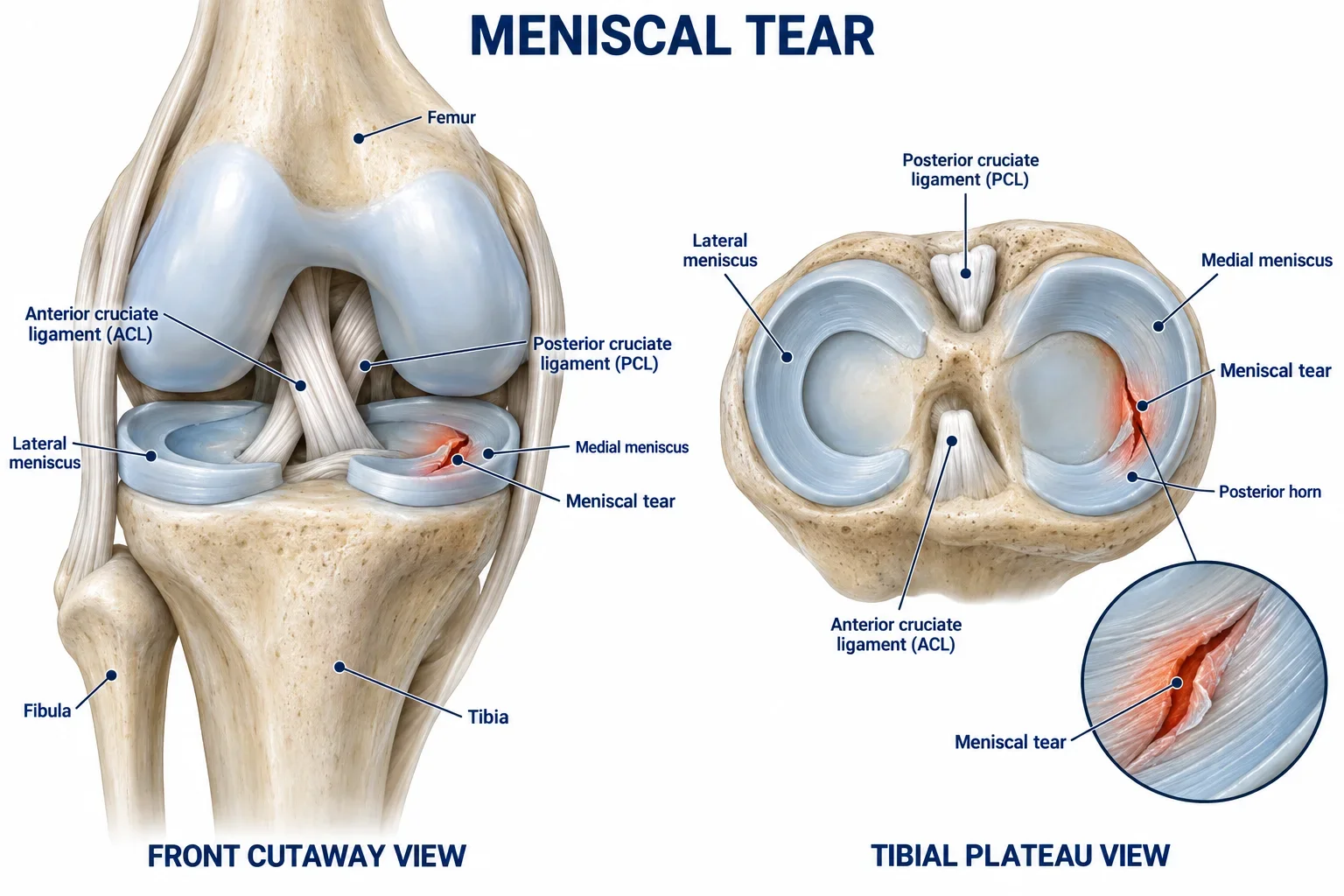
The menisci are two crescent-shaped, tough fibrocartilage shock absorbers that sit between your thigh bone and your shin bone, one on the inner side of the knee and one on the outer. Each acts as a wedge that deepens what is otherwise a fairly flat surface, so that the rounded end of the femur has something to sit into rather than simply resting on a plateau.
Their more important job is pressure distribution, and the mechanism is worth understanding because it explains almost everything that follows. When you land on the leg, the meniscus is squeezed outwards, and the fibres running around its circumference resist that spreading in the way a metal hoop resists being pushed off a barrel. That circumferential tension is what turns a small point of contact into a broad one, and it is why an intact meniscus reduces the pressure on the joint articular cartilage underneath it so substantially. It also explains why the position of a tear matters far more than its existence. A tear that interrupts those hoop fibres, or detaches them from their anchor, disables the mechanism. A tear that runs along the grain leaves it largely working.
Blood supply decides much of the rest. Only the outer rim of the meniscus receives a meaningful blood supply. It thins as you move inwards, and the innermost portion has essentially none, taking what nutrition it gets from the fluid in the joint. A tear in the outer rim therefore has the biological means to heal, or to be stitched and expected to heal. A tear further in does not. That sounds worse than it is, because a tear does not need to heal for a knee to become comfortable, strong and dependable, and the second of those is the outcome most people actually want.
The medial meniscus, on the inside of the knee, is more firmly tethered to the joint capsule and less able to move out of harm’s way, which is why it tears considerably more often. The lateral meniscus is more mobile and tears less, but it carries a greater share of load on its side of the joint, so losing lateral meniscal tissue has a higher long term cost. That difference influences how cautious we are about surgery on each side.

What a Meniscal Tear Feels Like
Pain from a torn meniscus usually sits precisely along the joint line, on the inside or the outside of the knee rather than at the front, and most people can put a finger on it. That alone is informative. Pain spread across the front of the knee or around the kneecap generally points somewhere else, and a good deal of what arrives labelled as a cartilage problem turns out to be patellofemoral pain instead.
Swelling follows a telling pattern. After a twisting injury the knee tends to swell over the following twelve to twenty four hours rather than instantly. A knee that balloons within minutes is more likely to be bleeding into the joint, which suggests a ligament or a bony injury and warrants faster assessment. With degenerative tears the swelling arrives quietly instead, coming and going with how much you have been on your feet.
Then there are the mechanical symptoms, which are the ones people describe least precisely, and understandably so. Catching is a brief snag or click as the knee passes a particular point, and it is common and not especially alarming. Giving way is a knee that buckles under you, and more often than not that is the quadriceps letting go rather than anything structural. True locking is a different event altogether: the knee stops in a bent position and will not straighten at all, however you coax it. If that has genuinely happened to you, please say so plainly when you contact us, because it changes how quickly we want to see you.
Alongside those, most people notice pain squatting, kneeling, twisting on a planted foot or getting in and out of a car, stiffness after sitting still, and difficulty on stairs, particularly coming down them.
Why Your Knee Has Not Settled
The distinction drawn above between a knee that catches and a knee that truly locks does more work than any other in this condition. A knee that will not fully straighten because a torn fragment has displaced into the joint is mechanically blocked, and no rehabilitation will move it. A knee that will not fully straighten because it is swollen and the hamstrings have tightened protectively around it is doing something quite different, and it responds well to treatment. From inside the knee the two can feel much the same, so it needs establishing early rather than assumed.
The most underestimated part of a meniscal injury is what the swelling does to your thigh. Fluid inside the joint does not simply make the knee sore. It actively switches the quadriceps down through a reflex driven by receptors in the joint capsule, and it does so within hours, long before any wasting could occur through disuse. The muscle then tends to stay switched down well after the pain has settled. This is genuinely counterintuitive, because the instinctive response to a swollen, painful knee is to protect it, and protection is precisely the thing that allows the muscle to keep switching off. Breaking that cycle needs loading the joint can accept, introduced early rather than once the swelling has gone.
It also helps to know that a tear appearing without any injury is a different animal from one that appears after a twist. A horizontal or complex tear in a fifty five year old knee, arriving quietly over months and usually alongside some early cartilage change, is less an accident that befell the meniscus than a sign that the demands on the joint have gradually outgrown what it can currently absorb. That changes what treatment is for. Protecting the knee and then returning to exactly what you were doing before leaves the original arithmetic untouched. Building the capacity of the joint changes it, and capacity is trainable at any age.
The last piece is that quadriceps strength is far easier to lose than to notice losing. Walking is not a demanding activity, so a knee that is a third down on strength can feel entirely acceptable on the flat and only declare itself on stairs, on a slope, coming downhill, or in the second set of tennis. Without a measurement, that deficit sits there quietly, which is the most common reason a knee stays half better for a year and why some people conclude their operation did not work when strength was the missing piece all along.
How a Meniscal Tear Is Diagnosed
A meniscal tear can usually be identified clinically, to a good standard of accuracy, by someone who examines knees regularly. We take a detailed history first, because the mechanism, the timing of the swelling and the exact location of the pain narrow the possibilities considerably before anyone touches the knee. Examination then covers the effusion, whether full extension and full flexion are available, tenderness along the joint line, and the specific meniscal provocation tests, principally McMurray’s, Thessaly’s and Apley’s. None of these is definitive on its own, which is precisely why they are used in combination and read alongside everything else we find. We also test the ligaments, because meniscal tears keep company with ligament injuries far more often than people expect, and we measure quadriceps, hamstring, hip and calf strength rather than judging any of it by eye.
Will I need a scan?
An MRI is the most sensitive way of seeing a meniscus, and that sensitivity is both its value and its limitation. It will faithfully report tears that have sat there for years causing nobody any trouble, which is why a scan is best read alongside an examination rather than in place of one. We arrange imaging when the result would change what we do: when a root tear is suspected, when the pattern suggests a repairable tear worth acting on quickly, when a ligament injury may be involved, or when your progress is not what we expected it to be. An X-ray shows nothing of the meniscus itself, but it does show joint space, alignment and arthritic change, and in an older knee those can matter a good deal more than the tear. If you already have a report, bring it and we will interpret it against what we find.
Our Approach to Meniscal Tear Treatment
Once we know what we are dealing with, we watch you move: a squat, a step down, a single leg sit to stand, a change of direction when you are ready for one. Watching a knee under load reveals what no table based examination can, and it tells us which specific demands your knee is currently failing to meet.
Treatment then follows a clear sequence. The first task is to settle the joint, because an irritable, swollen knee cannot be loaded productively. We use the effusion as the dial. It reports honestly on what the joint tolerated yesterday and it is considerably more reliable than a pain score. Alongside that we start on the quadriceps immediately rather than waiting for the swelling to resolve, because the inhibition is the thing that costs you months.
Where the knee cannot yet accept meaningful load, we use blood flow restriction training. A calibrated cuff applied to the upper thigh allows us to generate strength and muscle size adaptations at loads of around twenty to thirty per cent of maximum, far below the level that would ordinarily irritate an angry knee. For meniscal problems this matters, because the alternative is waiting weeks for the joint to calm down while the quadriceps continues to waste.
As the joint settles, the work becomes progressive strengthening in the ranges and positions your knee has been avoiding. Deep knee flexion under load, rotation on a planted foot and deceleration are the demands most likely to provoke a torn meniscus, which is precisely why they cannot be left out of the programme. Building capacity in the positions that hurt, gradually and at an intensity we control, is what changes a knee. Avoiding them indefinitely simply narrows the territory in which your knee is reliable, and then keeps narrowing it.
Throughout, we measure. We use VALD hand held dynamometry to compare knee extensor and flexor strength against your uninjured side, so that progress is a number rather than an impression and a deficit cannot hide behind a comfortable walk. As you approach return to sport we use VALD ForceDecks to assess hop and landing performance, because a meniscus is loaded most severely on impact and the capacity to absorb landing force is not something a strength test alone will tell us. Our threshold for clearance is ninety per cent symmetry alongside competent, symmetrical landing mechanics. Returning below that is how knees are re-injured and how degenerative change accelerates.
Types of Meniscal Tear We Treat
-
Degenerative Meniscal Tears
Horizontal and complex tears that appear without injury, typically from the mid forties onwards and usually accompanied by early cartilage change. This group is the subject of the most robust evidence in the whole of knee surgery: for degenerative tears without genuine mechanical locking, structured exercise therapy produces outcomes equivalent to arthroscopic partial meniscectomy, without removing tissue whose loss raises your long term risk of osteoarthritis. This is the presentation most often operated on unnecessarily and the one most reliably improved by good rehabilitation.
-
Traumatic Peripheral Tears
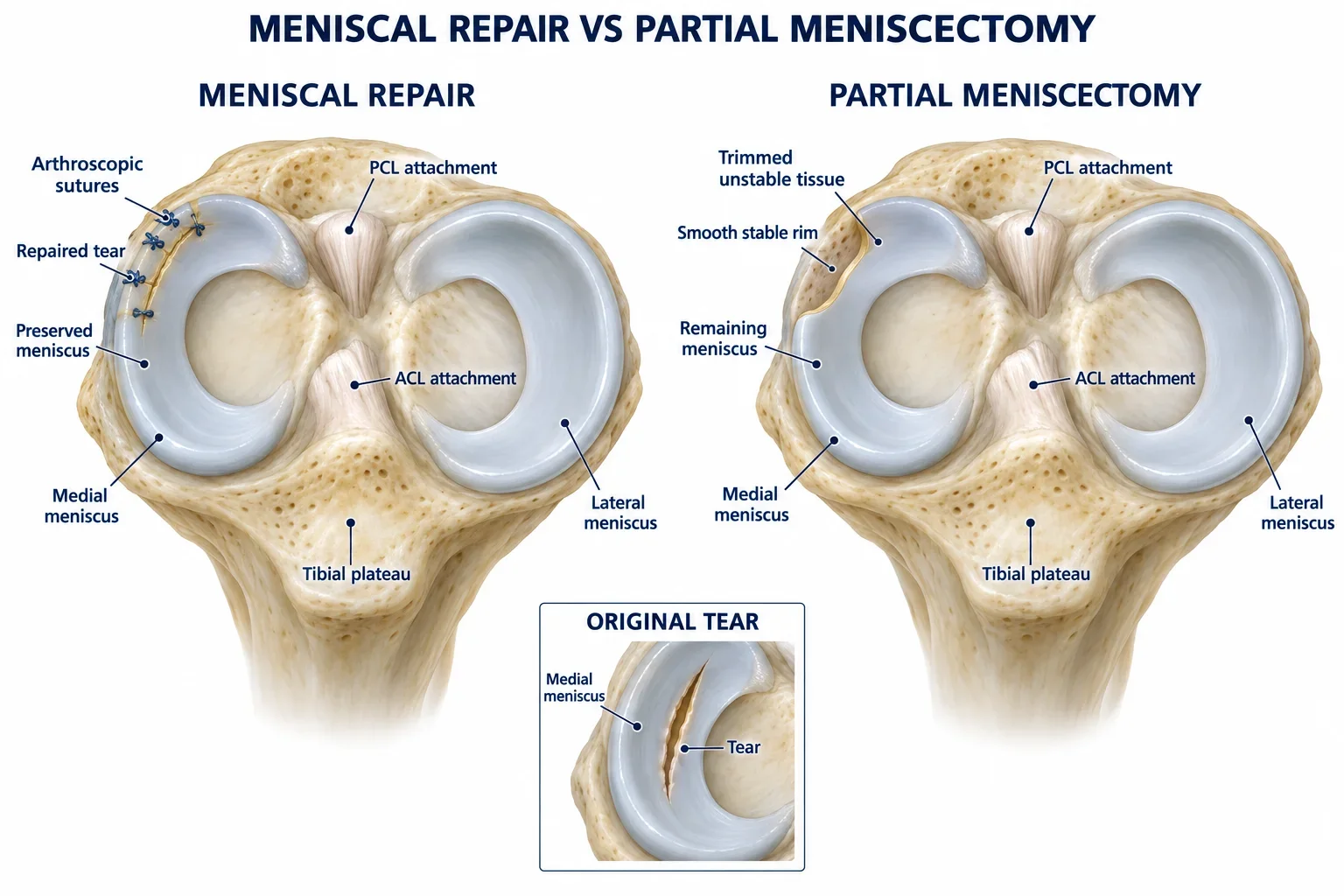
Vertical or longitudinal tears at the outer edge of the meniscus, where the blood supply is good. These have real healing potential, either on their own with appropriate protection and graded loading, or through surgical repair rather than removal. In a young athlete with a repairable peripheral tear, preserving the meniscus matters enormously, and we would far rather see you early enough for that to remain an option.
-
Bucket Handle Tears
A large longitudinal tear whose inner fragment displaces into the joint like the handle of a bucket. This is the classic cause of a truly locked knee that cannot be brought to full extension. It is a surgical problem and usually an urgent one, because a displaced fragment left where it is damages the cartilage it rubs against and becomes progressively harder to repair. If we suspect this at your first appointment, we will say so and move quickly.
-
Radial Tears
A tear running across the meniscus from the inner edge outwards. The meniscus works by converting downward compression into tension around its own circumference, so a radial tear that reaches the outer edge functionally breaks that ring and the meniscus largely stops distributing load. These warrant careful assessment rather than assumption, and the extent of the tear determines whether repair is worthwhile.
-
Meniscal Root Tears
A tear or avulsion at the point where the meniscus anchors into the tibia. This is the one every patient should know about, because it is the tear most often missed and the one where delay is most expensive. Biomechanically it is close to having no meniscus at all: the ring cannot hold tension, the meniscus extrudes sideways out of the joint, and cartilage loss can progress remarkably quickly. Where a root tear is repairable, repair is time sensitive. We look for it specifically and we escalate it immediately.
-
Post-Surgical and Post-Arthroscopy Rehabilitation
Whether you have had a partial meniscectomy, a meniscal repair with its longer protected phase and its restrictions on weight bearing and deep flexion, or a repair alongside an ACL reconstruction, what determines your eventual result is the rehabilitation that follows it. It is common to come through that process with a knee that walks perfectly well and a quadriceps that never quite came back, and without a measurement there is no way to tell the difference. That is usually what people are describing when they say the operation helped but the knee still is not right.
Deciding About Surgery
For degenerative tears without genuine mechanical locking, the trial evidence is unusually consistent and it points towards loading the knee rather than operating on it. The practical consequence is that you can give rehabilitation a proper attempt, on a defined timeline, and reassess. If a knee is going to respond, it generally shows meaningful change within about twelve weeks, and if it does not, the surgical option is still there and no worse for the wait. What we will not do is drift. We set out at the start what we expect to see and by when, so that a decision gets made rather than postponed indefinitely.
For traumatic tears in younger, more active knees the calculation is different. The question there is less whether to operate and more whether the tear can be repaired, because a repair preserves the meniscus whereas a trim removes part of it. Peripheral tears with a good blood supply can often be stitched, and where that option exists it is usually worth taking and usually time sensitive. This is the one situation where we would rather you came to us early than gave it a few months to see.
Some presentations point clearly towards a surgeon and we will say so at the first appointment rather than several months in. A locked knee that will not come to full extension. A suspected root tear. A repairable tear in a young athlete. A meniscal tear alongside significant ligament injury. And a knee that has been through a properly structured, properly loaded programme without meaningful change. We have direct working relationships with knee surgeons we trust and recommend personally, and rapid access to imaging and consultant opinion when the picture calls for it. You will not leave our clinic without a clear next step.
What we will not do is send you for an operation without first establishing whether your symptoms are actually coming from the tear. In a good number of knees they are not, or not entirely, and that is worth knowing before anyone books a theatre slot.

Where injections fit
Injections come up often and they occupy a narrow but real place. A corticosteroid injection settles inflammation in the joint lining, which can be worth doing when a knee is too irritable to load productively and the swelling refuses to give ground. Hyaluronic acid is sometimes used where there is established arthritic change alongside the tear. Neither repairs anything, and neither alters the trajectory of the knee by itself. Their value lies entirely in the window they open, and that window is only worth having if it is spent on the strength work that will hold the improvement in place. We will tell you when we think one is worth considering, and we have established pathways for guided injections when it is.
Frequently Asked Questions
-
Tears at the outer edge, where there is a blood supply, can genuinely heal. Tears further in generally do not. What matters more in practice is that a tear does not need to heal for a knee to become comfortable, strong and reliable, and that is the outcome most people are actually after.
-
If your knee is truly locked, or there is a root tear or a repairable tear in a young athlete, then quite possibly yes. For a degenerative tear without mechanical locking, the trial evidence supports trying a properly structured exercise programme first, because the outcomes are comparable, you keep your meniscus, and the option of surgery remains open. We will give you an honest view of which category you are in.
-
Most people notice meaningful change within six to twelve weeks. Return to pivoting sport usually sits between three and five months, determined by measured strength and landing quality rather than by the calendar. Degenerative presentations improve steadily but need the strength work maintained afterwards.
-
Not necessarily, because what most people call locking is a painful catch rather than a true mechanical block. A genuine block, where the knee will not fully straighten however you try, is a different matter and needs prompt assessment. Telling the two apart is one of the first things we do.
-
No. Meniscal problems can usually be assessed clinically to a high standard, and the examination tells us what a scan cannot, which is how much the tear is actually affecting you. If imaging would change our management we will arrange it promptly.
-
Often it is not, or not entirely. A good deal of the pain and swelling in these knees comes from irritation of the joint lining rather than from the torn tissue itself, which is one reason symptoms can settle substantially while the tear stays exactly where it is. Establishing the source is a large part of what the assessment is for.
-
A meniscal tear raises the risk, and removing meniscal tissue raises it further, which is a strong argument for preserving whatever can be preserved. It is not inevitable. Strong quadriceps, good movement quality and a joint that is loaded well are protective, and building those is much of what rehabilitation is for.
-
Almost always, with modifications. We work out what your knee currently tolerates and build the programme around it rather than stopping you entirely. Cycling, swimming, upper body and hip work usually continue throughout, and we reintroduce loaded knee flexion, running and change of direction in a controlled order.
-
Yes, and in time you should. Permanently avoiding deep flexion leaves you with a knee that is only reliable within a narrow band. We reintroduce those positions progressively, under load we control, until they are unremarkable again.
-
Our initial assessment is one hour at £190. We accept Bupa, AXA and Cigna International. Please confirm your cover with your insurer before your appointment.
Book Your Meniscal Tear Assessment at Physio Remedies, Mayfair
We will match you with the right physiotherapist for your knee and your goals.
If knee pain, swelling, catching or a torn meniscus is keeping you off the pitch, the slopes, the tennis court or simply the stairs, we would be pleased to assess you at Physio Remedies in the Lansdowne Club, Mayfair. We are a short walk from Green Park and Berkeley Square.
If you prefer to reach us directly: