

Knee Conditions
IT Band Syndrome - Runners Knee Treatment in Mayfair, London
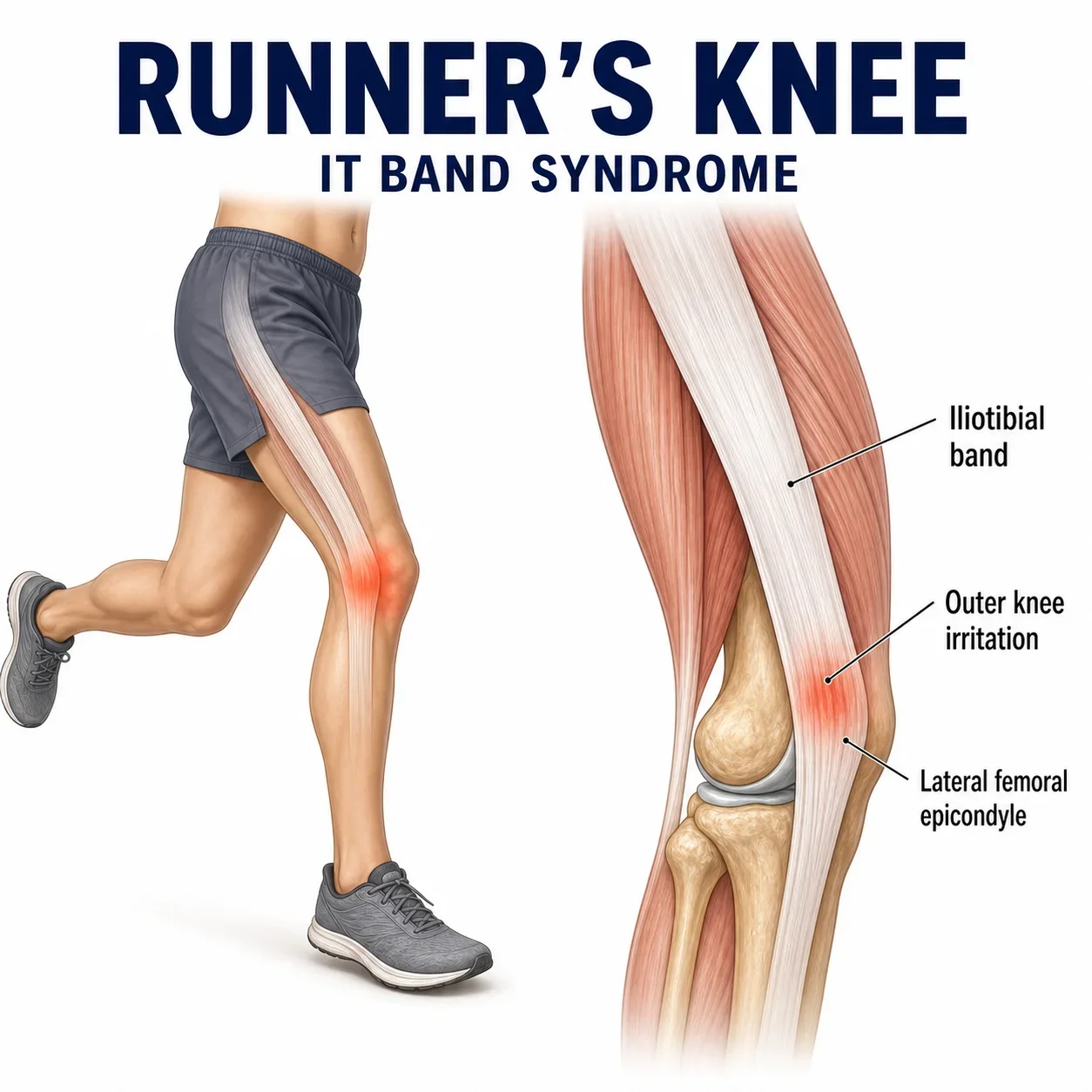
Iliotibial band friction syndrome, more commonly known as IT band syndrome or runner's knee, is the most common cause of lateral knee pain in runners and one of the most frustrating running injuries to have poorly explained to you. You are usually told your IT band is tight, told to stretch it, told to foam roll, told to rest. You do all of those things conscientiously and the problem returns the moment you start building mileage again. That is because iliotibial band tightness is rarely the true cause, and stretching and foam rolling are rarely the solution.
The iliotibial band is a thick band of connective tissue running from the top of your pelvis down the outside of your thigh to just below your knee joint. It does not stretch in any meaningful sense, because it is built not to. Modern anatomical research has changed how we understand this overuse injury. Rather than the band rubbing back and forth across the lateral femoral condyle, which was the traditional explanation, we now know that the ITB is anchored and does not glide. The pain comes from compression: as the knee joint loads during running, and particularly at around 30 degrees of knee flexion when the foot strikes the ground, the band presses down onto a highly sensitive layer of tissue beneath it, packed with nerve endings. That compression is what produces the sharp pain on the outside of your knee. And the reason it is happening is almost always that something further up the chain, most commonly the gluteal muscles (hip and knee stabilisers), are not doing their job properly.
Treat the IT band pain and you treat the symptom. Find out why the band is overloading in the first place, and you resolve the problem.
We see iliotibial band syndrome regularly at our Mayfair clinic, particularly among long distance runners and endurance athletes during the London Marathon training season when mileage is pushing beyond what hip muscle strength can currently support. With the right intervention at the right time, most cases resolve fully and do not come back.
Do You Recognise Your Situation?
-
Pain appears after a set distance, every run.
You can start fine, but somewhere between two and five miles the outside of your knee begins to ache. You push through, it worsens, eventually you stop. The next run, the same sharp pain returns at roughly the same point. This is classic IT band syndrome behaviour and it tells us a great deal about the load threshold your ITB is currently working within.
-
You have tried rest and the running injury keeps coming back.
You took two weeks off, the pain settled, you returned to running and within a fortnight it was back. Rest changes your symptoms without changing the underlying cause. Until the hip muscle weakness or the training load error is addressed, the problem will recur.
-
You have a race in the diary and you do not know whether to keep training.
This is the question we are asked most often by runners and endurance athletes, and it deserves a direct answer rather than a vague response. Whether you can continue running through IT band syndrome depends on pain levels, how quickly symptoms settle after each run, and where you are in your training block. We will give you a clear, specific answer in your first session.
-
You are a cyclist or hiker as well as a runner.
Iliotibial band friction syndrome is not exclusive to running. The same compression mechanism operates during cycling, and long descents on foot load the ITB heavily at the knee joint. If you are cross-training and the lateral knee pain is not settling, the contributing factors need to be identified across all your activities.

Why IT Band Syndrome Treatment Fails and What We Do Differently
The most common reason this running injury keeps recurring is that treatment focuses on the painful structure rather than the system driving it. Stretching an iliotibial band that cannot meaningfully stretch achieves little. Foam rolling reduces discomfort temporarily without addressing the load that produced the problem. Rest removes the pain without removing the cause.
At Physio Remedies, we begin with a thorough assessment of your running mechanics, gluteal muscles and hip muscle strength, foot and ankle control, and training history. We want to understand not just what is hurting, but why the IT band is being asked to work harder than it should. It is also important to rule out other sources of knee pain at this stage, including patellofemoral pain syndrome, which can sometimes present with overlapping symptoms and requires a different approach to physical therapy and rehabilitation.
Objective strength testing
One of the most important things we do, and one that most physiotherapy clinics do not, is measure your hip and lower limb strength objectively using hand-held dynamometry. Rather than estimating whether your gluteal muscles are strong enough, we measure it. We test side to side, identify the specific hip muscle deficit, and use that data to set your rehabilitation programme and track your progress session by session.
This matters because the strength gap driving your IT band syndrome is often greater than it feels. Runners and endurance athletes are good at compensating. You can feel strong and still have a meaningful deficit in hip abductor or external rotator strength that is enough to overload the IT band at higher mileages. The dynamometry tells us exactly where you are, which means we can be precise about when you are genuinely ready to return to full training rather than relying on guesswork.
We build your rehabilitation programme around progressive loading of the gluteal muscles and hip stabilisers, because the evidence consistently shows that restoring strength in the hip muscle groups controlling femoral rotation is the most reliable way to resolve iliotibial band syndrome and prevent recurrence. We will modify your training load rather than stopping it entirely, because long distance runners and endurance athletes who continue to train intelligently through rehabilitation return to full running faster than those who simply rest.
Where your running mechanics are contributing to the problem, we address them. That might be cadence, foot strike, hip drop, or trunk position. We identify what is relevant to you specifically rather than applying a generic correction.
When physiotherapy alone is not enough
In the majority of cases, a structured programme of load management, progressive hip muscle strengthening, and running modification resolves iliotibial band friction syndrome fully. But some cases, particularly those that have become chronic, that have not responded to previous treatment, or that need to be resolved quickly around a race, benefit from additional input.
If you are not progressing as expected, we can arrange rapid access to imaging through our specialist network. A diagnostic ultrasound, which is the most useful investigation for IT band syndrome, can clarify exactly what is happening in the tissue around the lateral femoral condyle and rule out other sources of lateral knee pain such as a meniscal problem or lateral ligament involvement.
Where imaging confirms significant inflammation that is limiting your ability to load and rehabilitate, a corticosteroid injection given under ultrasound guidance can reduce that inflammation and create a window in which the rehabilitation work becomes possible. We work closely with sports medicine physicians and musculoskeletal radiologists in London who perform this procedure, and we can usually arrange a consultation within a few days. The injection is not a standalone solution. It is most effective when followed immediately by a progressive rehabilitation programme, and without that follow-through the pain returns.
Surgery for IT band syndrome is very rarely required and is genuinely a last resort. We have access to orthopaedic colleagues if that conversation ever becomes relevant, but in practice it is not a path most patients need to go down.

Our Experience with Runner's Knee
We work regularly with long distance runners, endurance athletes, cyclists, and marathon runners who develop iliotibial band friction syndrome during training. The pattern is almost always the same: mileage has increased faster than hip muscle strength has adapted to support it. Sometimes there is a secondary factor such as a recent change of trainers, an increase in hill running, or returning after time off, but the hip abductor and gluteal muscle deficit is almost always present and almost always measurable.
Our clinic at the Lansdowne Club in Mayfair has full gym and rehabilitation facilities, which means the progressive loading work required to resolve iliotibial band syndrome properly can be done under supervision and progressed at the right pace. That matters particularly for runners and endurance athletes who need to maintain conditioning while rehabilitating, because complete rest is rarely necessary or helpful for this overuse injury.
Frequently Asked Questions
-
Sometimes yes, with specific modifications. As a general guide: if your lateral knee pain during running stays below three out of ten and settles within a few hours afterwards, you can usually continue with reduced volume and modified intensity. If pain exceeds five out of ten, worsens progressively during a run, or is significantly worse the following day, you need to modify more substantially. We will give you a specific framework in your first session based on your symptoms, your training load, and your race timeline.
-
Not in the way most runners approach it. The IT band is not a muscle and iliotibial band tightness cannot be resolved by stretching. Hip flexor and TFL stretching has some value, but it does not address the gluteal muscle weakness driving most cases of iliotibial band friction syndrome. Strengthening is consistently more effective than stretching for long-term resolution of this overuse injury.
-
Foam rolling can reduce discomfort in the short term and is reasonable as part of a warm-up or recovery routine. It will not resolve IT band syndrome because it does not address the cause. If foam rolling is the primary treatment you have been given, that is why the running injury keeps coming back.
-
For straightforward cases where a runner has caught it early, significant improvement typically occurs within four to six weeks of appropriate rehabilitation. For chronic or recurrent cases among long distance runners and endurance athletes, full resolution and return to unrestricted running usually takes eight to twelve weeks. The most important factor is not time but whether the hip muscle deficit is actually being addressed.
-
Not usually. Iliotibial band syndrome can be accurately diagnosed through clinical assessment. If your lateral knee pain has features suggesting an alternative diagnosis, such as a meniscal problem, a bony stress injury, or patellofemoral pain syndrome, we will tell you and arrange imaging promptly through our specialist network.
-
Because the IT band operates within a load threshold. Below a certain level of cumulative load, the compression at the lateral femoral condyle is tolerable. Once that threshold is crossed, pain begins. The predictable distance at which your symptoms appear tells us exactly where that threshold currently sits, and the goal of rehabilitation is to raise it by strengthening the hip muscles that reduce compressive load on the band and improving your running economy so that each stride demands less from the ITB.
-
Usually because previous treatment focused on symptom relief rather than the underlying hip muscle deficit, or because the loading programme was not sufficiently progressive or specific. Objective strength testing changes this: we measure the deficit precisely, target it throughout your rehabilitation, and track it at every session. We also do not clear you to return to running based on how the knee feels. We clear you when the strength data supports it.
Book Your Runner's Knee Assessment
If lateral knee pain is interrupting your training, do not wait for race day to force a decision. Early assessment gives us more options, more time, and a significantly better chance of getting you to the start line in good shape.
Your assessment costs £190 and lasts one hour. We will diagnose precisely what is happening, explain it clearly, and begin treatment in that same session.
If you prefer to reach us directly: