
Muscle Conditions
Proximal Hamstring Tendinopathy in Mayfair, London
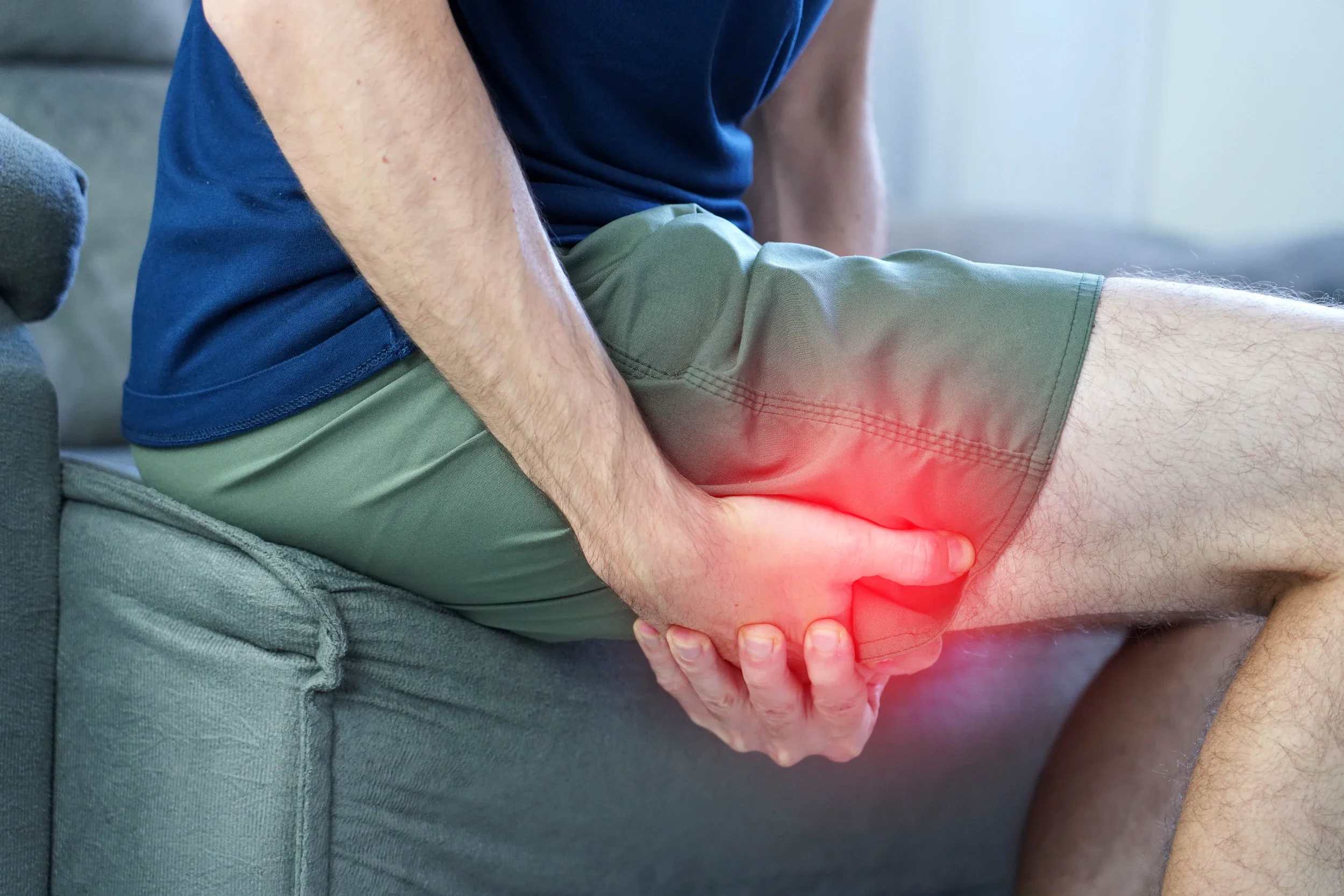
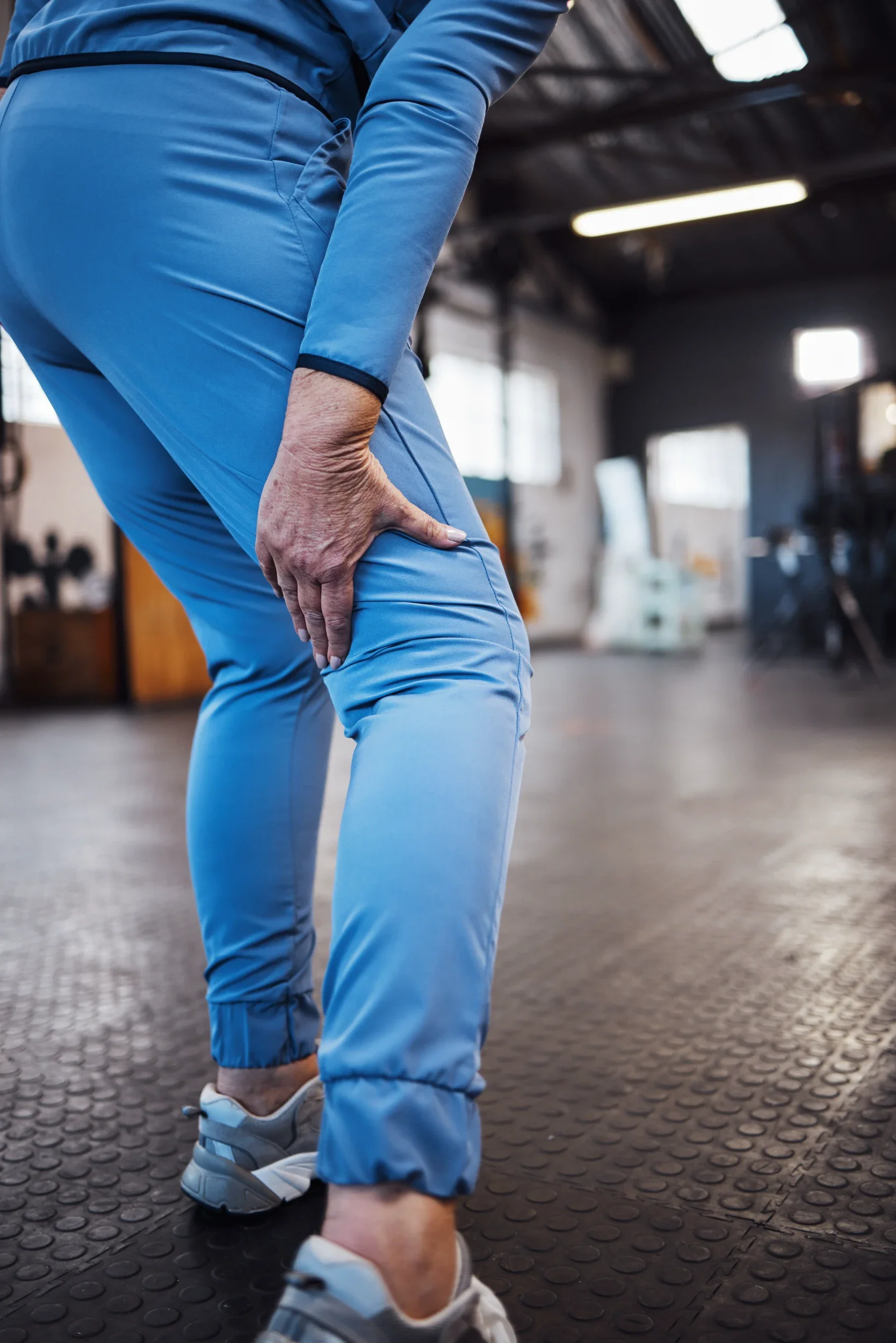
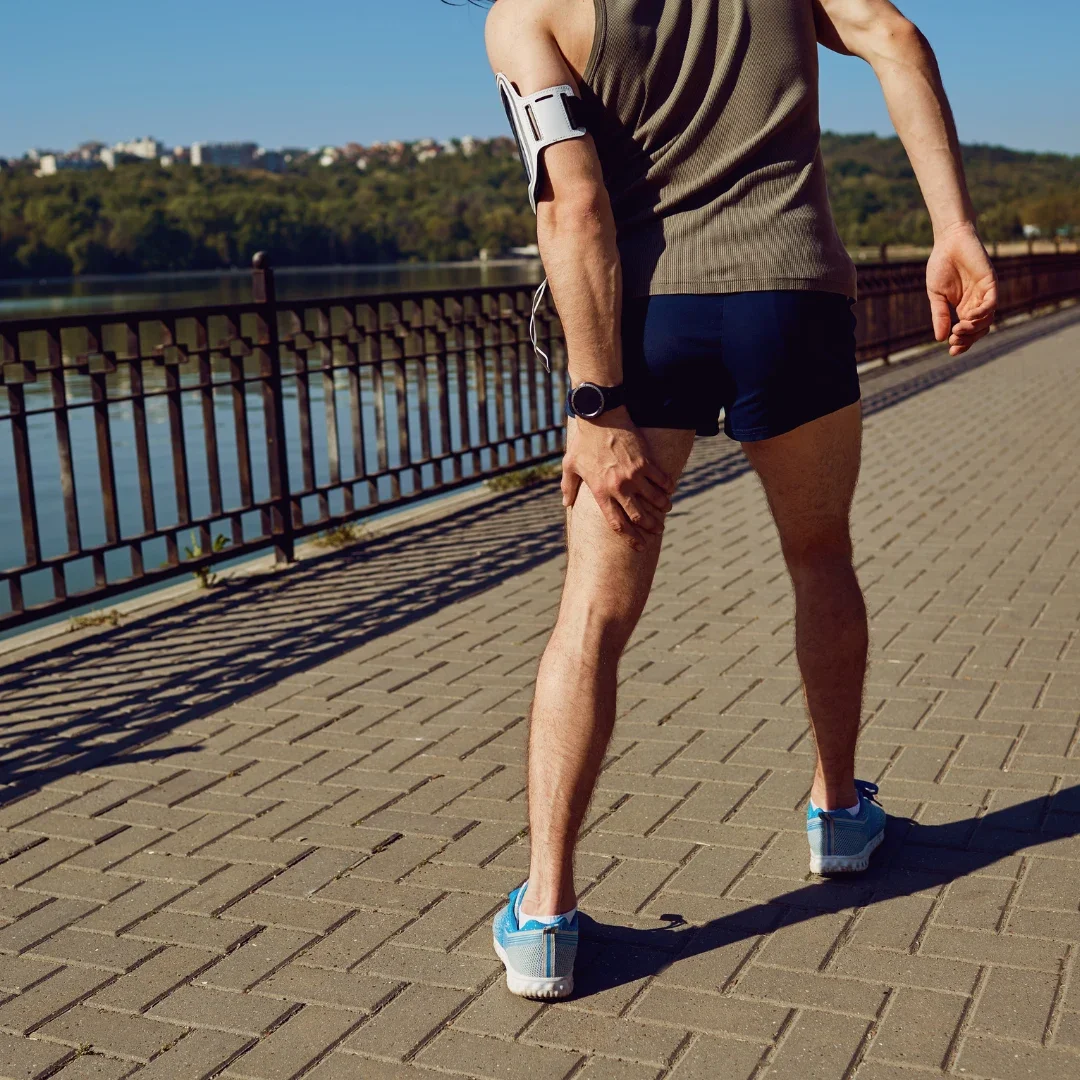
Proximal hamstring tendinopathy (also known as high hamstring tendinopathy) usually starts as an ache when sitting. It’s notice low down in your buttock or ‘sit bone’, builds through a long day at a desk, a drive out of London or a flight, until you find yourself perched on one side of the chair. Runners feel it on hills and in faster sessions. Some people first notice it the morning after heavy deadlifts or lunges. Many have been told it is sciatica, a tight hamstring or a back problem, and have spent weeks stretching something that should never have been stretched.
This is proximal hamstring tendinopathy, also called high hamstring tendinopathy or hamstring origin tendinopathy, and often described as hamstring tendonitis or upper hamstring pain. The “itis” is misleading, because inflammation is not really the problem. It is a problem with the tendon where your hamstrings attach to your sit bone, and it is one of the more stubborn tendon conditions our physios treat. It is also very treatable once it is properly understood, and understanding it is exactly where most treatment goes wrong.
What Is Actually Happening in Your Tendon?
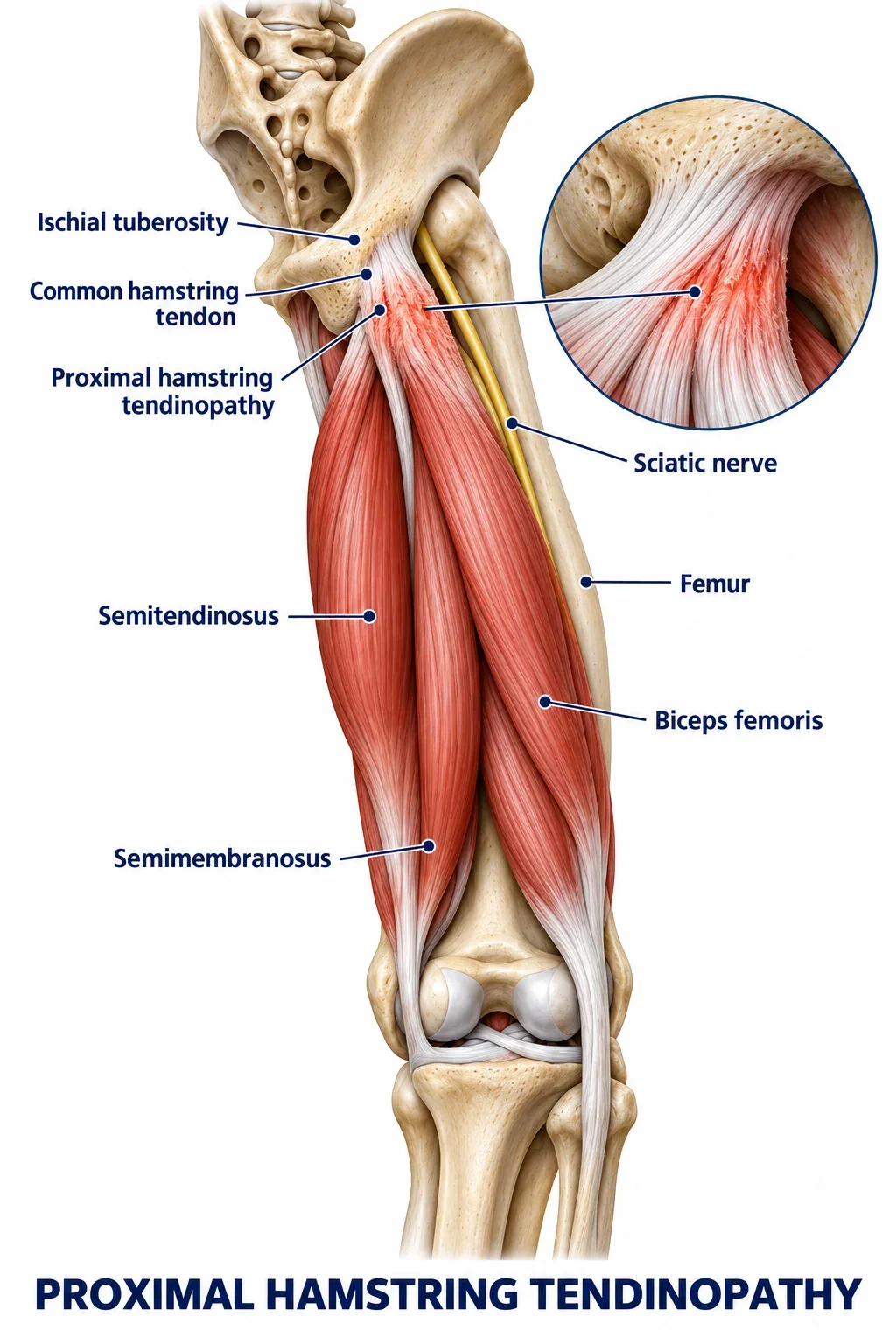
Your hamstring muscles run down the back of your thigh and share a thick tendon attachment on the ischial tuberosity, the bony point you sit on. Most tendons are irritated mainly by being pulled. This one has a second problem: as your hip bends, the tendon wraps around the curve of the sit bone and is squeezed against it. Think of a strap pulled tight across the corner of a box. Tension alone is fine. Tension while pressed hard into an edge is what wears it down.
That single idea explains nearly everything you are experiencing. Sitting presses the tendon directly between bone and chair. Hills, lunges, deep squats and a long running stride all bend the hip under load. Stretching your hamstrings pulls the tendon tight across the ischial tuberosity and compresses it further against the bone, so it aggravates the tendon rather than helping it. The same idea tells us how to fix it: rebuild the tendon’s strength first in positions where it is not being compressed, then gradually earn back the deeper angles.
Tendinopathy develops when the load on a tendon outstrips its capacity, usually after a change: more running, faster running, a new training block, a return to the gym, or months of longer days at a desk. Because it is not primarily an inflammatory problem, rest and anti-inflammatories tend to take the edge off without changing the outcome.
Is It Really Your Hamstring Tendon?
Pain low in the buttock has several possible sources, and the first job of our assessment is to be certain. Referred pain from the lower back can sit in exactly the same place. The sciatic nerve runs just beside the tendon attachment and can become irritated alongside it, or instead of it. Ischiofemoral impingement, ischial bursitis, sacroiliac joint pain and, occasionally, a stress fracture can all mimic tendinopathy. We examine your back, hip and nerve mobility as well as the tendon itself, and if the picture points elsewhere, we treat what is actually there.
Scans need careful interpretation. Tendon changes are common on MRI in people with no pain at all, so a report describing tendinopathy does not by itself prove the tendon is your problem, and a clear scan does not rule it out. If you have imaging, bring it and we will read it alongside what we find on examination.
One situation is different. If you felt a sudden pop high in the back of your thigh, often during a slip, an accidental splits, a water-skiing fall or a sprint, followed by bruising spreading down the thigh, the tendon may have pulled away from the bone. This is a proximal hamstring avulsion, and it needs a prompt specialist opinion because the timing of surgical repair matters. Call us the same day and we will arrange urgent imaging and consultant review.

Why Your High Hamstring Pain Hasn’t Got Better
The most common reason we see is stretching. The hamstring feels tight, so someone advised stretching it, and every stretch since has compressed the tendon harder against the sit bone. That tightness is the tendon protecting itself. It eases as the tendon gets stronger, and stretching only keeps it irritated.
Close behind are three loading mistakes: resting until the pain settles, then losing it all again on the first run back; jumping straight to Romanian deadlifts, deep lunges or Nordic curls before the tendon can tolerate deep hip flexion; and months of bridges and band work that never progress to the load a tendon needs in order to adapt. Finally, nobody looked at the rest of your day. Nine hours on a hard office chair, a long commute and deep massage pressed into the sore spot can undo perfect rehabilitation. Recovery depends on the whole week’s load on the tendon, not just the twenty minutes you spend on exercises.
Our Physiotherapy Approach to Hamstring Tendinopathy
Your first appointment lasts an hour. We take a detailed history of how the pain started and what provokes it, examine your back, hip, hamstrings and gluteal strength, and watch you do the things that hurt: sitting, a single-leg bridge, a squat, a lunge and, where appropriate, a short run. You leave that session with a clear diagnosis, a plan, and treatment already under way.
The early aim is to calm the tendon down without stopping you living. We adjust the activities that provoke it most, usually sitting, hills and faster running, rather than removing everything, and we give you practical strategies for getting through the working day. If your pain is rooted in how you are set up at your desk, our ergonomic assessments address that directly. Isometric holds, in which the hamstring works hard without the joint moving, are often our first loading exercises, because they begin rebuilding strength and can ease pain for many people.
From there, loading becomes progressively heavier and progressively deeper. We start with the hip relatively straight, where the tendon is working but not compressed, and move into greater hip flexion only as the tendon earns it, eventually returning to the deadlift and lunge patterns that caused trouble at the start. Where heavy load is not yet tolerated, blood flow restriction training lets us build muscle strength with much lighter weights. We train your glutes and calves alongside, because weak glutes leave the hamstrings doing more than their share. Sitting itself becomes part of the rehabilitation: we build your tolerance in measured steps, from cushioned seats to firm ones, rather than simply avoiding it.
The final phase restores what you actually do, whether that is hill running, speed work, kicking, lifting, or a full working day followed by the drive home. Throughout, the tendon’s response over the following 24 hours is our guide. Some discomfort during exercise is acceptable. Pain that is worse the next morning tells us to adjust.
Measuring Your Progress Instead of Guessing
Tendon pain is an unreliable guide to tendon readiness. Pain often settles well before strength returns, which is precisely when people go back to running and relapse. From your first appointment, we use VALD handheld dynamometry to measure hamstring and hip extension strength on both sides, so we know the size of the deficit rather than estimating it. The numbers tell us when to progress, show you that you are moving forward on the days it does not feel like it, and give insurers measurable evidence of improvement.
For runners and athletes, VALD ForceDecks lets us assess force production and power in single-leg and hopping tests before we clear you for speed work or sport. Our threshold for return to sport is 90% of the strength of your uninjured side, alongside a settled response to sport-specific loading. We do not clear anyone on the basis of weeks elapsed.
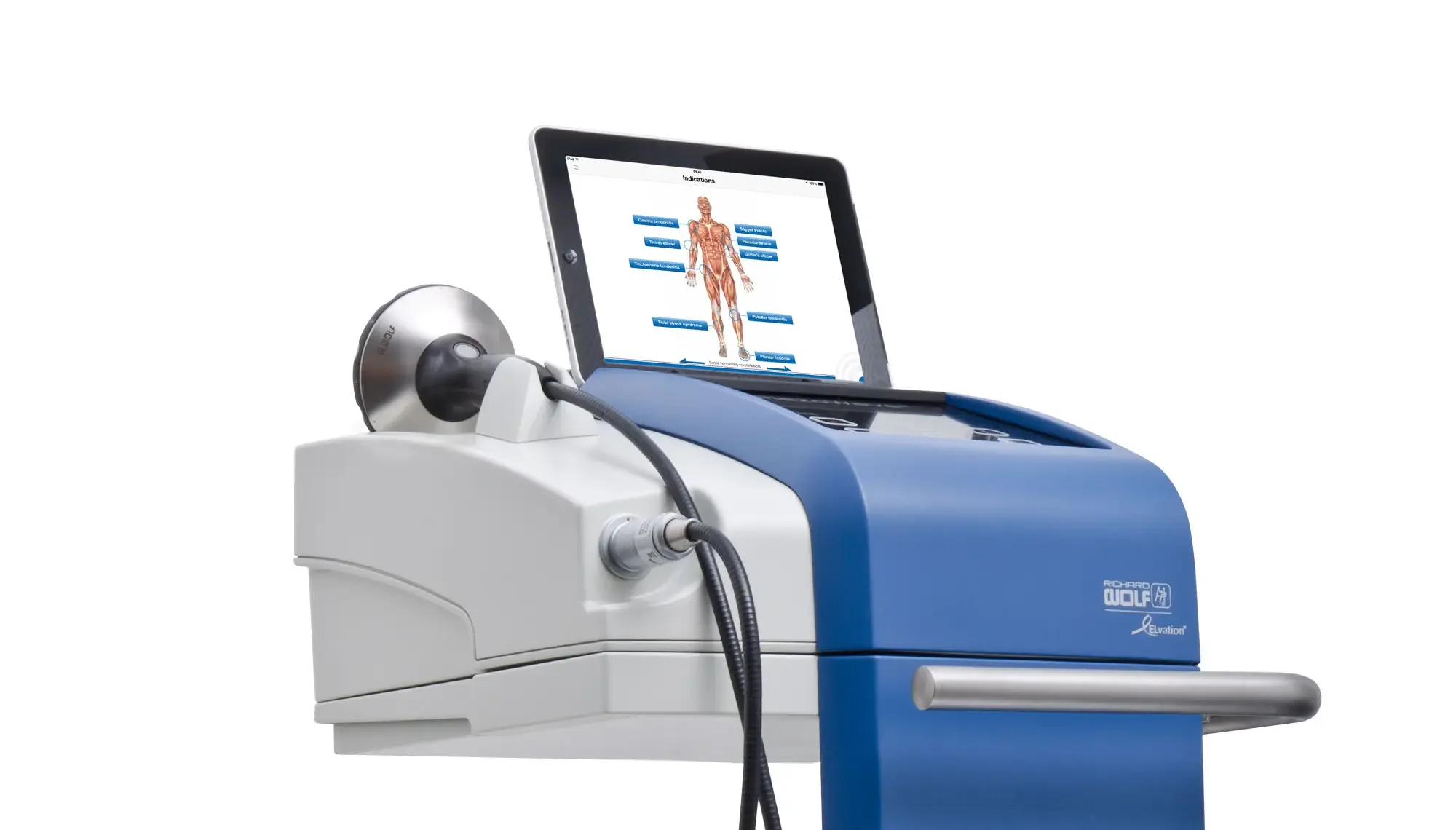
Focused Shockwave Therapy for Hamstring Tendinopathy
The proximal hamstring tendon lies deep beneath the gluteal muscles, which makes it one of the harder tendons for shockwave to reach. We use Piezowave2 focused shockwave, which delivers energy at a controlled depth of up to 12cm, rather than the radial shockwave used in most clinics, which disperses close to the surface. Positioning matters with a tendon this deep, and we take care to target the attachment itself rather than the muscle above it.
We are honest about what the evidence shows. The largest trial so far found that shockwave and well-structured individualised physiotherapy produced similar results for proximal hamstring tendinopathy, with patients who had shockwave reporting greater satisfaction. So we use it as an addition to loading, not a replacement for it, typically when pain has persisted beyond three months or is holding back progress with exercise. A course is usually three to six sessions alongside your rehabilitation, and it often opens a window of reduced pain in which loading can move forward.
Hamstring Tendon Pain and the Menopause
Tendon problems around the hip and buttock become more common in perimenopause and menopause, because falling oestrogen affects how tendons maintain and repair their collagen, and the tendon may be slower to adapt to loading. If you are also dealing with pain on the outside of the hip, a stiff shoulder or other tendon problems, please mention it at your assessment, because it shapes how we progress your treatment.
When Physiotherapy Is Not Enough
Most people recover with well-structured rehabilitation. If you are not progressing as expected, we have direct relationships with sports medicine consultants and orthopaedic surgeons with a specialist interest in the hip and hamstring, and we can arrange imaging and appointments within days. You will not leave our clinic without a clear next step.
Frequently Asked Questions
Here are answers to some of the common questions we receive regarding proximal hamstring tendinopathy at Physio Remedies.
-
Sitting presses the tendon directly between your sit bone and the chair, and bending the hip pulls it tight at the same time. Firm seats, low sofas and car seats are usually the worst. A cushion that takes pressure off the sit bone, shorter sitting spells and regular standing breaks help while we rebuild your tolerance. Be aware that sitting is often the last thing to settle, sometimes lagging behind a full return to running, so do not be discouraged if it takes longer.
-
A strain usually happens suddenly, during a sprint or a kick, and the pain sits in the muscle towards the middle of the back of the thigh. Most settle within a few weeks. Tendinopathy builds up gradually, sits right at the sit bone, is aggravated by sitting, and takes months rather than weeks to resolve.
-
No, although it can feel similar, and sometimes both are present because the sciatic nerve runs so close to the tendon. Tendon pain tends to stay low in the buttock and is provoked by sitting and hamstring loading, while nerve pain more often travels down the leg with tingling or numbness. Our examination tells the two apart.
-
No. Stretching pulls the tendon tight across the ischial tuberosity and compresses it further against the bone, which is exactly what irritates it. If you have been stretching, stop. The tightness you feel is the tendon protecting itself, and it eases as the tendon gets stronger. Loading is what fixes it.
-
The order matters more than the exercise. We usually begin with isometric holds, such as pressing your heel down into a bench while lying on your back with the knee bent, then progress to bridges, single-leg bridges and hamstring curls with the hip fairly straight. Only once those are comfortable under real load do we move into deeper hip flexion with step-ups, Romanian deadlifts and lunges, and finally the faster, springier work that running and sport demand. Your programme is set and progressed against your strength testing, not a generic sheet.
-
Usually, with changes. Flat, easy running with a slightly shorter stride is often tolerated, while hills, intervals and sprinting generally need to come out for a while. Cycling can be fine with the saddle adjusted so you are not sitting on the sore spot, although some people find it aggravating. We will tailor this to you.
-
Most people see meaningful improvement within six to twelve weeks, with full recovery typically taking three to six months. If you have had symptoms for a year or more, expect longer. If you are not improving by around three months, we reassess rather than carrying on regardless.
-
Rest often eases the pain, but it rarely resolves the problem, because rest does not restore the tendon’s capacity. The pain tends to return as soon as you go back to running or long days at a desk. Progressive loading is what changes the outcome.
-
Not usually. Proximal hamstring tendinopathy is mainly a clinical diagnosis. We arrange imaging if the examination suggests a tear, if another cause needs ruling out, or if progress stalls.
-
It helps many people, particularly those with long-standing pain, but it works best alongside progressive loading rather than instead of it. We will advise you on whether it is worth adding in your case.
-
Most people need neither. If pain is too high to load the tendon effectively, a guided injection arranged through our consultant colleagues can settle it enough to make progress. Surgery is rarely needed: it is considered for an avulsion, or for long-standing tendinopathy that has not responded to a thorough rehabilitation programme.
-
Your initial assessment is £190 for one hour. Our Tendon Recovery Packages, which include focused shockwave, a progressive loading programme and VALD strength testing, run from £740 for three months to £1,975 for nine months, with the assessment fee included. We accept Bupa, AXA and Cigna International; please check your cover before your appointment.
Hamstring Tendinopathy Physiotherapy in Mayfair, Near Green Park
Meet Paul Martin · Meet Charlie Brahmbhatt Meet Sarah Lawson
If deep buttock pain is interrupting your working day, your running or your training, our sports physios would be pleased to assess you at Physio Remedies in the Lansdowne Club, Mayfair, a short walk from Green Park and Berkeley Square.
If you prefer to reach us directly: