
Hip & Groin Conditions
Groin Strain & Adductor Tendinopathy Treatment in Mayfair, London
The groin is the injury that athletes try to run through. It starts as a twinge during sprinting or a change of direction. It eases on warm-up, so training continues. It grumbles the following day. A week of rest, a return to full training, and it is straight back. What started as a three-week problem is now a three-month one, and the inner thigh has started to feel permanently unhappy.
We see this pattern constantly. Groin strain and adductor tendinopathy are among the most common and most persistently mismanaged injuries in sport: acute strains undertreated because the pain seems tolerable; tendinopathy developing because load was never properly addressed; and in some cases, a gradual progression to osteitis pubis, or pubic overload, which is a different and considerably more stubborn problem. Getting an accurate diagnosis at the outset, and managing load correctly throughout rehabilitation, is what separates a complete recovery from a recurring injury.
What Is Happening in Your Groin?
These are three distinct presentations that require different approaches. What they share is that all three worsen without the right treatment, and all three resolve well with it.
You changed direction sharply during a match and felt an immediate pull in the inner thigh. You got through the session, just. Three weeks later it is no better despite rest, and you want to know what you are dealing with and what the realistic timeline is.
You have been told you have an adductor tendinopathy. You have been doing the exercises, but they are not working. Something about the approach is not right, and you know it
There was no single incident. The pain developed gradually over a block of training: grumbling during runs, worse the morning after, better after ten minutes of warm-up but always returning the next day. You have been dealing with it for three or four months without meaningful improvement.
From Groin Strain to Osteitis Pubis: Understanding the Spectrum
Groin injuries in sport sit on a spectrum, and knowing where you are on it determines everything about how you should be managed.
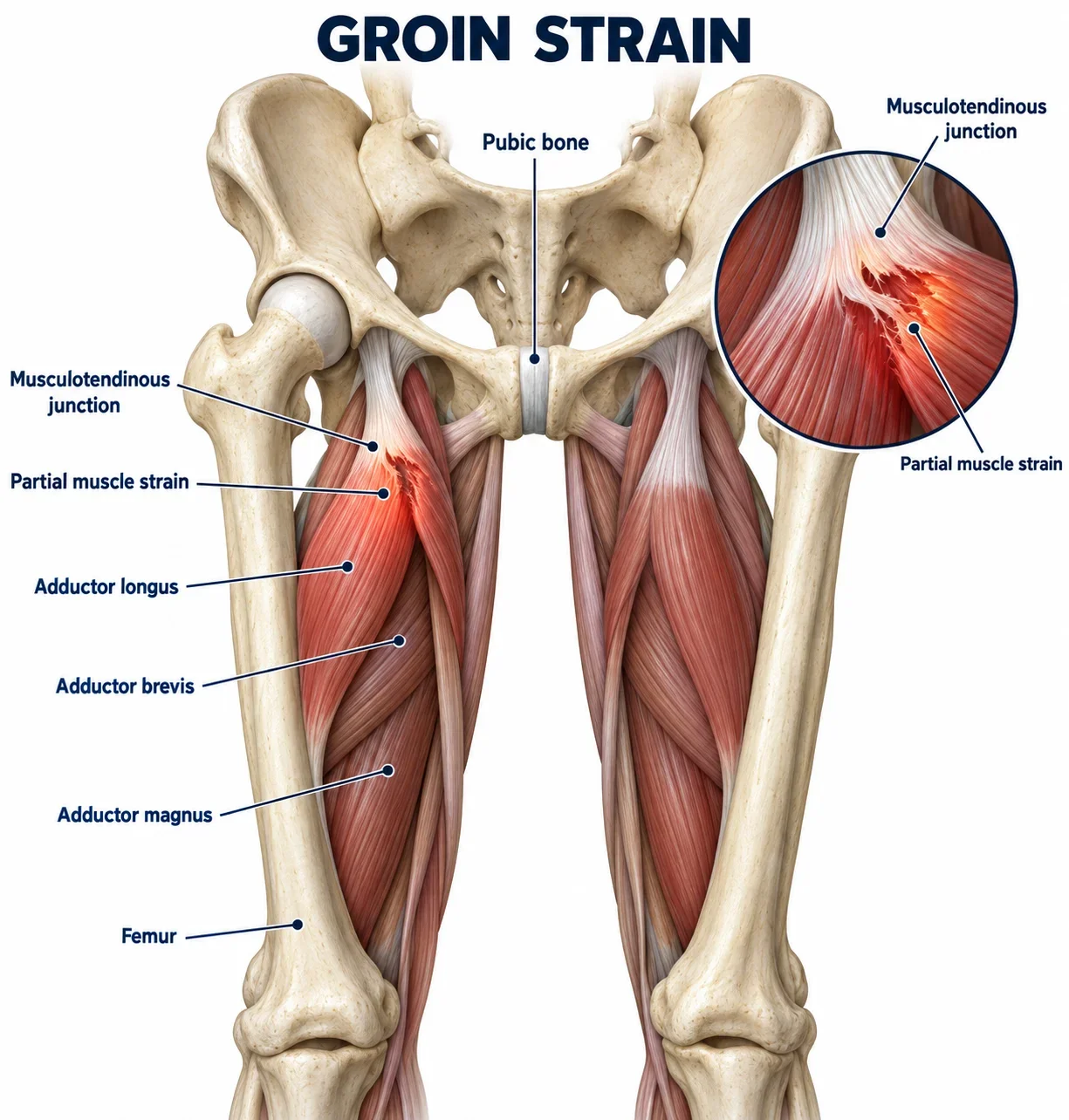
An acute groin strain is a muscle tear, most commonly of the adductor longus, the large inner thigh muscle that runs from the pubic bone down towards the knee. It happens when the muscle is forcefully stretched under load: a sudden change of direction, a tackle, an explosive kick. Severity ranges from a mild Grade 1 strain, involving minimal fibre disruption and resolving within two to three weeks with correct management, to a Grade 2 or 3 tear involving significant damage, possible bruising tracking down the inner thigh, and a rehabilitation period of six to twelve weeks or longer. The critical factor is where the tear sits: injuries at the muscle belly are generally more straightforward; tears at or near the tendon attachment to the pubic bone are slower to heal, more prone to becoming chronic, and require more careful management.
Adductor tendinopathy develops differently. There is no single traumatic incident. Repeated loading of the adductor tendon at its attachment to the pubic bone gradually overwhelms the tendon's capacity to repair, leaving it in a state of disorganised, sensitised tissue that does not settle with rest alone. This is not an inflammatory condition in the traditional sense, and treating it like one, with rest, gentle stretching, and anti-inflammatories, is precisely why so many cases become entrenched. Tendinopathy needs progressive loading to resolve.
At the more complex end of the spectrum sits osteitis pubis, sometimes called pubic overload or athletic pubalgia. This is inflammation at the pubic symphysis, the cartilaginous joint at the front of the pelvis, driven by the competing pulls of the adductors below and the abdominal muscles above. In rugby players, footballers, and distance runners, where repetitive asymmetric loading places constant shearing stress on the pubic bone, osteitis pubis can become severely debilitating. The pain is felt at the front of the pelvis, often radiating into the groin and lower abdomen. It is worse on impact, worse going up stairs or during any sudden change of direction, and it is slow to respond to treatment if the underlying loading problem is not addressed. Osteitis pubis is also seen following pregnancy and childbirth, where the pubic symphysis has been placed under unusual mechanical stress.
These three conditions frequently coexist or follow one from another. A groin strain inadequately managed leads to adductor tendinopathy. Chronic tendinopathy combined with ongoing training load and poor pelvic control is an established route to osteitis pubis. Early, accurate diagnosis reduces the risk of this progression considerably.
Why Your Groin Has Not Got Better
Most groin injuries are undertreated in the acute phase and then incorrectly managed in the chronic phase. Neither is working in your favour.
In the acute phase, the instinct is to push through. The pain is manageable, the injury does not feel serious, and stopping training seems like an overreaction. But groin strains, particularly those close to the tendon attachment, are slow to heal even with optimal management. Without it, they frequently fail to heal at all. What becomes a chronic adductor tendinopathy is almost always a groin strain that was run through rather than properly rehabilitated.
In the chronic phase, the advice swings the other way: rest, reduce activity, stretch the inner thigh. None of this resolves adductor tendinopathy. A sensitised tendon needs graduated mechanical load to stimulate tissue reorganisation and rebuild its capacity to handle the demands of sport. Rest reduces pain temporarily but does not resolve the underlying problem. Stretching the adductor attachment at the pubic bone, in particular, can actively worsen both tendinopathy and osteitis pubis by increasing compressive stress on the tissue.
The other consistent failure we see is not identifying what drove the injury in the first place. Adductor tendinopathy and osteitis pubis rarely appear without reason. They develop in the context of a spike in training load, inadequate hip and adductor strength, poor pelvic control during running and change of direction, or a premature return to sport after a previous groin injury. Until those contributing factors are found and addressed, the injury will keep returning.
Our Approach to Groin and Adductor Treatment
We assess the complete picture. That means not just the inner thigh itself, but the pelvis, lumbar spine, hip strength, and the specific loading demands of your sport or activity. We take a detailed history of the injury and your training environment, because understanding the load that produced this problem is essential to managing it.
We use VALD hand-held dynamometry to measure adductor strength output objectively between sides throughout your rehabilitation. For return to sport, we apply a 90% symmetry threshold: you need to demonstrate at least 90% of the strength of the uninjured side before you are cleared to return to full training. Below that threshold, reinjury risk remains unacceptably high, regardless of how the injury feels subjectively.
For chronic adductor tendinopathy and osteitis pubis, we use focused shockwave therapy with our Piezowave2 system where the evidence supports it. Focused shockwave penetrates to the depth required to reach the adductor tendon attachment at the pubic bone, which the radial shockwave used by most clinics simply does not achieve. In the right cases, it provides the stimulus that allows loading to become effective again.
Where physiotherapy alone is insufficient, we have direct referral pathways to sports medicine consultants and musculoskeletal radiologists in London for guided injection procedures, including platelet-rich plasma and corticosteroid injections for recalcitrant tendinopathy, and for MRI or diagnostic ultrasound where the diagnosis requires imaging confirmation. You will always have a clear next step.
Philip Harris has treated groin and adductor injuries at Olympic Games, Commonwealth Games, and with the Barbarians. In elite contact sport, a misdiagnosed or mismanaged groin injury can end a season. That level of diagnostic precision and loading judgement shapes how we approach every groin injury in our Mayfair clinic, whether the goal is returning to international rugby or completing a half marathon.
When to Come to Us
Come to us as soon as possible after an acute groin injury, rather than waiting to see whether it settles over a few more weeks of training. Early accurate diagnosis shortens recovery significantly and reduces the risk of a chronic problem developing. Come to us if you have had groin or inner thigh pain for more than six weeks that has not responded to rest or to treatment elsewhere, particularly if you have been stretching and reducing activity without improvement. Come to us if you have been told you have osteitis pubis or pubic overload and have not been given a structured rehabilitation programme with clear return-to-sport targets. Come to us if your groin injury keeps recurring every time you try to return to full training.
Frequently Asked Questions
Here are answers to some of the common questions we receive regarding groin strain and adductor tendinopathy at Physio Remedies.
-
That depends on the grade of the injury and, critically, how it is managed. Grade 1 strains involving minimal fibre disruption resolve within two to three weeks with correct treatment. Grade 2 injuries with more significant muscle damage typically take six to twelve weeks. What determines how serious your injury ultimately becomes is usually what happens in the first two to three weeks: undertreated early groin strains are the most common route to chronic adductor tendinopathy.
-
Adductor tendinopathy is a problem within the tendon tissue itself, where repeated overloading has left the tendon in a state of disorganised, painful disrepair. Osteitis pubis, or pubic overload, is inflammation at the pubic symphysis joint at the front of the pelvis, driven by the competing tension of the adductor muscles and the abdominal wall. The two conditions can coexist, and adductor tendinopathy is one of the recognised precursors to osteitis pubis. Osteitis pubis typically presents with pain more centrally at the front of the pelvis, is more sensitive to impact activity, and generally takes longer to resolve.
-
Most groin strains and adductor tendinopathies can be diagnosed clinically. We use imaging selectively: where the severity of a tear is unclear, where the diagnosis is uncertain, or where we need to exclude a pubic ramus stress fracture, inguinal hernia, or hip joint problem contributing to the symptoms. Where imaging is indicated, we can arrange MRI or diagnostic ultrasound directly through our referral network.
-
This depends on the nature and severity of what you have. In the acute phase of a groin strain, you need a clear picture of what has torn and how badly before returning to load. With adductor tendinopathy, we almost always keep you active, modifying load rather than stopping entirely. Complete rest makes tendinopathy worse, not better. We will give you a specific framework for what you can do, at what intensity, and how to monitor your response so that you are not guessing.
-
A Grade 1 groin strain managed correctly from the outset: two to three weeks. A Grade 2 tear: six to twelve weeks. Chronic adductor tendinopathy that has been present for several months: three to six months to achieve full, durable resolution. Osteitis pubis is typically the longest recovery, often three to six months even with optimal management, and significantly longer if treatment has been delayed or incorrect. The most important variable in all of these is not time elapsed but whether adductor strength has reached 90% of the uninjured side: that is the threshold that determines safe return to sport.
-
We accept Bupa, AXA, and Cigna International. Your first assessment is £190 and lasts one hour.
Book Your Groin and Adductor Assessment in Mayfair
If groin pain, inner thigh pain, or a recurring groin injury is affecting your sport, your training, or your daily life, book an assessment at Physio Remedies in the Lansdowne Club, Mayfair. We are a short walk from Green Park and Berkeley Square and regularly see patients from across central London.
If you prefer to reach us directly: