
Hip & Groin Conditions
Gluteal Tendinopathy Treatment in Mayfair, London
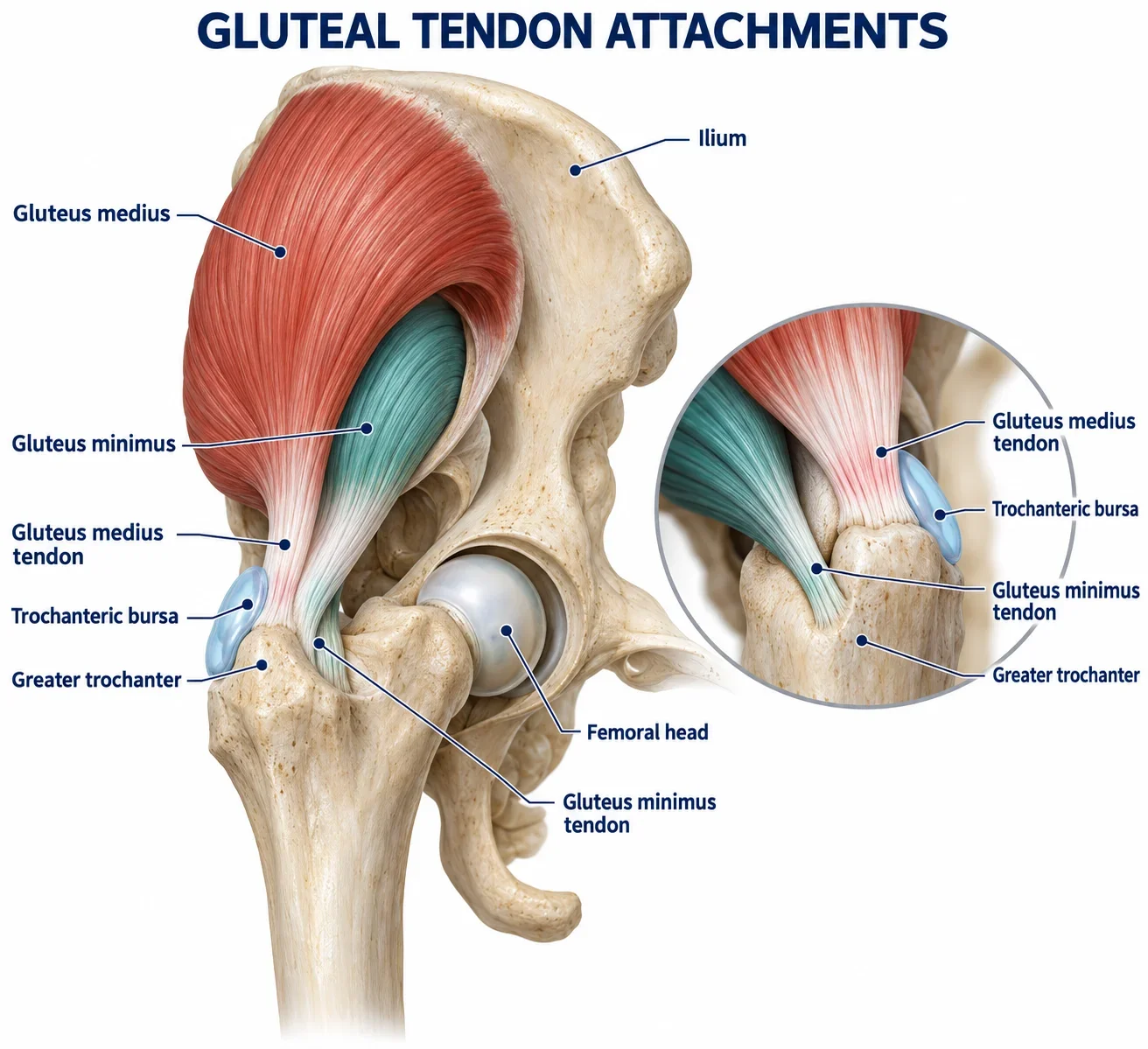
Gluteal tendinopathy (also known as greater trochanteric pain syndrome, or GTPS) is the most common cause of pain on the outer side of the hip. It affects the gluteus medius and minimus tendons where they attach to the greater trochanter, the bony prominence you can feel on the outside of your upper thigh. You may have been told you have hip bursitis or trochanteric bursitis: these are older terms for what research has now established is primarily a tendon problem. The bursa may be irritated, but treating the bursa while leaving the tendon unaddressed produces temporary relief at best.
The most important thing to understand about gluteal tendinopathy is also the most counterintuitive: the instinct to stretch the outer hip makes it worse, not better. Gluteal tendinopathy is driven by compression rather than tension. The tendon is compressed against the greater trochanter whenever the hip moves into adduction, and that compression, from crossing your legs, sitting with hips tilted, lying on the affected side at night, or stretching the glute, is what maintains the condition and explains why it fails to improve with rest and stretching alone.
At Physio Remedies in Mayfair, we treat gluteal tendinopathy with a structured programme grounded in the research of Dr Alison Grimaldi, whose work established education and load management alongside progressive exercise as the gold standard approach for this condition. Between our team, we treat a significant number of perimenopausal and menopausal women with gluteal tendinopathy, and we integrate the hormonal context into the management programme in a way that most clinics do not.
What Is Gluteal Tendinopathy and What Does It Feel Like?
The gluteus medius and gluteus minimus run from the outer surface of the pelvis and attach via their tendons to the greater trochanter. These hip abductor muscles stabilise the pelvis during every single-leg activity: walking, climbing stairs, running, and standing on one leg all demand that they hold the pelvis level against gravity. When the tendons degenerate under compressive and tensile load, they become painful and their function is compromised.
The condition is the primary diagnosis within what is now called Greater Trochanteric Pain Syndrome (GTPS). It replaces the older diagnosis of trochanteric bursitis or hip bursitis, which attributed the pain to inflammation of the fluid-filled bursa overlying the greater trochanter. Two decades of research have established that the bursa is rarely the primary cause: gluteus medius tendinopathy, and in more severe cases gluteus minimus tendinopathy or tendon tearing, is the predominant pathology. The bursa becomes secondarily inflamed in response to compression from the degenerating tendon.
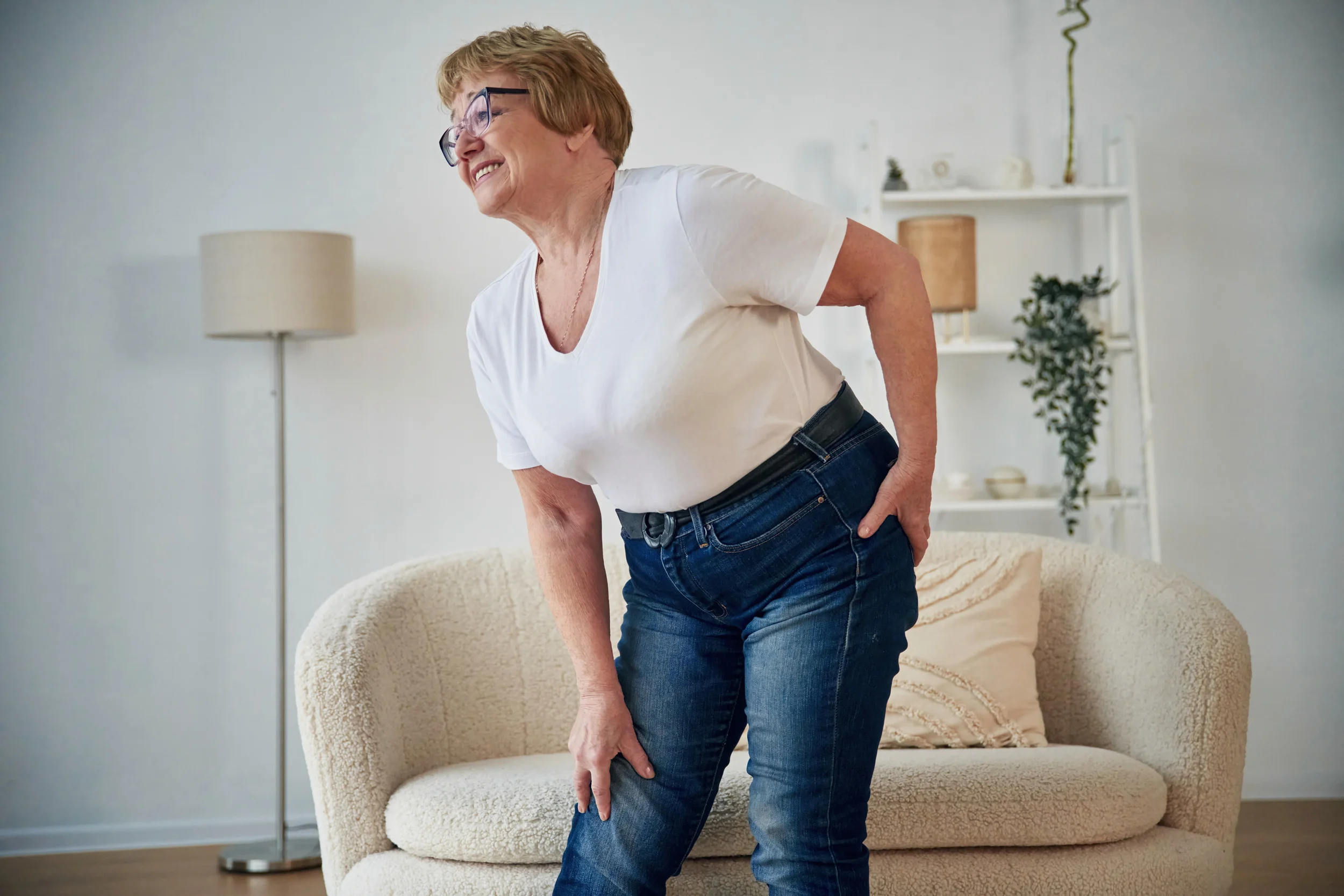
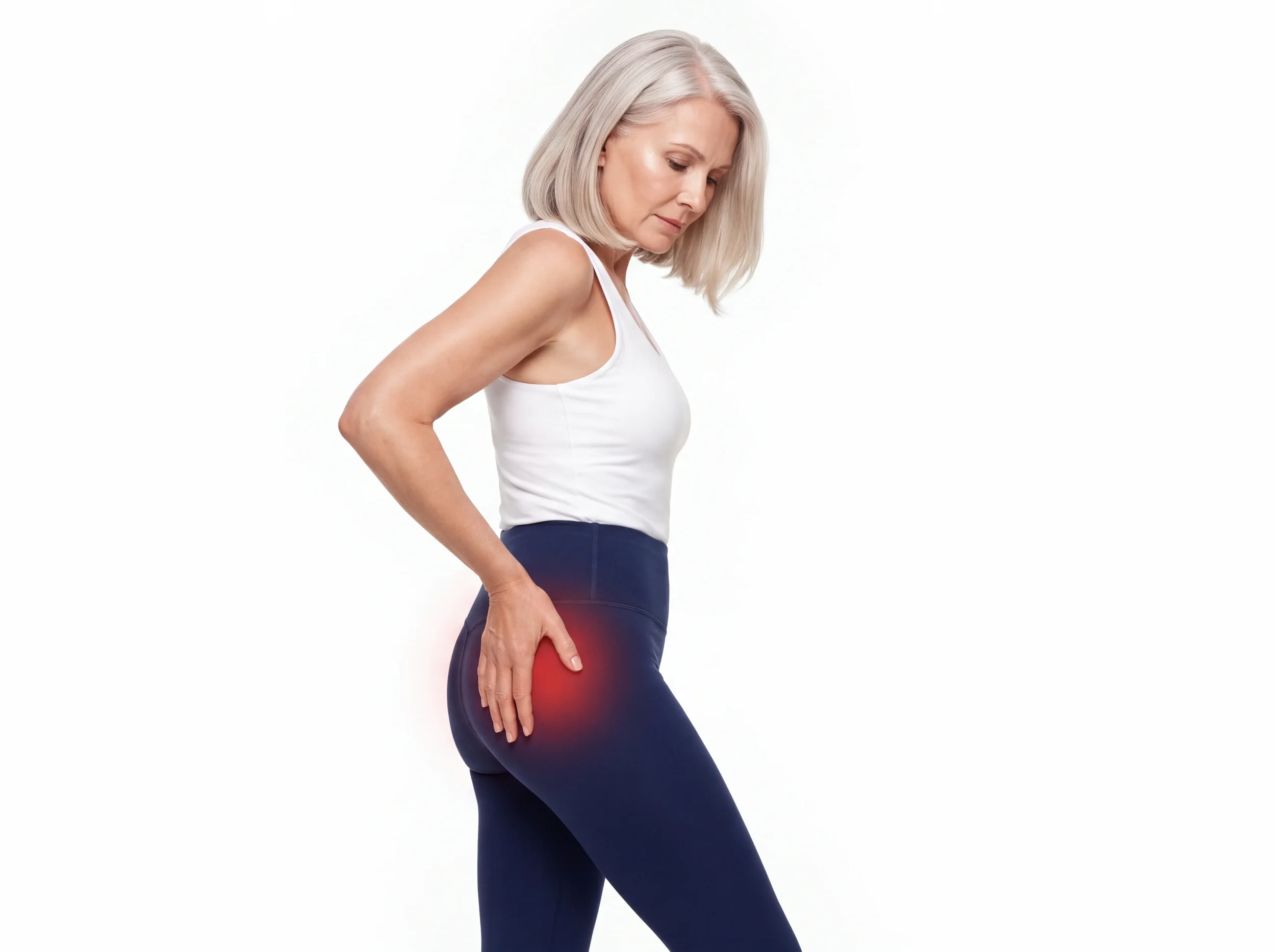
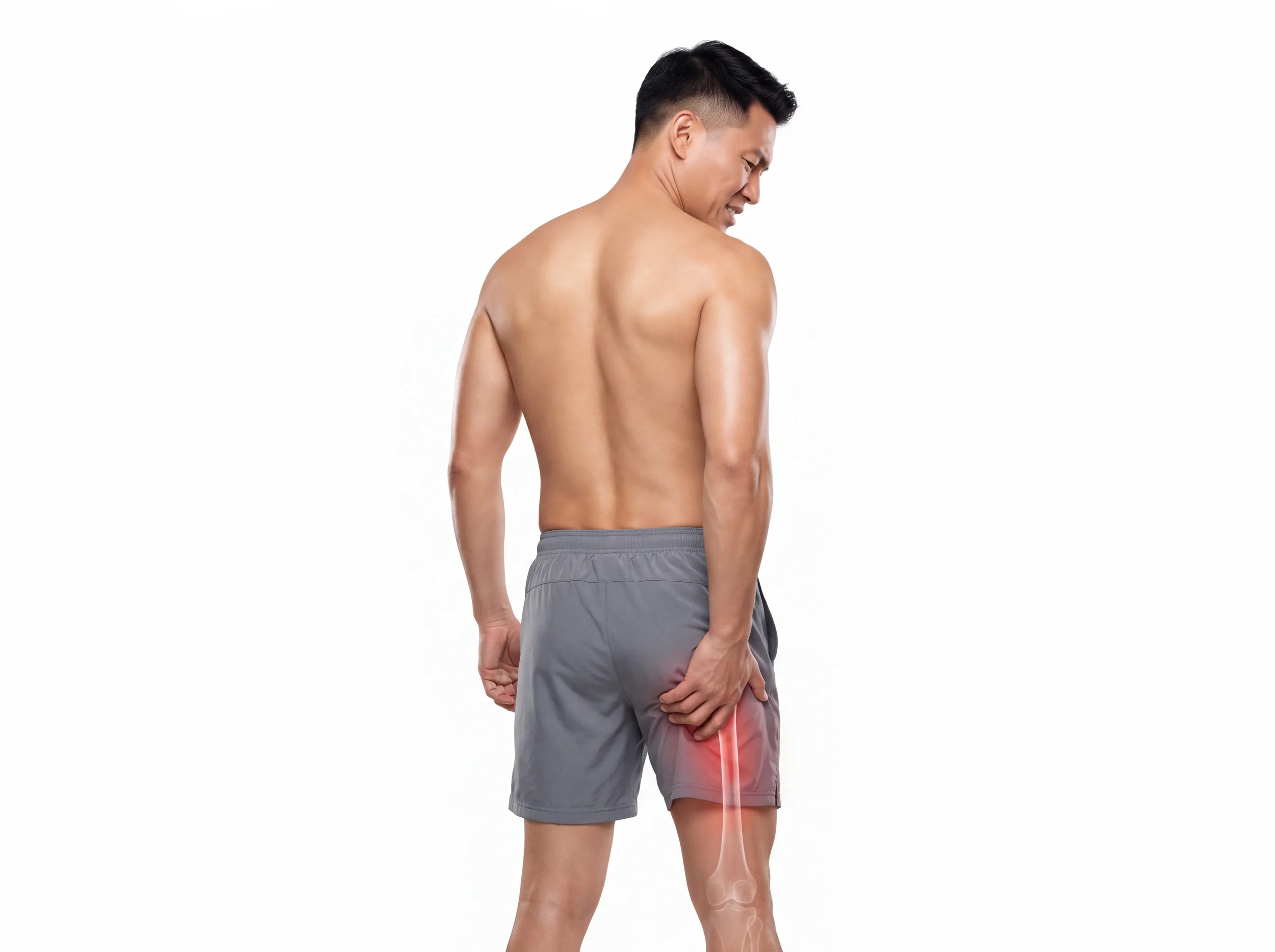
Pain is felt on the outer side of the hip and sometimes radiates into the outer thigh or as far as the knee. It is commonly worse when lying on the affected side at night, with prolonged sitting, when getting in and out of a car, going up and down stairs, and during or after walking and running. Hip pain when sitting for long periods is particularly characteristic. As many as one in three people with lower back pain also experience lateral hip pain from gluteal tendinopathy, and the two conditions frequently coexist. The pain has a tendinopathy pattern: manageable during activity but building for hours afterwards, and often worst the following morning.
Who Gets Gluteal Tendinopathy and Why?
Gluteal tendinopathy affects women four times more commonly than men, with peak incidence between the ages of 40 and 60, precisely the perimenopausal and menopausal years. This is not coincidence. The hormonal mechanisms are the same as those driving frozen shoulder, tibialis posterior tendinopathy, and other connective tissue conditions that cluster in this demographic: declining oestrogen reduces collagen quality throughout the body, increases systemic inflammation, and impairs the tendon’s capacity to manage load and repair itself.
A tendon that is already under compressive load from the positions described above, managed by collagen that is less resilient as a result of hormonal change, in a body whose muscle mass and hip abductor strength have been reduced by the same hormonal transition, is a tendon with a very specific set of vulnerabilities. Managing gluteal tendinopathy in perimenopausal or menopausal women without accounting for this context produces a programme calibrated for the wrong patient. We integrate the hormonal picture and, where patients are not yet in conversation with their GP about HRT, we encourage that conversation given the potential benefits of maintained oestrogen levels for tendon quality and systemic inflammation.
Beyond menopause, gluteal tendinopathy also affects runners, hikers, and people with occupations or habits that involve prolonged single-leg standing or sustained hip adduction positions. A change in training load, a new walking route with sustained hills, or simply an increase in walking distance during a holiday can be sufficient provocation in a tendon that was already under compressive stress.
Understanding the Compression Mechanism: What Is Making Your Hip Worse?
The gluteal tendons wrap around the greater trochanter and are compressed against it when the hip moves into adduction: when the thigh crosses toward or beyond the midline of the body. This compression is the primary mechanical driver of symptoms. It explains why certain apparently harmless positions and habits consistently aggravate the condition, and understanding them is essential before any exercise programme can be effective.
Sitting with crossed legs takes one hip into adduction and directly compresses the tendon. Sitting with the legs together and the trunk leaning away from the painful side does the same. Standing with the weight shifted onto one hip, the classic posture of someone resting with their hip jutting out to the side, holds the tendon under sustained compressive load. Sleeping on the affected side compresses the tendon under body weight. Stretching the glute or piriformis, the most instinctive response to outer hip pain, takes the hip into exactly the position of maximum compression.
This is why load management education is a central component of treatment, not an afterthought. A patient who continues sitting with crossed legs, standing with a hitched hip, and stretching the glute every morning while simultaneously doing their strengthening exercises will make slower progress than one who understands and modifies these habits from the start. The exercises rebuild tendon capacity: the load management removes the compressive stimulus that is maintaining the tendon in a reactive state.
Our Approach to Gluteal Tendinopathy
Assessment
We begin by testing hip abductor strength using VALD hand-held dynamometry, giving us an objective measure of the strength deficit between sides rather than an impression. Tendon load tolerance is assessed through specific single-leg loading tests. We identify the specific compressive positions and habits in the patient’s daily life that are maintaining the reactive tendon state. We also assess the lumbar spine and the lower extremity for contributing factors: hip flexor tightness, lumbar spine stiffness, and gait patterns that increase hip adduction loading with each step are all relevant.
Progressive Loading
Once compressive load habits have been modified and the tendon has begun to settle, progressive strengthening of the hip abductors and gluteal muscles is introduced in positions that load the tendon in tension without compression. This starts in positions of neutral or slight hip abduction and progresses as the tendon adapts. The programme is monitored closely: too much too soon will flare a settling tendon, and we adjust based on the 24-hour symptom response to each loading session. The target is 90% hip abductor strength symmetry against the unaffected side on VALD testing before return to full running, sport, or hiking.
Load Management and Education
The first and most important phase of treatment is education and load management. We explain the compression mechanism, identify the specific provocative positions in the patient’s daily life, and make specific modifications. This includes sitting position, standing habits, sleeping position, walking technique, and for active patients, training load. The goal is to reduce the compressive stimulus on the tendon enough to allow it to settle from its reactive state before progressive loading is introduced.
Focused Shockwave Therapy
For cases of established gluteal tendinopathy that have not responded adequately to load management and progressive exercise alone, our Piezowave2 focused shockwave system is used as an adjunct. Focused shockwave stimulates tendon remodelling and neovascularisation at depth: the gluteal tendon attachment on the greater trochanter is a structure that requires precision and depth penetration that radial shockwave devices cannot reliably deliver. Focused shockwave is not a replacement for load management and progressive exercise. It works best as part of a comprehensive programme that addresses both the tendon biology and the mechanical environment driving the problem.
Frequently Asked Questions
Here are answers to some of the common questions we receive regarding gluteal tendinopathy at Physio Remedies.
-
Pain and tenderness on the outer side of the hip, directly over the greater trochanter, the bony prominence you can feel on the outside of your upper thigh. It is typically worse with prolonged walking, stairs, standing on one leg, and lying on the affected side. Many people describe it as a deep aching pain that builds during activity and lingers for hours afterwards. It is frequently mistaken for hip joint pain, sciatica, or referred from the lumbar spine, all of which we assess and distinguish clinically.
-
They are related but not identical. Trochanteric bursitis, the inflammation of the bursa overlying the greater trochanter, is usually a secondary response to gluteal tendinopathy rather than a primary condition. The most effective treatment addresses the tendinopathy rather than the bursa. Treating the bursa with steroid injection without addressing the tendinopathy and the compressive load habits that caused it produces temporary relief rather than resolution.
-
Because gluteal tendinopathy is a compression tendinopathy. Stretching the glute takes the hip into adduction, which compresses the gluteal tendons against the greater trochanter. This compression is the primary mechanical driver of the problem, not tightness in the muscle. Stretching feels intuitively correct but actively provokes the condition. Stopping the compressive stretches is one of the first and most important changes we make.
-
Crossing your legs takes one hip into adduction, directly compressing the gluteal tendon insertion against the greater trochanter. Sitting with legs together and the body leaning away from the painful side does the same. These are the most common compressive provocations in daily life, and modifying them is essential before any exercise programme can be effective.
-
Yes, and staying active is important. What needs to change is the nature of the activity rather than its volume. We guide specifically: running on cambered roads increases hip adduction loading and should be modified. Hiking on steep cross-slopes does the same. Sustained single-leg standing, step workouts, and lateral movements can be provocative in the early stages. We identify what is specifically loading the tendon and modify that, while preserving as much activity as possible.
-
With appropriate management, most patients notice meaningful improvement within eight to twelve weeks, and substantial resolution by four to six months. Chronic cases, where the tendon has been in a reactive state for over six months, take longer. The research shows 60% of patients reporting symptom resolution at 15 months with structured physiotherapy. The timeline improves significantly when load management is implemented properly from the start, because it removes the compressive stimulus that was preventing any treatment from working.
-
Declining oestrogen during perimenopause and menopause reduces collagen quality throughout the body, including in the gluteal tendons, increases systemic inflammation, and reduces hip abductor muscle mass. A tendon that is also being compressed by sitting, standing, and sleeping habits, managed by collagen that is less resilient due to hormonal change, is significantly more vulnerable to developing tendinopathy. We account for this in how we structure the programme and, where relevant, encourage a conversation with the GP about HRT, which can support tendon quality and reduce systemic inflammation.
-
Possibly as an adjunct, but not as a standalone treatment. Steroid injection into the trochanteric bursa can reduce pain and allow earlier engagement with rehabilitation. It does not change the tendon structure or address the compressive habits driving the condition. In cases where pain is too severe to engage with rehabilitation, an injection can provide a useful window. We refer for guided injection when this is clinically appropriate. Used alongside a structured programme rather than instead of one, it can meaningfully accelerate the early stages of recovery.
-
Yes, and the research supports this. Resolution of symptoms and return to full activity is the expected outcome of well-delivered physiotherapy for gluteal tendinopathy in the majority of patients. Long-term maintenance requires awareness of the compressive positions to avoid and continued hip abductor strengthening, which we teach as part of the programme. A tendon that has been rehabilitated with good habits and adequate strength is significantly less likely to become symptomatic again than one that has simply been rested until the pain settled.
Book Your Hip Assessment in Mayfair
If you have outer hip pain, side of hip pain at night, or lateral hip pain that has not resolved with rest, stretching, or previous treatment, your first appointment lasts one hour. We will assess the tendon load tolerance, identify the compressive habits maintaining the condition, and give you a clear programme that addresses both. The assessment costs £190.
If you are searching for gluteal tendinopathy physiotherapy, GTPS treatment, or a hip bursitis specialist in London, we are based at the Lansdowne Club in Fitzmaurice Place, Mayfair, a few minutes’ walk from Green Park station.
If you prefer to reach us directly: