
Hand & Wrist Conditions
Finger Pulley Injury Treatment in Mayfair, London
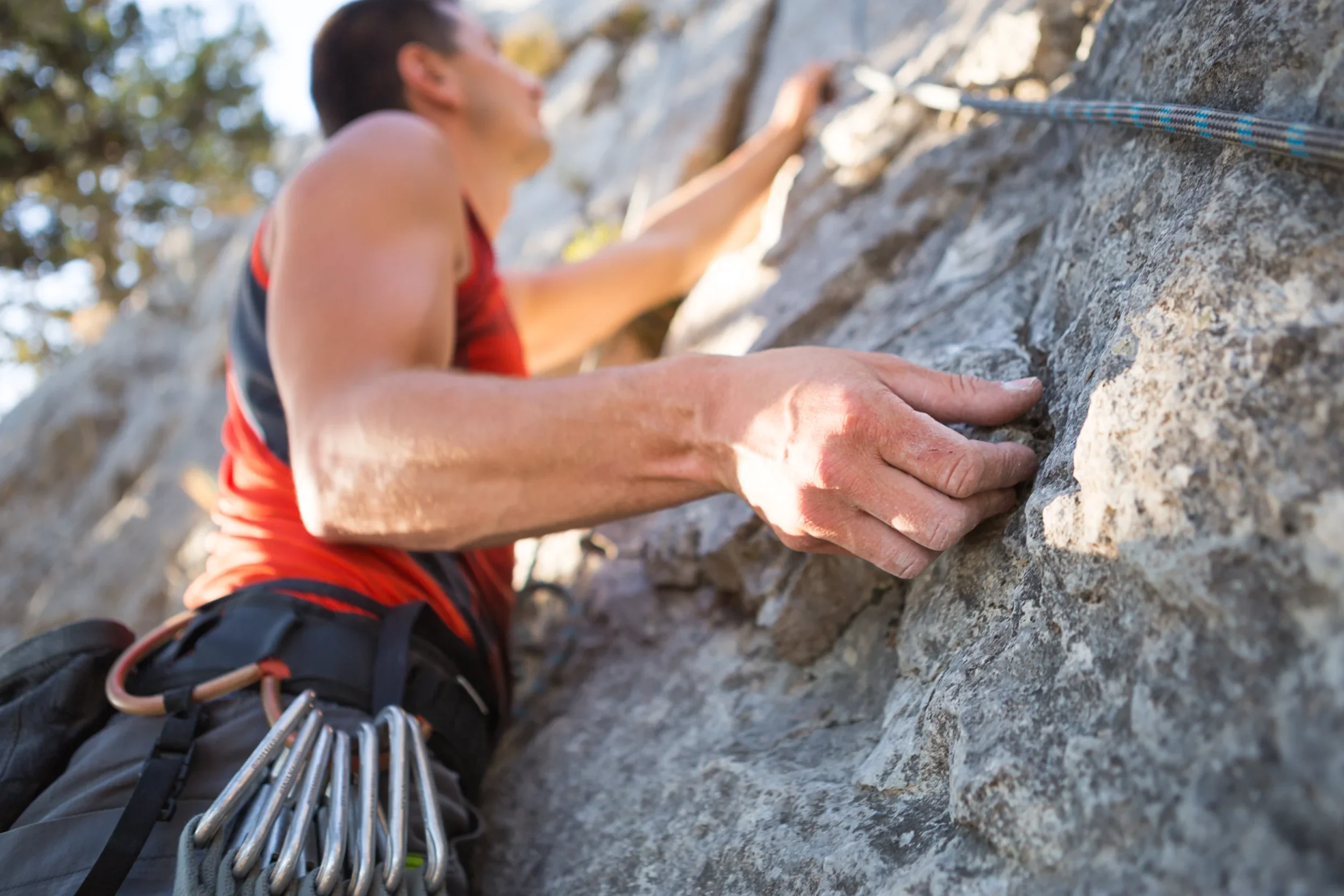
Most climbers know the moment it happens. There is a pop, or sometimes just a sharp give, somewhere in the finger, usually the ring or middle, usually mid-crimp or on a dynamic movement off a small hold. The pain is immediate. The swelling follows within the hour. And then begins the familiar spiral: a week of rest, some tape, a tentative return to easier routes, a flare-up, more rest, and no real progress.
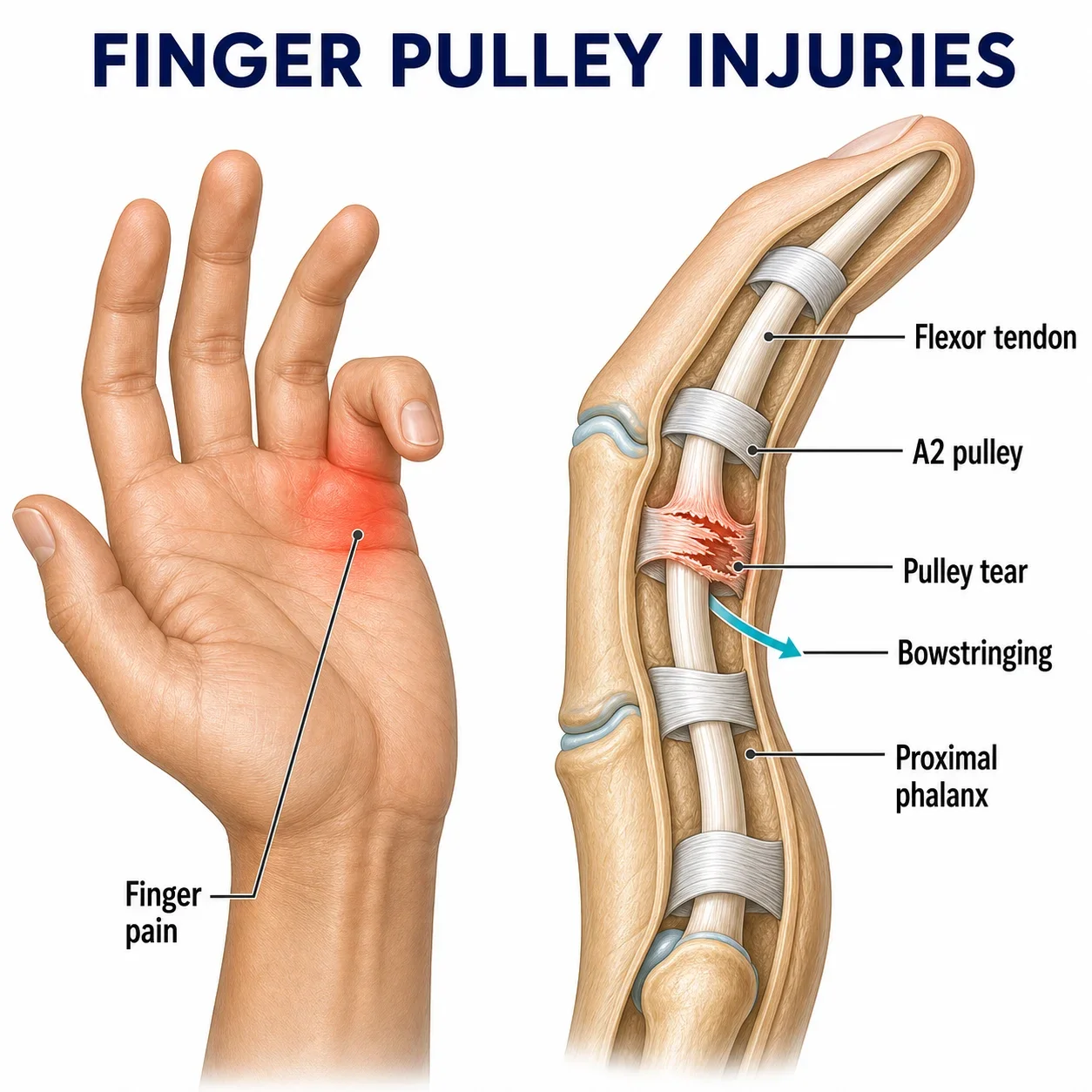
Finger pulley injuries are the single most common injury in rock climbing, accounting for around 40% of all climbing-related presentations. The majority involve the A2 pulley, the strongest and most load-bearing of the five annular pulleys in each finger, located just under the palm side of the proximal phalanx at the base of the finger. They can develop gradually through cumulative overuse, with pain building over weeks until the tendon sheath becomes too irritable to climb through. Or they can happen in a single incident, with an audible or palpable pop and immediate loss of strength and range.
What they have in common is this: they are rarely well-managed. The standard advice of rest, tape, and a gradual return does not account for the forces involved in climbing, does not address why the injury happened in the first place, and does not build the pulley system back to the loads it will face on the wall. At our Mayfair clinic, we treat pulley injuries with the same structured, objective rigour we apply to any high-demand tendon problem.
What Is a Finger Pulley, and Why Does the A2 Injure So Often?
The muscles that flex your fingers originate in the forearm. Their tendons run down through the wrist and along the palm side of each finger, all the way to the fingertip. Without something to hold those tendons close to the bone, they would bowstring outward every time you bent the finger, losing most of their mechanical efficiency. That is what the pulleys do: five fibrous rings, A1 through A5, act as retaining loops that keep the flexor tendons in close contact with the bone, preserving the line of pull and the strength of grip.
The A2 pulley sits at the base of the finger, over the proximal phalanx. It is the largest of the five and the one that bears the greatest load during climbing, because it holds both of the main flexor tendons, the flexor digitorum profundus and the flexor digitorum superficialis, in position simultaneously. Two things determine how much force passes through it: the load at the fingertip and the angle of the proximal interphalangeal joint.
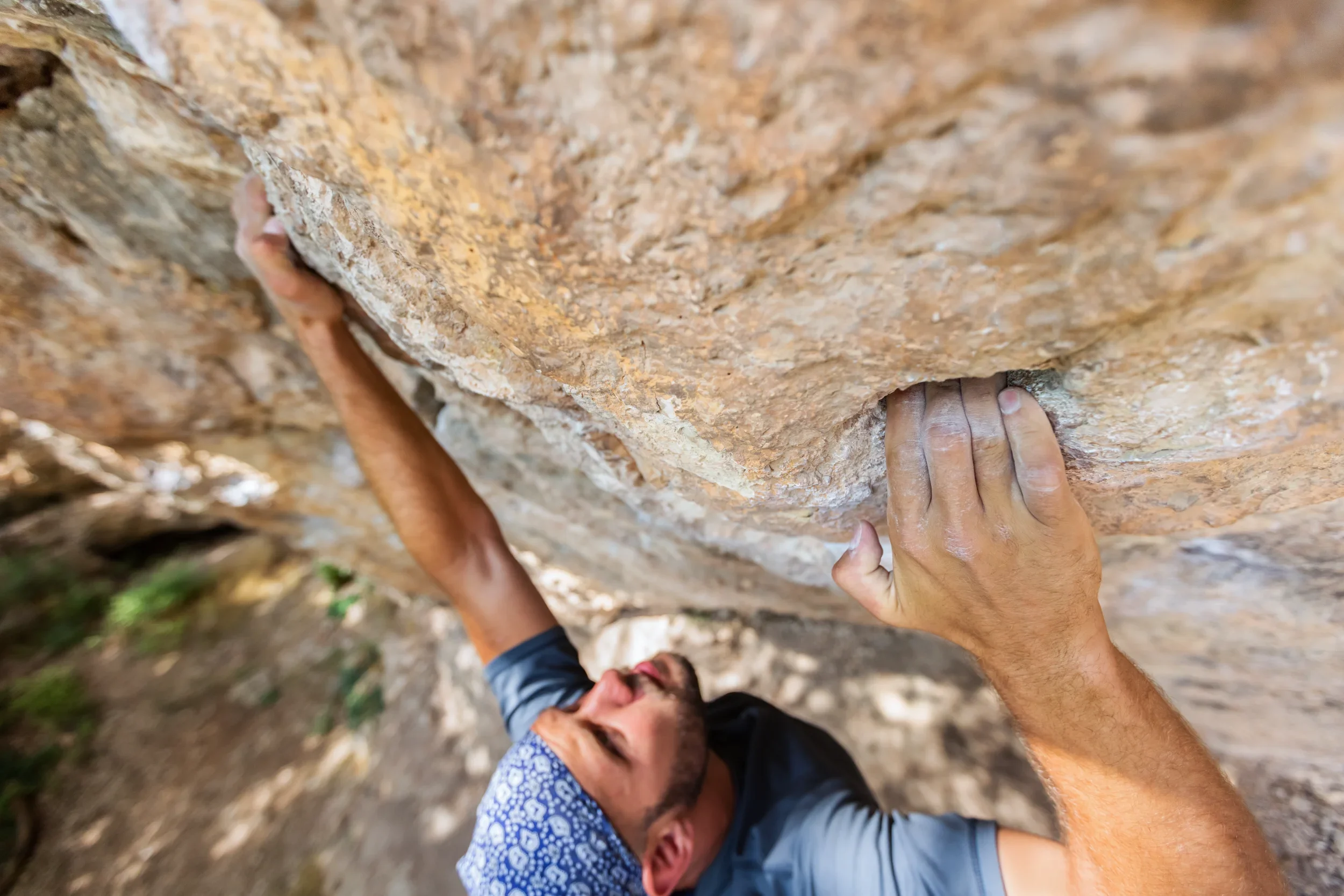
That second factor is where the crimp position becomes so significant. In a full crimp, the PIP joint is acutely flexed with the thumb pressing down across the fingers. Biomechanical research has shown that this position dramatically increases the force on the A2 pulley compared to an open-hand grip. The same external load, held in a full crimp rather than an open hand, multiplies the stress on the pulley many times over. Add the dynamic component of pulling off a hold rather than holding it statically, and the forces through the finger are substantially higher again. The A2 pulley is a piece of very strong connective tissue, but it has limits, and climbing pushes consistently against those limits.
Two Ways a Pulley Injury Presents
Understanding which type of injury you have determines how urgently it needs to be assessed and what the initial management should be.
The gradual onset injury develops over time. Pain builds slowly at the base of the finger, initially only present during and immediately after climbing, then persisting longer into the day. There is no specific incident, just a creeping awareness that a particular finger does not feel right on small holds or during crimping. Grip strength is often subtly reduced, and the finger may feel stiff first thing in the morning. This is the overuse picture: the pulley has been accumulating load beyond its recovery capacity over weeks or months.
The acute rupture is harder to miss. There is a pop, or a sharp tearing sensation, typically at the moment of maximum load through a crimped hold or during a dynamic movement. Immediate pain, rapid swelling at the base of the finger, and a significant loss of grip strength follow. In more severe cases, particularly where multiple pulleys have been involved, visible bowstringing may be apparent: the flexor tendons, no longer held close to the bone, stand out from the finger surface when it is flexed against resistance. This is a clinical sign that needs rapid investigation.
When we see visible bowstringing combined with bruising and swelling after an acute incident, we move quickly to arrange diagnostic ultrasound to assess the structural integrity of the pulley system. The distinction between a partial tear, a complete single-pulley rupture, and involvement of multiple pulleys changes the management pathway significantly, and it is not a distinction that can be made reliably on clinical examination alone.
Why Most Pulley Injuries Do Not Recover Fully
The finger is an unforgiving place to have an injury. The soft tissue structures are packed into a very small space, and even modest swelling significantly impairs range of movement and disrupts the length-tension relationship of the finger flexors. When those ratios are compromised, grip strength falls, and the climber either stops loading the finger altogether, losing strength and capacity through deconditioning, or pushes back too soon and reloads an unprepared structure.
The most common failure is the absence of any objective measure of recovery. Returning to climbing because the finger “feels okay” is not the same as returning because it has been tested and found ready. We assess finger and grip strength using objective measurement tools to gauge the deficit between the injured and uninjured side, and we track that deficit through rehabilitation. Until the finger demonstrates the capacity to handle load progressively, returning to high-intensity climbing is not safe.
The second failure is treating the injury as purely local. The finger is the end-point of a kinetic chain that runs from the foot through the leg, hip, trunk, shoulder, elbow, and wrist. If a climber is not driving sufficiently through the lower limb, is overloading the upper body because of positional inefficiency, or has a technique pattern that concentrates force through the fingers rather than distributing it across the whole body, the same pulley will be overloaded again after recovery. Treating the finger without addressing what loaded it is treating a symptom, not a problem.
Finally, the rehabilitation exercises used in most recovery programmes do not replicate the forces involved in climbing. Small theraband exercises are useful in the early stages, but the loads through the finger tendons on a steep wall or during a dynamic movement are far greater than any band exercise can generate. Late-stage rehabilitation needs to bridge that gap deliberately, using plate holds, hangboard protocols, and progressive climbing-specific loading that genuinely prepare the tissue for the demands it will face.
How We Assess a Pulley Injury
The first assessment appointment lasts an hour. We are establishing several things in parallel: the severity and type of injury, the integrity of the pulley system, the current level of grip and finger strength, any history of previous hand, wrist, elbow, or shoulder injury that may be contributing, and the technical and training factors that may have led to overload.
Clinical examination includes palpation of the A2 pulley and surrounding structures, active and passive range of movement at all finger joints, resisted flexion testing to provoke symptoms and assess strength, and a broader assessment of the wrist, elbow, and shoulder. Where bowstringing is visible or where the acute injury picture warrants it, we arrange rapid access to diagnostic ultrasound imaging to grade the injury accurately.
We take a detailed training history. How many days per week were you climbing? What grades? What hold types dominate your sessions? Have you been crimping more than usual, training on a hangboard, or working on projects that demand sustained high-intensity finger loading? Are there any technique patterns, insufficient lower body engagement, poor footwork, reliance on small edge crimping rather than body positioning, that have contributed to the load? These questions change the rehabilitation plan.
Treatment: From Swelling Control to Return to Climbing
The structure of pulley injury rehabilitation follows the tissue through its phases, but the priorities at each stage are specific to the demands of climbing.
Early stage: controlling swelling and protecting range of movement.
Because the structures inside the finger are so tightly packed, swelling has a disproportionate effect on range of movement and on the efficiency of the finger flexors. Controlling that swelling promptly is not just about comfort: it directly affects how quickly rehabilitation can progress. In the early days after an acute injury, or during a significant flare of an overuse injury, we focus on reducing swelling, protecting the pulley from further load, and maintaining what range of movement is available. Finger taping, including H-taping and ring splinting where appropriate, can support the pulley and reduce bowstringing forces during this phase. We advise specifically on what you can and cannot do, because the answer is rarely “stop everything”.
Middle stage: rebuilding finger and grip strength with objective targets.
As swelling settles and range of movement is restored, we begin progressive loading of the finger flexors with the pulley under controlled and increasing stress. We use objective measurement throughout to track the deficit between sides. The target is not “feels better”: it is a measurable return towards symmetry in grip strength and finger strength. Exercises in this phase are chosen to load the relevant structures without reproducing the crimp position, using open-hand grip patterns that place lower stress on the A2 pulley while still building tendon and pulley capacity.
Return-to-climbing phase: progressive exposure, not permission to climb.
This is the stage that determines the outcome. Returning to climbing is not a single decision but a structured progression. We begin with lower-intensity sessions on hold types and grip positions that are least stressful for the pulley: open-hand gripping on larger holds, easier angled walls, avoiding full crimp positions entirely. Volume and intensity increase only as the finger demonstrates that it can tolerate the preceding level without flare-up.
The full crimp position, which places the greatest load on the A2 pulley, is the last thing to return, and it returns only when the finger has been tested and found to have the capacity for it. Short of that threshold, returning to full crimping is the most reliable way to re-injure a pulley that has not finished recovering.
Throughout this phase, we are also introducing the exercises that replicate climbing forces more specifically: plate holds and hangboard protocols that generate the levels of finger tendon load that bands and putty exercises simply cannot match. These are not replacements for climbing; they are the bridge between light rehabilitation exercise and the real demands of the wall.
Climbing Technique as a Rehabilitation Variable
Pulley injuries are not only the product of too much climbing. They are often the product of how climbing is done. A climber who does not push sufficiently through the feet and legs, who reaches for holds rather than stepping up to them, or who relies on finger strength to compensate for poor body positioning, transfers an excess of load to the finger flexor system. That excess accumulates across sessions until the A2 pulley reaches its limit.
As part of rehabilitation at our clinic, we look at whether technique factors are contributing to the load. This does not require filming a climbing session, though that can be useful: the training history and a clear account of the movement patterns that provoked the injury usually make the relevant technique issues apparent. Returning to climbing with an unchanged technique after a pulley injury is a reliable route back to the same problem.
Frequently Asked Questions
Here are answers to some of the common questions we receive regarding finger pulley injury treatment at Physio Remedies.
-
Not always, but sometimes yes. If there is visible bowstringing, significant acute swelling, or a clear pop with immediate loss of strength, we will arrange diagnostic ultrasound promptly to grade the injury. For gradual onset overuse injuries without signs of structural failure, clinical assessment is usually sufficient to guide early management. We will advise you at your first appointment.
-
Depending on the severity of the injury, often yes, with significant modification. Open-hand gripping on easier terrain, avoiding crimped positions, and working on technique and lower-body engagement can allow you to stay on the wall while the pulley recovers. Continuing to climb in the same way on the same grades is a different matter: that is unlikely to allow recovery and likely to worsen the injury.
-
A mild overuse injury with no structural failure can resolve in four to eight weeks with appropriate management. A partial A2 tear typically requires three to four months before return to full climbing intensity. A complete rupture managed conservatively may take four to six months or longer, depending on severity and how closely the rehabilitation is followed. Our aim is always to return you to your previous climbing level, not just to basic hand function.
-
The majority of pulley injuries, including many complete A2 ruptures, are managed successfully without surgery. Surgical reconstruction of the pulley is generally considered only when multiple pulleys have ruptured simultaneously, when conservative management has been thorough and has failed, or when the injury is in a high-demand competitive athlete for whom the timeline of conservative recovery is unacceptable. If we feel surgery is the right next step, we have direct referral access to hand and upper limb surgeons with experience in climbing injuries.
-
It depends on the technique and the stage of injury. Circumferential taping has limited evidence of mechanical benefit. H-taping and ring splinting have better evidence for reducing the distance between the tendon and the bone, which reduces the functional demand on a damaged pulley. We will show you the taping techniques that have clinical evidence behind them, and advise on when they are useful and when they have outlived their purpose in your rehabilitation.
-
We accept Bupa, AXA, and Cigna International. Our initial assessment is £190 for one hour. Please contact us to confirm your cover before your appointment.
Book Your Finger Pulley Injury Assessment at Physio Remedies, Mayfair
If a finger pulley injury is keeping you off the wall, or if you have been managing it yourself without making real progress, come and see us. We are based at the Lansdowne Club in Mayfair, a short walk from Green Park and Berkeley Square.
If you prefer to reach us directly: