

Hand & Wrist Conditions
Carpal Tunnel Syndrome Treatment in Mayfair, London
Most people who come to us with carpal tunnel syndrome have already spent weeks shaking their hand out of bed in the middle of the night, trying to type through pins and needles, and wondering why something so small is making daily life so frustrating. Many have been told it will settle with rest, or handed a splint and sent on their way. Some have been referred for surgery and aren't sure whether that's the right next step.
Carpal tunnel syndrome is common, manageable, and in the majority of cases does not require surgery. But it does need proper assessment and a clear treatment plan, not guesswork.

What Is Carpal Tunnel Syndrome?
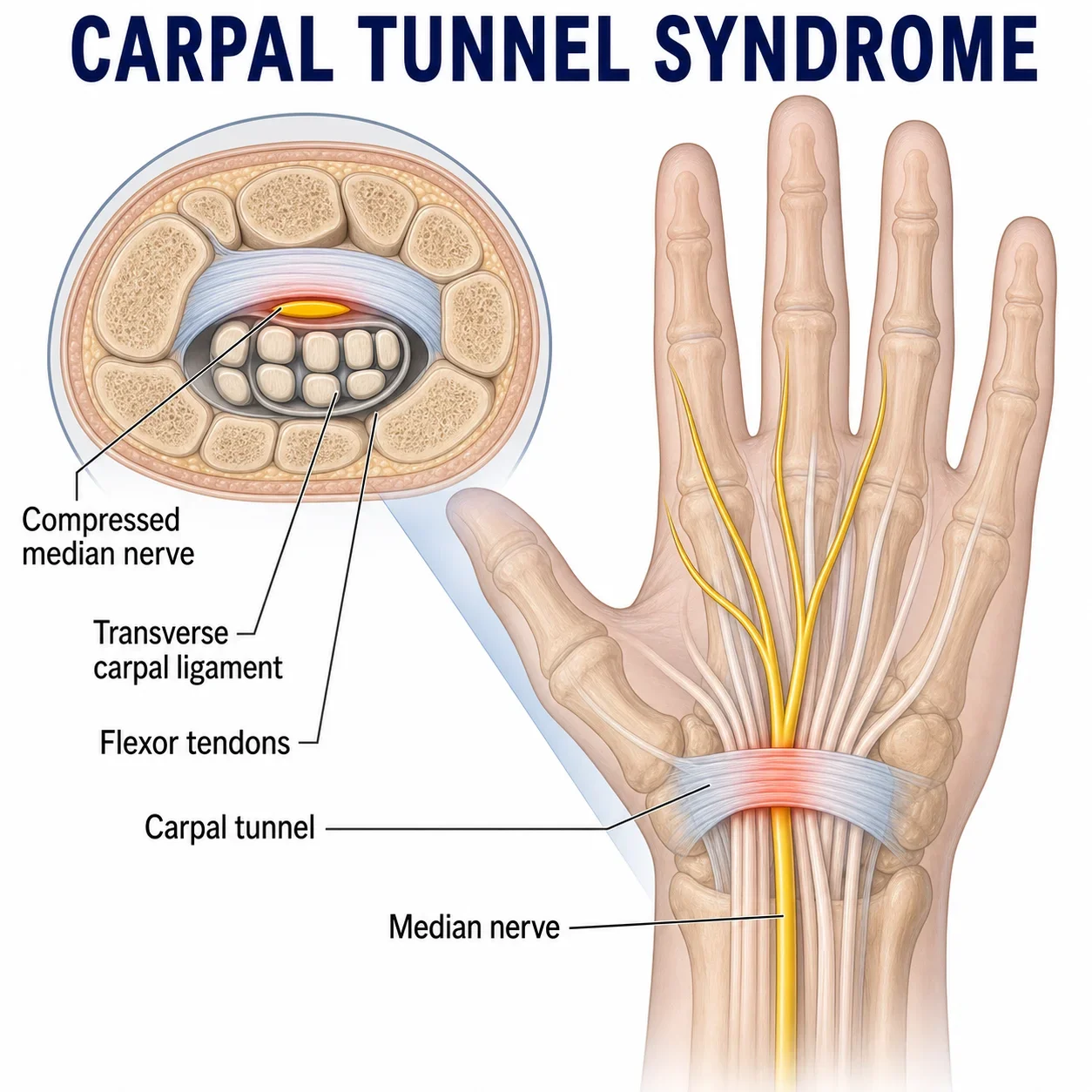
The carpal tunnel is a narrow channel in your wrist through which the median nerve passes, alongside the tendons that flex your fingers. When the pressure inside that tunnel rises, the median nerve becomes compressed and begins to misfire. The result is the characteristic pattern most people recognise: numbness and tingling in the thumb, index, middle, and part of the ring finger, often worst at night or first thing in the morning, sometimes accompanied by a dull ache running up the forearm.
In more established cases, grip strength weakens, fine motor tasks become unreliable, and in the most severe presentations the muscles at the base of the thumb can begin to waste away. That is the stage you want to avoid, which is why early assessment matters.
Do I Have Carpal Tunnel Syndrome?
The classic symptom pattern is distinctive. Ask yourself:
Do you have numbness, tingling, or burning in your thumb, index, or middle fingers? (The little finger is almost never affected — that detail matters clinically.)
Are symptoms worst at night or on waking?
Do you find yourself shaking or hanging your hand down to get relief?
Are you dropping things, struggling with jars, or losing precision in your fingers?
Try this at home: Phalen’s Test
Press the backs of both hands together, wrists bent downward, fingers pointing to the floor. Hold for up to sixty seconds. If this reproduces your tingling or numbness, that is a positive Phalen’s test — one of the standard clinical tests we use in assessment, and a reasonable indicator of median nerve compression at the wrist.
A positive test is not a diagnosis. It will not tell you how advanced the compression is, whether there are contributing factors further up the arm or neck, or whether conservative treatment will be sufficient. Book in to see us for a proper assessment.

Who Gets Carpal Tunnel Syndrome, and Why?
Carpal tunnel syndrome is significantly more common in women than men, and its peak incidence sits squarely in the perimenopausal and menopausal years. Declining oestrogen affects the quality of connective tissue throughout the body, including in the wrist, making the carpal tunnel more prone to inflammation and swelling. In contrast, as levels of progesterone If you are already dealing with other joint or tendon complaints alongside wrist symptoms, that pattern is worth noting.
Beyond hormonal factors, the condition is strongly associated with repetitive hand and wrist use: extended keyboard work, gripping tools, manual tasks performed in fixed positions. Pregnancy is another well-established trigger, as fluid retention increases pressure within the tunnel. Diabetes, thyroid dysfunction, and rheumatoid arthritis all raise your risk, and in some cases a previous wrist fracture that has altered the anatomy of the canal is the underlying cause.
Why Is Carpal Tunnel Syndrome Worse at Night?
If you sleep reasonably well but wake at two or three in the morning to shake out a numb hand, there is a straightforward explanation.
Two things happen simultaneously when you lie down. Without gravity doing its usual job, fluid redistributes towards your extremities and pressure inside the carpal tunnel rises. At the same time, almost everyone sleeps with their wrists bent: an unconscious habit, but one that narrows the tunnel and compresses the median nerve for hours at a stretch.
During the day, normal hand movement acts as a fluid pump, keeping things circulating. At rest, that pump stops. Circulation to the extremities also reduces during sleep, and with fewer competing signals to process, the nervous system registers discomfort more sharply.
This is precisely why a neutral-position wrist splint worn at night is often the first thing we recommend. It removes the wrist-bending problem immediately, before anything else in the treatment plan has had time to work.
Why Is Carpal Tunnel Syndrome Worse in Pregnancy?
Pregnancy is one of the most common triggers for carpal tunnel syndrome, and the mechanism is largely fluid-driven. The body retains significantly more water during pregnancy, and that excess fluid increases pressure throughout the body's soft tissues, including inside the confined space of the carpal tunnel.
The median nerve has very little room to spare in a healthy wrist. Add swelling, and compression becomes almost inevitable for some women, particularly in the second and third trimesters when fluid retention peaks.
Hormonal changes compound this. Relaxin, produced in increasing quantities during pregnancy, softens ligaments and connective tissue throughout the body. This is necessary for birth, but it also affects the stability of the wrist, which can alter the mechanics of the carpal tunnel itself.
The good news is that pregnancy-related carpal tunnel syndrome typically resolves after delivery, once fluid levels normalise. In the meantime, night splinting is safe and effective, and we can advise on activity and positioning modifications to reduce symptoms without any intervention that would be inappropriate during pregnancy.

Why Your Carpal Tunnel Syndrome Has Not Got Better
Rest may reduce symptoms temporarily, but it does nothing to address why the median nerve is being compressed in the first place, and the moment you return to the activities that aggravated it, the symptoms return.
Equally, wearing a splint at night without addressing the contributing factors during the day is only half a strategy. Night splinting works by keeping the wrist in a neutral position so the carpal tunnel is at its most open while you sleep. That is genuinely useful in the early stages. But it is the beginning of the plan, not the plan itself.
The most common reason people plateau is that nobody has properly assessed what is loading the wrist, how the rest of the arm is functioning, or whether there are contributing factors further up the chain, at the elbow, shoulder, or neck, that are adding to the nerve's irritability. Carpal tunnel syndrome can also be mimicked by nerve compression higher up, and treating the wrist when the problem is actually in the neck is a straightforward way to fail.
We also see a number of people who have had a steroid injection that worked well initially but whose symptoms have returned. Injections can be a very useful part of management, particularly in pregnancy or when symptoms are severe enough to warrant faster relief, but they are not curative. If the underlying causes are not addressed, recurrence is the likely outcome.
Our Approach to Carpal Tunnel Treatment
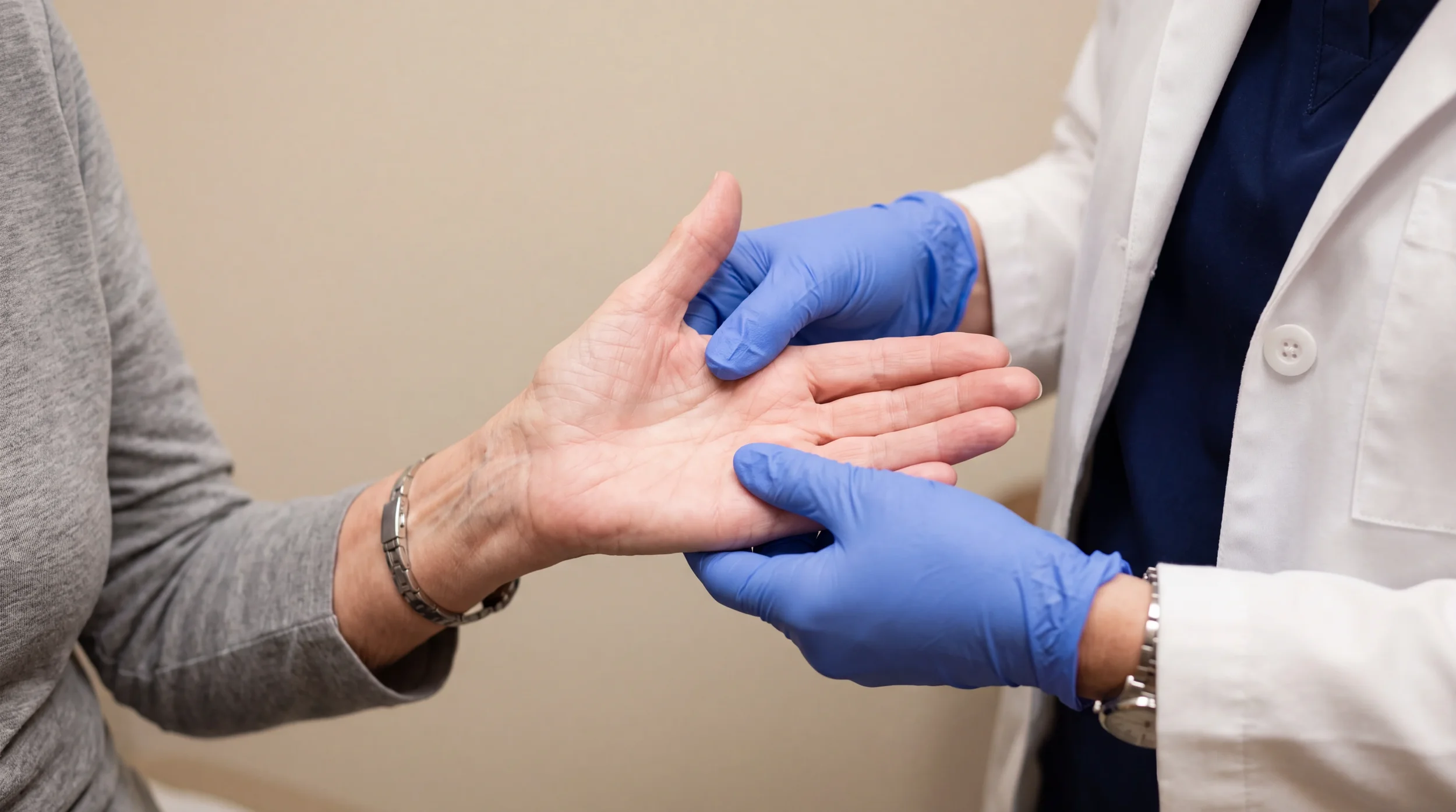
At our Mayfair clinic, the first thing we establish is whether what you have is actually carpal tunnel syndrome, and if so, what is driving it. Clinical examination will include provocation tests such as Phalen's and Tinel's, assessment of your grip strength and sensation, and a look at your wrist, forearm, elbow, and neck. We are checking for the level of the compression, not simply assuming the wrist is the only place that matters.
From there, treatment is built around three things: offloading the nerve, restoring normal movement and strength, and addressing whatever is keeping the problem going.
-
Offloading and activity modification
This means working out which postures and activities are compressing the nerve and making specific, practical changes. For desk workers, that often involves a workstation assessment. For manual workers or those doing repetitive tasks, it means identifying the specific movements that are provocative and finding ways to reduce their frequency or modify their technique. Our clinic already provides formal DSE and ergonomic assessments, so if your wrist problem is rooted in how you are set up at work, we can address that directly.
-
Splinting
A neutral-position wrist splint worn at night is one of the simplest and most evidence-supported interventions for mild to moderate carpal tunnel syndrome. We will advise you on when and how to wear it, and whether a working splint during the day is appropriate for your specific situation and activities.
-
Nerve gliding and neurodynamic exercises
These are specific exercises designed to encourage the median nerve to move freely within the carpal tunnel rather than adhering to surrounding structures. Done correctly, they reduce nerve irritability and improve function over time. Done incorrectly, they can aggravate symptoms, which is why technique and progression matter. We will teach you a precise programme and monitor how your nerve is responding.
-
Tendon gliding and grip rehabilitation
Alongside the nerve, the flexor tendons in the wrist also benefit from specific gliding exercises that maintain their mobility within the tunnel. As symptoms settle, we reintroduce grip strength work progressively, rebuilding the functional strength that carpal tunnel syndrome tends to erode.
-
Steroid injection
When conservative measures are making progress but symptoms remain disruptive, or when the clinical picture warrants faster relief, a corticosteroid injection into the carpal tunnel can be a genuinely useful adjunct. We have established referral pathways for guided injections, and we will advise you clearly when this is worth considering and when it is not.
When Surgery Is the Right Answer
Carpal tunnel release surgery is highly effective and, for the right patient, the outcome is both predictable and durable. Most people do improve with conservative management. But when symptoms are severe, when there is significant weakness or muscle wasting at the thumb, when nerve conduction studies confirm significant nerve damage, or when a thorough trial of conservative treatment has not produced adequate improvement, surgery becomes the sensible next step rather than a last resort.
If we believe that is where you are heading, we will say so clearly and help you access the right surgical opinion quickly.

Post-Operative Rehabilitation After Carpal Tunnel Release
Surgery is not the end of the process. What happens in the weeks after a carpal tunnel release largely determines how quickly and completely you recover.
In the early stages, the priority is straightforward: reduce swelling, manage discomfort, and protect the surgical site while it heals. Most people notice a degree of tension or tightness around the scar as the release settles, which is normal and expected. We guide you through this phase carefully.
Once that initial swelling has settled, typically within the first couple of weeks, we introduce nerve gliding and tendon gliding exercises to restore the mobility that the operation has created space for. Wrist range of movement, and in particular ulnar deviation, becomes a focus at this point.
The later stages of rehabilitation concentrate on restoring grip strength in its different forms: power grip, pinch strength, and the finer functional strength that the thumb depends on. The thumb is so central to hand function that any residual weakness or loss of confidence in using it tends to linger in ways that affect daily life disproportionately. We address that directly, building both the physical capacity and the confidence to use the hand normally again. Having an operation and then not rehabilitating the thumb properly is, frankly, a waste of a good surgical result.
Frequently Asked Questions
Here are answers to some of the common questions we receive regarding carpal tunnel syndrome treatment at Physio Remedies.
-
Not necessarily. Many cases of carpal tunnel syndrome can be confidently diagnosed on clinical examination alone. If you already have nerve conduction results, bring them, they give us useful objective information. If your symptoms are ambiguous or not responding as expected, we may recommend one. We can advise you on this at your first appointment.
-
In most cases, yes. We will advise you on specific activity modifications rather than blanket rest. For most desk workers, the goal is to adjust how you are working rather than to stop entirely. For those doing heavy manual work, there may be a period of modification or temporary task adjustment.
-
This varies considerably. If your symptoms are mild to moderate and caught early, meaningful improvement within four to eight weeks of treatment is realistic. More established or severe cases take longer. If symptoms are not moving in the right direction after a reasonable trial of conservative treatment, we will reassess and discuss next steps, including whether an injection or surgical referral makes sense.
-
It can be. If you are perimenopausal or menopausal and experiencing multiple joint and tendon problems, there is often a hormonal mechanism connecting them. Declining oestrogen affects connective tissue quality throughout the body. We take that broader picture into account rather than treating your wrist in isolation.
-
We accept Bupa, AXA, and Cigna International. Our initial assessment is £190 for one hour. Please contact us to confirm your cover before your appointment.
Book Your Carpal Tunnel Syndrome Assessment at Physio Remedies, Mayfair
If wrist pain, hand numbness, or tingling fingers is affecting your sleep, your work, or your daily life, come and see us. We are based at the Lansdowne Club in Mayfair, a short walk from Green Park and Berkeley Square.
If you prefer to reach us directly: