
Elbow Conditions
Tennis Elbow Treatment and Physiotherapy in Mayfair, London
Your elbow has been bothering you for weeks, possibly months. What started as a dull ache after sport or a day at a desk has become something that intrudes on ordinary life: lifting a coffee cup, turning a door handle, typing, shaking hands. You have probably tried rest. Perhaps an injection. Maybe exercises from the internet. And the pain keeps coming back.
The most important thing we can tell most patients arriving with tennis elbow is something they were not told earlier: cortisone injections, which remain the most widely offered treatment, produce significantly worse outcomes than physiotherapy at twelve months. A randomised controlled trial published in The Lancet established this more than twenty years ago, and the finding has been replicated consistently since. The injection works quickly, which is why it remains popular. The pain returns because the tendon has not been fixed, only quietened temporarily. We see this pattern week after week in clinic.
"I had the injection last October which worked for three months. Now the pain is back and is really painful, so I had another injection yesterday." This is the cycle we are trying to break.
What Tennis Elbow Actually Is
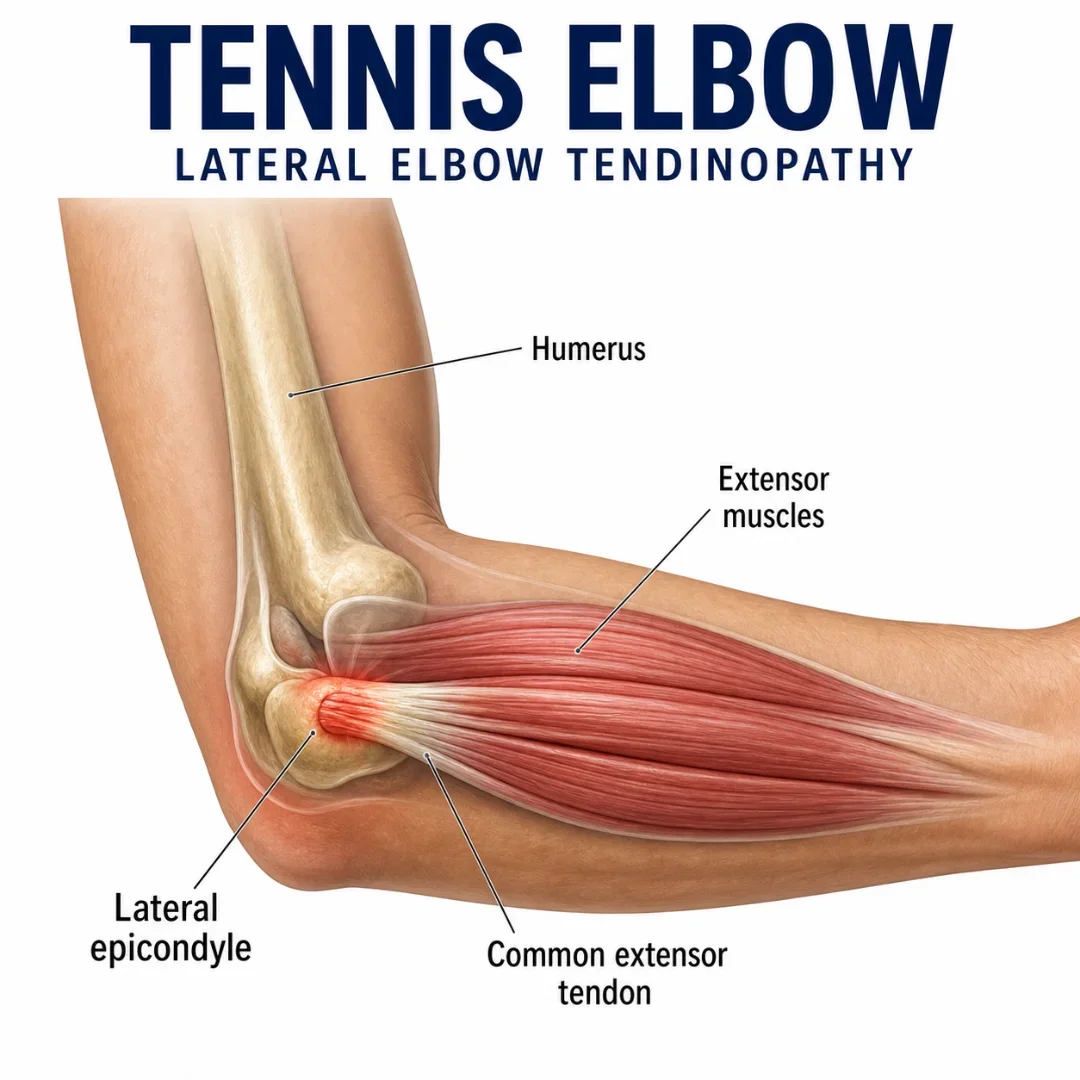
Despite the name, you do not need to play tennis to develop it. Lateral epicondylopathy (the more accurate clinical term, since the problem in established cases is degenerative rather than primarily inflammatory) affects the common extensor tendon where it attaches to the outer elbow. The tendon has been repeatedly loaded beyond what it can manage, the tissue breaks down faster than it can repair, and you are left with a structure that is painful under loads it previously handled without difficulty.
The severity of the pain does not reliably indicate the severity of the tissue damage. We regularly see people with intense symptoms who have a relatively straightforward condition that responds well to the right treatment. We also see people who have been told their scan is unremarkable and have been struggling for eighteen months. The scan is rarely the limiting factor. The treatment approach is.
How Long Does Tennis Elbow Take to Heal?
Honestly - longer than most people expect, and shorter than most people fear. With appropriate treatment started reasonably early, the majority of patients see meaningful improvement within six to eight weeks. Around sixty to eighty percent resolve completely within six months. Up to ninety percent recover fully within twelve months.
The cases that take longest are those where treatment was delayed, where the wrong approach was used for an extended period, or where repeated cortisone injections have been used without addressing the underlying tendon. We hear this regularly:
"I probably should have gone to the doctors sooner, as I know this has been creeping up on me for about nine months now."
The biology of tendon healing is slower than muscle healing, which is why tennis elbow cannot be rushed. But it can be significantly accelerated with the right loading programme, and there is no reason to spend a year in pain when effective treatment exists. The earliest patient testimonial in our clinic records on this condition is someone who described seventy-five percent improvement within the first week of treatment and complete resolution within two weeks. That is not the norm, but it illustrates what early, targeted intervention can achieve.
Is Your Elbow Pain Definitely Tennis Elbow?
Before committing to a treatment direction, the right diagnosis matters. Lateral elbow pain is not always lateral epicondylopathy, and treating the wrong problem is a common reason patients plateau.
The cervical spine is a frequent unrecognised contributor. The nerve roots supplying the forearm originate in the neck, and a stiff or irritated cervical spine can produce lateral elbow pain that is clinically indistinguishable from tennis elbow without proper assessment. We regularly see people who have had months of elbow-focused treatment with limited progress, examine their neck, and find the elbow symptoms change immediately. If your tennis elbow has not responded to appropriate treatment, a cervical assessment is essential.
Posterior interosseous nerve entrapment, also called radial tunnel syndrome, produces pain at the outer forearm and elbow that closely overlaps with tennis elbow. It is less common but frequently missed, and it does not respond to tendon loading. A thorough clinical assessment distinguishes between the two. We will always screen for cervical and neural contributions before concluding we are dealing with a straightforward tendon problem.
What Works and What Does Not
Rest
Rest reduces pain by reducing load. It does not rebuild tendon capacity. Once load is reapplied, the same tendon meets the same demands with the same inability to handle them. Brief relative rest during an acute flare is sensible. Rest as a recovery strategy for established tennis elbow is not — it leads to weakness and stiffness without addressing the underlying problem.
Cortisone injection
For acutely inflamed tissue in the very early stages of the condition, cortisone can be genuinely useful. For established lateral epicondylopathy, the evidence is clear: superior pain relief at six weeks, worse outcomes than physiotherapy at twelve months. The mechanism is understood: the injection suppresses the inflammatory response that forms part of the tendon's healing attempt, providing short-term relief while potentially impairing longer-term recovery. A single injection to create a window for rehabilitation to begin, managed carefully, can be appropriate. Repeated injections in the absence of structured rehabilitation are not.
A brace or tennis elbow strap
An epicondylitis clasp can reduce pain during activity by redistributing load, which makes it a reasonable short-term aid. It is not a treatment. The tendon is not rebuilding while you wear it. We may recommend one for comfort in the early stages of rehabilitation, as a bridge to loading rather than an alternative to it.
Generic exercises at insufficient load
Most tennis elbow exercise programmes prescribe eccentric wrist extension exercises at a load that is too low to stimulate meaningful tendon adaptation. The Tyler Twist protocol using a FlexBar resistance bar has strong RCT-level evidence. Heavy slow resistance training, progressing the load systematically over months, has the strongest evidence base of any exercise intervention. Neither resembles a gentle stretch with a light resistance band. We prescribe the exercises at the load that will actually drive change.
Our Approach at Physio Remedies
Assessment begins by understanding the full picture: how long the pain has been present, what aggravates and eases it, what treatments have already been tried, and precisely what your work and sport demand from your forearm. We screen for cervical and neural contributions before focusing on the tendon. We measure your grip strength objectively using VALD handheld dynamometry — both sides — to establish a baseline and a target. Pain-free grip strength within ten percent of the uninjured side is the threshold for clearance to return to full training.
The loading programme is structured and progressed systematically. Isometric gripping exercises form the early phase: they allow tendon loading with lower pain provocation and have a demonstrable analgesic effect. This transitions to isotonic loading, progressing through the Tyler Twist or wrist extension protocol toward heavy slow resistance training as capacity builds. The programme is adjusted based on your response over twenty-four to forty-eight hours after each session. Some discomfort during loading is expected and does not indicate harm. A significant flare the following day means we have progressed too quickly and need to step back.
We also look at what is loading your elbow beyond the rehabilitation sessions: your desk setup, your grip technique in sport, how you are lifting in the gym, the weight and stringing of your racquet. Correcting the context that caused the problem is as important as loading the tendon to rebuild it.
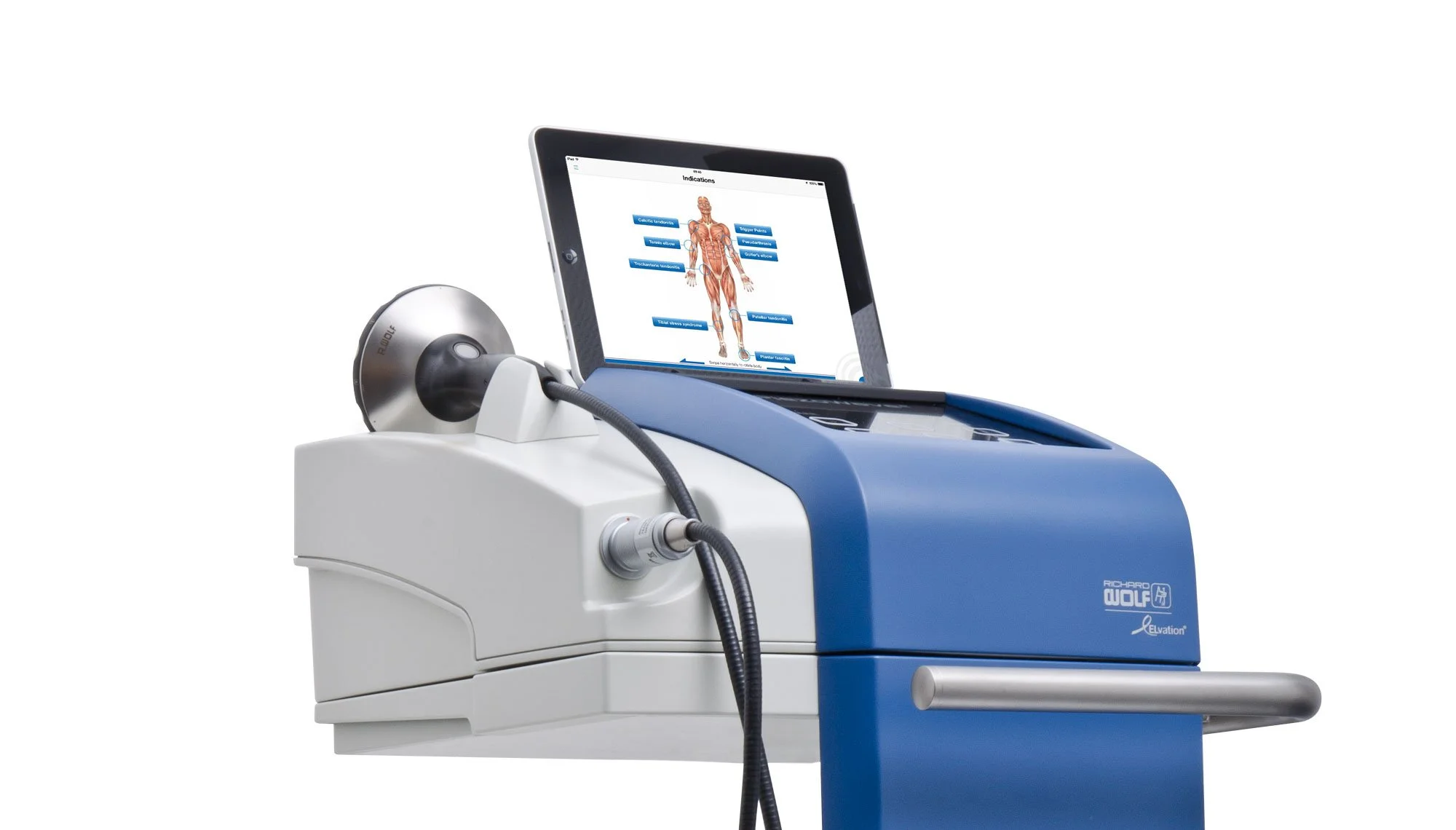
When we use focused shockwave
For lateral epicondylopathy that is not responding adequately to a well-structured loading programme, we use Piezowave2 focused shockwave therapy. Research shows sixty to eighty percent of people experience significant improvement when shockwave is used for chronic tennis elbow. The sessions take around five to ten minutes and are typically delivered weekly over three to six weeks. Most people describe it as uncomfortable but tolerable — a firm, repetitive pressure at the elbow — and return to normal activities immediately. Some temporary soreness over the following twenty-four to forty-eight hours is common.
The type of shockwave matters. Focused shockwave delivers therapeutic energy with the precision and tissue penetration needed to reach the common extensor tendon effectively. Radial shockwave, which is more widely available, disperses energy over a broader surface area and does not reach the same depth. If you have had shockwave therapy elsewhere without benefit, it is worth establishing which type you received. If it was radial, you have not yet had the treatment the evidence actually supports.
When we refer
We have direct working relationships with sports medicine consultants and radiologists who perform ultrasound-guided PRP (platelet-rich plasma) injection for lateral epicondylopathy. PRP has a stronger evidence base than cortisone at twelve months and is worth considering where loading and focused shockwave have been properly optimised without sufficient resolution. Surgery for tennis elbow is rarely the right answer before comprehensive conservative management has been genuinely exhausted — but where it is, we refer to upper limb surgeons with specific expertise in this area.

“Charlie's great, very knowledgeable, empathetic and professional. Really knows his stuff and helped me immensely with my elbow tendonitis. Would recommend!”
Frequently Asked Questions
Here are answers to some of the common questions we receive regarding tennis elbow treatment at Physio Remedies.
-
With appropriate treatment started reasonably early, most people see meaningful improvement within six to eight weeks and substantial resolution within three to six months. Cases that have been present for more than six months, or where treatment was delayed or inappropriate, take longer but still respond well. Left untreated or managed only with rest and injections, tennis elbow can persist for twelve to twenty-four months. It tends to resolve eventually, but that is a long time to wait when effective treatment exists.
-
If pain is severe enough to prevent you engaging with rehabilitation at all, a single injection can create a window for treatment to begin — but only as a precursor to a proper loading programme, not as a standalone treatment. For established lateral epicondylopathy, the Lancet trial and subsequent research consistently show worse outcomes at twelve months compared with physiotherapy. If you have already had one or more injections without lasting resolution, the answer is better rehabilitation, not another injection.
-
Usually yes, with modification. We will identify the specific loads and movements driving your symptoms and advise on what can continue and at what volume. Completely stopping sport is rarely necessary and counterproductive. Playing through severe pain without modification prolongs the problem. We give you specific guidance based on your sport and where you are in rehabilitation.
-
Tennis elbow is lateral epicondylopathy: pain at the outer elbow from the common extensor tendon, worse with gripping and wrist extension. Golfer's elbow is medial epicondylopathy: pain at the inner elbow from the common flexor tendon, worse with gripping and wrist flexion. Both are tendinopathies, both respond to progressive loading, and they occasionally coexist. The assessment and treatment principles are similar but the exercises differ, which is why accurate diagnosis matters.
-
It can reduce pain during activity by offloading the tendon origin, which is useful while rehabilitation is underway. It will not resolve the underlying tendon problem. We may recommend one in the early stages as a symptomatic aid, with the expectation that you will not need it once the tendon has rebuilt adequate capacity.
-
Yes, particularly for chronic lateral epicondylopathy that has not responded sufficiently to loading alone. The evidence specifically supports focused shockwave — which we deliver using the Piezowave2 system — rather than radial shockwave, which is more widely available but has a weaker evidence base and does not penetrate to the depth of the tendon. It works best as part of a comprehensive approach alongside exercise rehabilitation, not as a replacement for it.
-
Rarely. Surgery is appropriate when comprehensive conservative management including properly structured loading, focused shockwave, and where indicated PRP injection has failed over twelve months or more. The large majority of tennis elbow cases resolve without it when the right programme is applied consistently.
-
It can, particularly if the technique and load factors that caused it are not addressed alongside the tendon rehabilitation. Completing the full loading programme, not stopping when pain resolves, significantly reduces the risk. We address desk setup, grip technique, gym loading patterns, and any other contributing factors as part of treatment, not as an afterthought.
-
The most common reasons previous physiotherapy has not worked: the exercises were not loaded sufficiently to drive tendon adaptation; the cervical spine was not assessed and is contributing; or the programme was not progressed as capacity improved. We will review what has been tried, screen the full picture including the neck and nerves, measure your grip strength objectively, and build from there.
Book Your Tennis Elbow Assessment at Physio Remedies, Mayfair
We will match you with the right physiotherapist for your specific presentation. If tennis elbow or lateral elbow pain is affecting your sport, your work, or your daily life, we would be pleased to assess you at Physio Remedies in the Lansdowne Club, Mayfair. We are a short walk from Green Park and Hyde Park Corner stations.
If you prefer to reach us directly: