
Elbow Conditions
Distal Biceps Tendinopathy Treatment and Physiotherapy in Mayfair, London
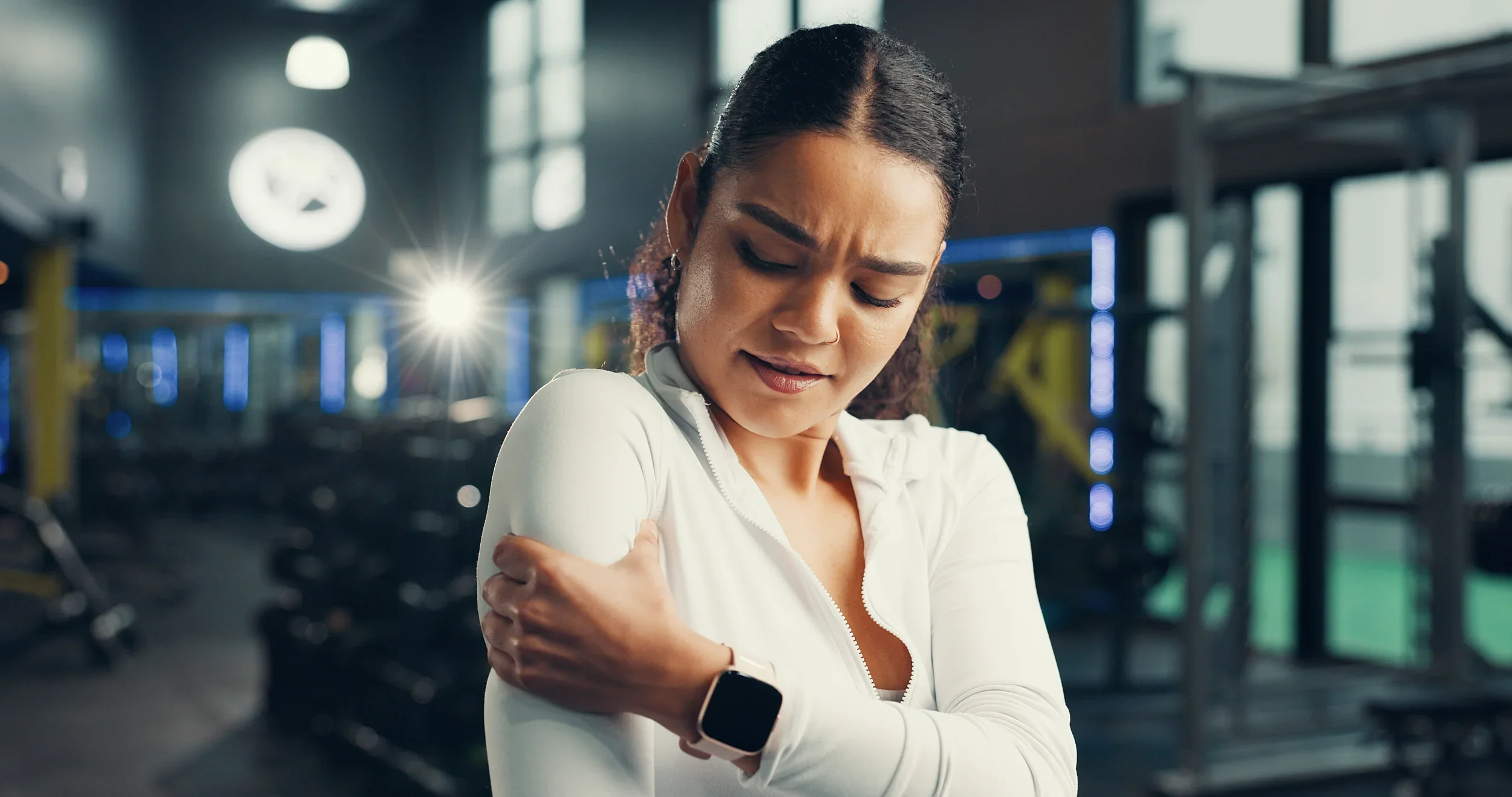
Most people who come to us with this have been in the gym. The pain sits right in the crease at the front of the elbow, it started after a session that felt harder than usual or a few weeks of building up, and it is now making chin-ups, rows and curls uncomfortable. Carrying the shopping has started to niggle, and it may hurt if your dog pulls sharply on the lead.
It is a frustrating injury because it does not stop you doing much, so it is easy to train through, and training through it is precisely what turns a six-week problem into a six-month one.
What This Tendon Actually Does
Your biceps has two attachments at the shoulder and one at the elbow. The one at the elbow is the distal tendon, and it crosses the joint to anchor onto the radius, one of the two forearm bones.
It has two jobs. It bends your elbow, which is the obvious one. It also turns your palm upwards, which is the one people forget, and it is why a screwdriver, a doorknob or a stiff jar lid can hurt more than lifting something heavy. Any activity that loads either of those movements repeatedly can irritate it.
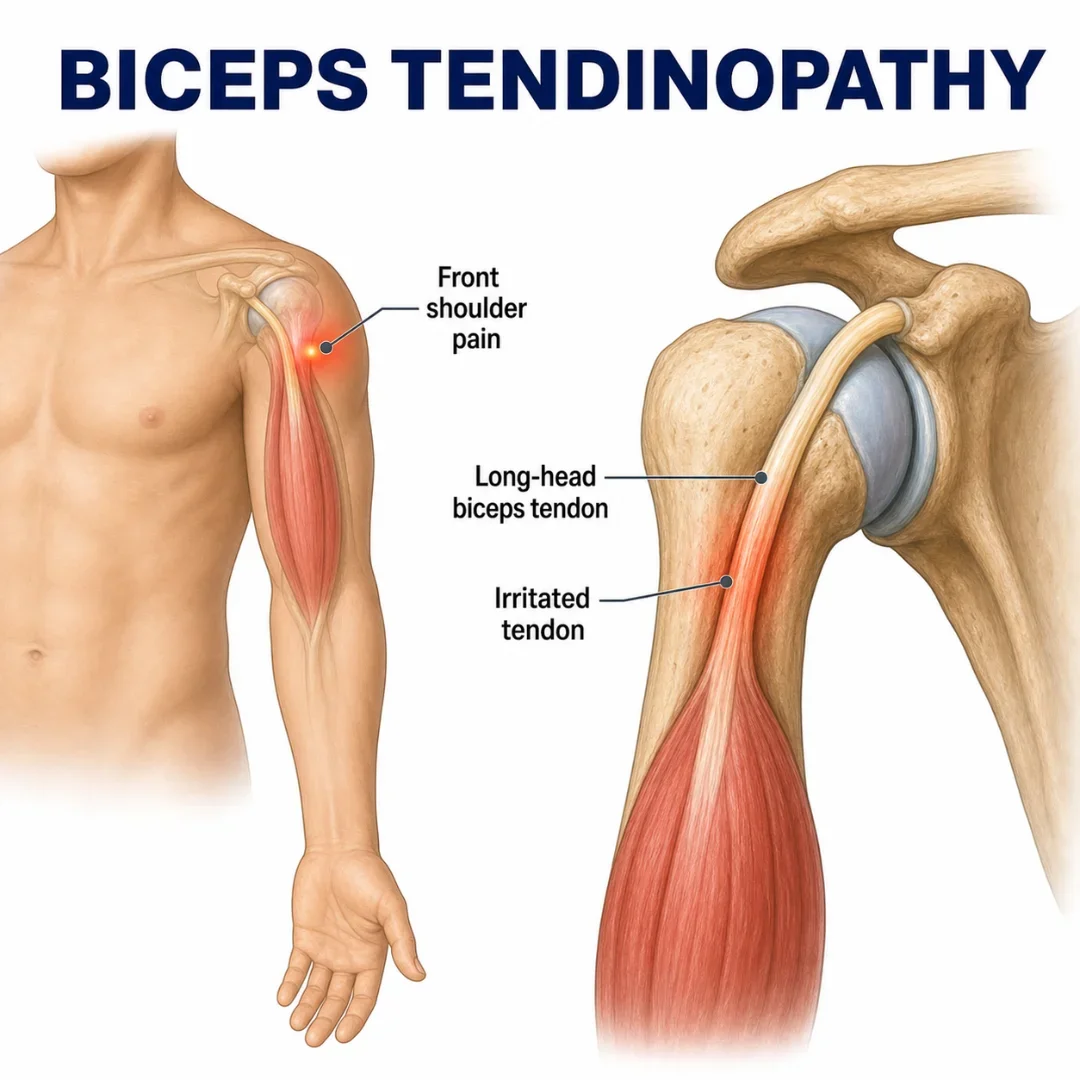
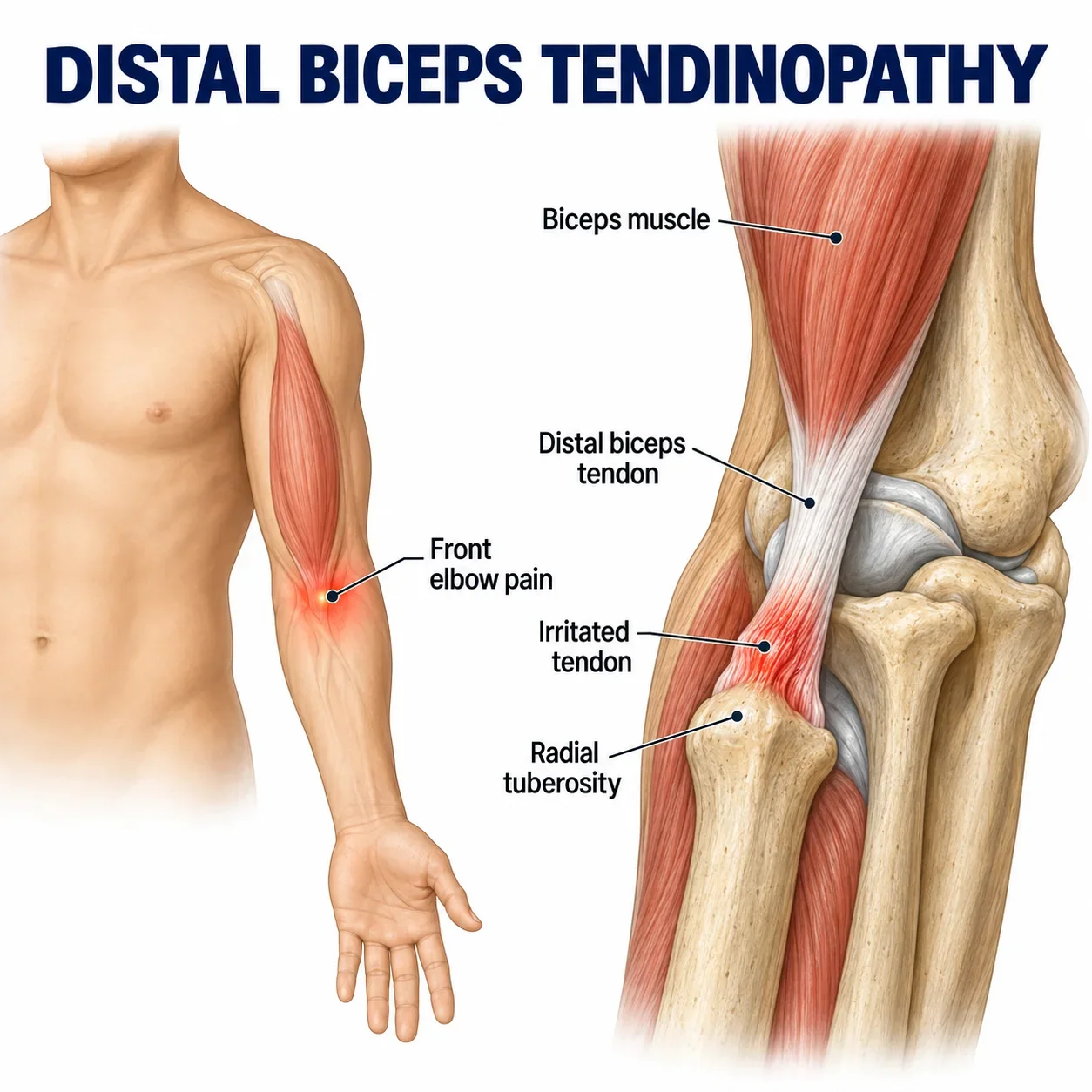
Symptoms of distal biceps tendinopathy
There are two versions.
The first is a single session that asked too much. One heavier day than you have been doing, a new programme, a training partner who talked you into an extra set. The tendon does not necessarily complain at the time. It complains that evening, or you wake up with it the next morning wondering what on earth happened.
The second is gradual. You have been training hard and consistently for weeks, and the tendon has not had long enough between sessions to keep up with the repair work. Damage accumulates quietly until it reaches the point of being noticeable.
It is not only a gym injury. We see it in tennis and racquet sports, in climbers, in swimmers, and in people whose work involves repeated lifting and twisting. The mechanism is the same: more load than the tendon currently has the capacity for.

Is It a Tear Rather Than a Tendinopathy?
This is the first thing we want to rule out, and the distinction is usually clear from the story.
Tendinopathy builds. It may get gradually more uncomfortable during a session, or only announce itself hours later.
A tear announces itself immediately. There is a sudden sharp pain or a pop, usually when your bent elbow was holding load and something forced it straight: catching a falling weight, a bar slipping, lowering something heavy that shifted unexpectedly. Bruising often appears over the following days, and the shape of the upper arm can change, with the muscle bunching upwards.
If that describes what happened to you, please get it looked at promptly rather than waiting to see if it settles. The pain frequently eases within a few days, which is reassuring but misleading, and with complete tears there is a window in which repair is much more straightforward. We can usually tell in the room, and if we think you need a surgical opinion we will arrange it quickly rather than sending you away to wait.
For everything else, which is most people, this is a loading problem and we treat it as one.
What Causes Distal Biceps Tendinopathy?
The distal biceps tendon attaches to a small bony prominence on the radius. When you turn your palm downwards, that bone rotates and squeezes the tendon into a narrow space against the neighbouring bone. So, this is not purely an overload problem. It is partly a compression problem.
The practical consequence is significant. If you have been diligently strengthening in a palms-down position, you have been compressing the tendon at exactly the point where it is already sore, every single repetition. Palms-up and neutral positions are almost always better tolerated early on.
Simply understanding which grip positions to favour and which to leave alone for a few weeks makes a substantial difference, and it is often the single change that unsticks someone who has been trying hard and getting nowhere.


Our Approach at Physio Remedies
Assessment begins by understanding the full picture: how long the pain has been present, what aggravates and eases it, what treatments have already been tried, and precisely what your work and sport demand from your forearm. We screen for cervical and neural contributions before focusing on the tendon. We measure your grip strength objectively using VALD handheld dynamometry — both sides — to establish a baseline and a target. Pain-free grip strength within ten percent of the uninjured side is the threshold for clearance to return to full training.
The loading programme is structured and progressed systematically. Isometric gripping exercises form the early phase: they allow tendon loading with lower pain provocation and have a demonstrable analgesic effect. This transitions to isotonic loading, progressing through the Tyler Twist or wrist extension protocol toward heavy slow resistance training as capacity builds. The programme is adjusted based on your response over twenty-four to forty-eight hours after each session. Some discomfort during loading is expected and does not indicate harm. A significant flare the following day means we have progressed too quickly and need to step back.
We also look at what is loading your elbow beyond the rehabilitation sessions: your desk setup, your grip technique in sport, how you are lifting in the gym, the weight and stringing of your racquet. Correcting the context that caused the problem is as important as loading the tendon to rebuild it.
Why Has It Not Settled?
Rest is the most common reason. Complete rest lets the tendon quieten down but does nothing about its capacity, so the moment you go back to what you were doing, you are back where you started with a slightly weaker tendon than before.
Loading in the wrong position is and stopping too early are also reasons why people don’t get back to full activity. Elbow tendons are genuinely slow, and a great many people abandon a perfectly good plan at six weeks because nothing appears to be happening. We use objective force testing with dynamometry to track progress and correct strength deficits. If you don’t use data, it’s much harder to understand where a person is in their rehabilitation.
How We Treat It
The first appointment establishes what is actually going on, whether there is any tearing involved, and what has been loading the tendon beyond its capacity.
Reducing the load without stopping. You do not need to stop training. What you need is to bring the specific things provoking it down to a level the tendon can handle, and leave everything else alone. Pulling and curling usually need reducing. Pushing movements are generally fine. Lower body and cardiovascular work almost always continue untouched.
Finding your starting point. The starting load is nearly always lighter than people expect, and this is particularly true if you are strong. A tendon that has been irritated does not care what you were lifting last month. We find the level it genuinely tolerates and build from there, which is far faster in the end than starting where you would like to and having to reset.
Objective testing with dynamometry. We use data to identify strength deficits and to monitor improvement over time, so we can progress your loading.
Leaving enough time between sessions. Tendons adapt in the gaps, not during the work. Some people do best with two sessions a week and some with three, and getting this wrong is a common reason progress stalls.
Everyday life counts too. Shopping bags, laptop bags, lifting a small child, a weekend of DIY. These all load the same tendon, and people are often surprised how much difference a few temporary adjustments make. If your job involves a lot of lifting, it is worth a conversation with your manager about modifying it for a few weeks.
We also look at the shoulder, because a shoulder that is stiff or not controlling well pushes more work down the arm, and if your problem comes from a racket or a stroke rather than a barbell, we look at the technique that is overloading it.
Focused shockwave therapy. Where a tendon stays stubbornly irritable despite good loading, focused shockwave therapy is worth considering. Our Piezowave2 system reaches the depth this attachment sits at, which the radial shockwave most clinics use, does not.
How Long Will It Take?
Most people are meaningfully better within eight to twelve weeks, with the first improvements usually showing up somewhere around week five or six. Longstanding cases take longer.
Progress is rarely linear. There will be weeks that feel worse than the one before, and that is normal rather than a sign it is going wrong. What matters is the direction over a month, not the difference between Tuesday and Thursday.

“Charlie's great, very knowledgeable, empathetic and professional. Really knows his stuff and helped me immensely with my elbow tendonitis. Would recommend!”
Frequently Asked Questions
Here are answers to some of the common questions we receive regarding distal biceps tendinopathy treatment at Physio Remedies.
-
No. Tennis elbow sits on the outside of the elbow and golfer's elbow on the inside. This is at the front, in the crease. They get confused regularly, and it is one reason people spend months being treated for the wrong thing.
-
No, and we would rather you did not. We reduce the handful of movements provoking it and leave the rest of your training alone.
-
Stretching tends to irritate this one rather than help. What it responds to is graded load.
Why does turning a doorknob hurt more than lifting?
Because this tendon turns your palm upwards as well as bending your elbow, and rotational tasks load and compress it at the same time.
-
Usually not. We would image where we suspect a tear, or where the picture is not adding up on examination. We will tell you if it would genuinely change what we do.
-
We work with Bupa, AXA and Cigna International. Our initial assessment is £190 for one hour. Please confirm your cover with your insurer beforehand.
Book Your Tennis Elbow Assessment at Physio Remedies, Mayfair
We will match you with the right physiotherapist for your specific presentation. If tennis elbow or lateral elbow pain is affecting your sport, your work, or your daily life, we would be pleased to assess you at Physio Remedies in the Lansdowne Club, Mayfair. We are a short walk from Green Park and Hyde Park Corner stations.
If you prefer to reach us directly: